

On this page
When coordinate geometry problems ask for the fourth vertex of a parallelogram given three points, students often reach instinctively for the distance formula. Equating side lengths produces quadratic equations full of radicals, turning a simple problem into lengthy and tedious algebra. You can avoid that trap by using one core property: the diagonals of a parallelogram bisect each other at a shared midpoint.
Equating midpoints solves the coordinates linearly in a few quick steps, and it explains why problems that omit the vertex naming order yield three valid answers instead of one.
Why do the diagonals of a parallelogram bisect each other?
In Euclidean geometry, a quadrilateral is a parallelogram when opposite sides are parallel. As proved on Wikipedia's parallelogram characterisations, the two diagonals create alternate interior angles across those parallel sides. Combined with equal opposite sides, this produces congruent triangles by the Angle-Side-Angle criterion, meaning each diagonal bisects the other at a common midpoint M.
In the CBSE Class 10 mathematics curriculum, where coordinate geometry carries 6 marks out of 80, the midpoint formula M = ((x₁ + x₂)/2, (y₁ + y₂)/2) is the standard method for solving these problems. Equating midpoints of both diagonals replaces quadratic distance equations with simple linear arithmetic. Reviewing Coordinate geometry in Class 10 shows how this principle simplifies quadrilateral proofs.
How do you find the fourth vertex when the order is given?
When a problem specifies that points A, B, C, and D are taken in order as parallelogram ABCD, the cyclic naming fixes the boundary. Opposite vertices are (A, C) and (B, D), so AC and BD form the diagonals.
To find vertex D(x_D, y_D):
Find the midpoint of diagonal AC: M = ((x_A + x_C)/2, (y_A + y_C)/2).
Express the midpoint of BD: M = ((x_B + x_D)/2, (y_B + y_D)/2).
Equate components to solve for D: x_D = x_A + x_C − x_B and y_D = y_A + y_C − y_B.
For example, given A(1, 2), B(5, 3), and C(2, 7) in order ABCD, the midpoint of AC is (1.5, 4.5). Equating midpoints gives x_D = 1 + 2 − 5 = −2 and y_D = 2 + 7 − 3 = 6, yielding D(−2, 6).
The Fermi Problem Library has worked problems with a step-by-step solver that explains the reasoning rather than printing an answer, showing how midpoint equivalence replaces brute-force distance calculations.
Why are there three different fourth vertices if the order is unknown?
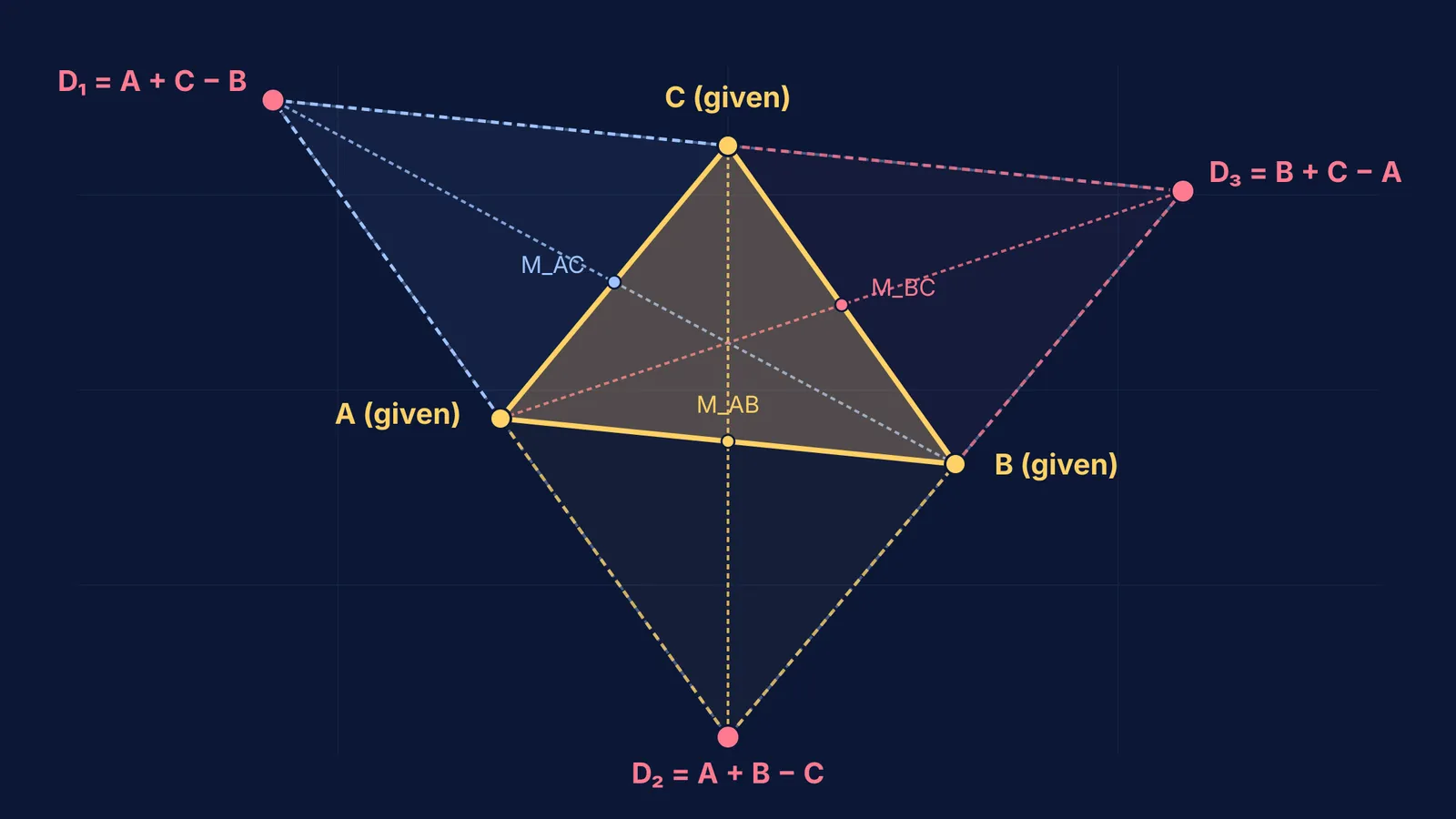
In entrance exams like JEE Main, questions often state: "Three vertices of a parallelogram are A(1, 2), B(5, 3), and C(2, 7). Find the fourth vertex." Without the qualifier "taken in order", any two points can form a diagonal, creating three distinct parallelograms:
Case 1 (Diagonal AC): Opposite pairs are (A, C) and (B, D₁). Solving gives D₁ = A + C − B = (−2, 6), forming parallelogram ABCD₁.
Case 2 (Diagonal AB): Opposite pairs are (A, B) and (C, D₂). Solving gives D₂ = A + B − C = (4, −2), forming parallelogram ACBD₂.
Case 3 (Diagonal BC): Opposite pairs are (B, C) and (A, D₃). Solving gives D₃ = B + C − A = (6, 8), forming parallelogram ABD₃C.
Foundational proofs in Class 9 quadrilaterals theorems confirm that each configuration preserves parallel opposite sides and equal lengths.
What is the geometric relationship between all three fourth vertices?
Connecting the three candidate vertices D₁(−2, 6), D₂(4, −2), and D₃(6, 8) forms an outer triangle ΔD₁D₂D₃. The midpoints of its sides are the original points: the midpoint of D₁D₂ is A(1, 2), of D₂D₃ is B(5, 3), and of D₃D₁ is C(2, 7).
As shown on Wikipedia's medial triangle analysis, ΔABC is the medial triangle of ΔD₁D₂D₃, making ΔD₁D₂D₃ the antimedial triangle of ΔABC. This yields three key properties: the area of ΔD₁D₂D₃ is 4 times the area of ΔABC, each parallelogram has twice the area of ΔABC, and all figures share centroid G = (8/3, 4). Techniques for testing collinearity with vectors verify that the outer edges run parallel to the sides of ΔABC.
How can you avoid common coordinate geometry exam traps?
To avoid lost marks in exams, apply four quick checks:
Check the naming: If the problem specifies "taken in order" or "ABCD", provide the single vertex. If no order is stated, list all three vertices.
State the theorem: Writing that "diagonals of a parallelogram bisect each other" secures method marks in board exams before calculating.
Check collinearity: Ensure the three points do not lie on one line, which would yield zero area and no valid parallelogram.
Use opposite-sum mental arithmetic: On multiple-choice tests, evaluate D = opposite + opposite − adjacent directly without scratch work.
When tackling multi-case coordinate geometry questions, Fermi's AI tutor notices where a student is stuck and decides whether to explain, ask, or show the underlying geometric figure.


