On this page
Propanal to butanone is a classic Class 12 and JEE Main conversion because it tests two ideas at once: making a new carbon-carbon bond, and moving a molecule one step up the oxidation ladder. Once you see why each reagent is there, you can rebuild the answer in an exam instead of memorising it.
Start by counting carbons. PubChem lists propanal as C3H6O (PubChem, propanal) and butanone, IUPAC name butan-2-one, as C4H8O (PubChem, butanone). So you need one new carbon, and the C=O has to end up in the middle of the chain instead of at the end.
How do you convert propanal to butanone?
Use two stages: a Grignard addition, then an oxidation.
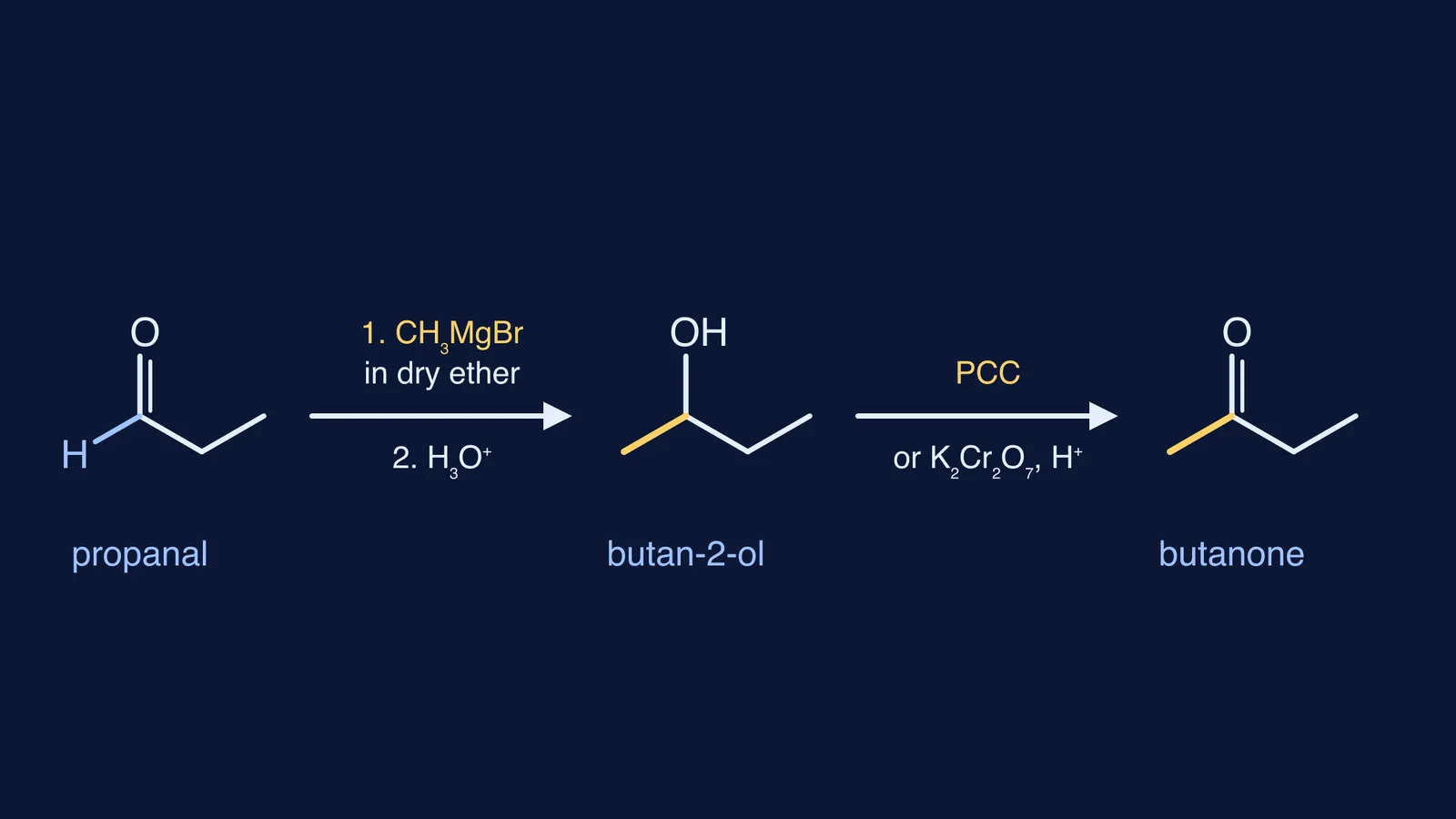
Treat propanal with methylmagnesium bromide in dry ether: CH₃CH₂CHO + CH₃MgBr → CH₃CH₂CH(OMgBr)CH₃.
Add dilute acid (H₃O⁺) to protonate the alkoxide: CH₃CH₂CH(OMgBr)CH₃ → CH₃CH₂CH(OH)CH₃, which is butan-2-ol.
Oxidise butan-2-ol with PCC, or with acidified potassium dichromate: CH₃CH₂CH(OH)CH₃ → CH₃CH₂COCH₃, which is butanone.
PubChem gives butan-2-ol the formula C4H10O (PubChem, butan-2-ol), so the oxidation simply removes two hydrogens. Butanone is the same compound many labels call methyl ethyl ketone or ethyl methyl ketone; both names are in its PubChem synonym list.
Why does the Grignard reagent add exactly one carbon?
In a Grignard reaction, the nucleophilic carbon of the reagent forms a carbon-carbon single bond with the electrophilic carbonyl carbon, according to the LibreTexts organic chemistry text (LibreTexts, Grignard reagents/17%3A_Alcohols_and_Phenols/17.05%3A_Alcohols_from_Carbonyl_Compounds_-_Grignard_Reagents)). Methanal gives primary alcohols, other aldehydes give secondary alcohols, and the alkoxide formed first becomes the alcohol only when aqueous acid is added.
The same source notes that these reactions must be run in a water-free environment, because the reagent reacts with acidic protons, such as those in water, as a base instead of attacking the carbonyl. That is why the acid goes in as a separate second step. If you want the full reason, our post on why a Grignard reagent must be made in dry ether walks through it.
The choice of Grignard is fixed by the target. The carbonyl carbon of propanal already carries an ethyl group; butanone needs a methyl on the other side. So the reagent has to be CH₃MgBr, not C₂H₅MgBr.
Why oxidise with PCC or dichromate, and why does it stop at the ketone?
Secondary alcohols are oxidised to ketones, and PCC turns secondary alcohols into ketones and primary alcohols into aldehydes (LibreTexts, oxidation of alcohols/17%3A_Alcohols_and_Phenols/17.07%3A_Oxidation_of_Alcohols)). The same page says chromic acid and dichromate reagents also oxidise secondary alcohols to ketones, but they take primary alcohols all the way to carboxylic acids.
That difference matters for primary alcohols, not for this question. Butan-2-ol is secondary, so PCC and acidified dichromate both give butanone. The ketone carbon has no hydrogen left on it, which is why the oxidation stops there under these conditions. For the primary-alcohol side of the story, read our comparison of PCC and KMnO4 for alcohol oxidation.
What mistakes cost marks in this conversion?
Use this checklist before you move on to the next question:
Wrong Grignard. Ethylmagnesium bromide with propanal gives a five-carbon alcohol, pentan-3-ol, and oxidation then gives pentan-3-one, not butanone.
Acid in the same step. Writing CH₃MgBr and H₃O⁺ together suggests they are mixed at once. Number them 1 and 2.
Oxidising first. Oxidising propanal gives propanoic acid, which does not lead to butanone by this route. Add the carbon first, oxidise last.
Calling the intermediate primary. The OH sits on the second carbon, so butan-2-ol is a secondary alcohol. That is the whole reason the last step gives a ketone.
Name slip. Butanal is an aldehyde; butanone is a ketone. Write butan-2-one if you want to be unambiguous.
This pattern carries over: an aldehyde plus a Grignard, then oxidation, is a general way to turn an aldehyde into a ketone with one more group. You can see the same Grignard logic used to climb from ethanol to a secondary alcohol in how to convert ethanol to propan-2-ol in two stages.
How should you practise conversions like this?
A simple three-question routine works for most step-up problems:
Carbons: how many does the product have compared with the start? A change of one points to a Grignard, cyanide or similar step.
Functional group: where must the oxygen end up, and at what oxidation level?
Order: which step must come first so that later reagents are not destroyed?
If you get stuck on step 3 or pick the wrong reagent, the Fermi Problem Library has worked problems with a step-by-step solver that explains the reasoning rather than printing an answer. If the gap is the idea itself, such as what makes an alcohol primary or secondary, the Fermi Concept Library gives each concept its own lesson.
Try the routine on one more conversion today: propanal to pentan-3-one. Count the carbons first.