

On this page
You start with a two-carbon alcohol and need a three-carbon one with the OH on the middle carbon. That one extra carbon is the whole puzzle. Ethanol (CH3CH2OH) has two carbons and propan-2-ol ((CH3)2CHOH) has three, so your route must make one new carbon-carbon bond, and it must make it at the carbon that ends up carrying the OH.
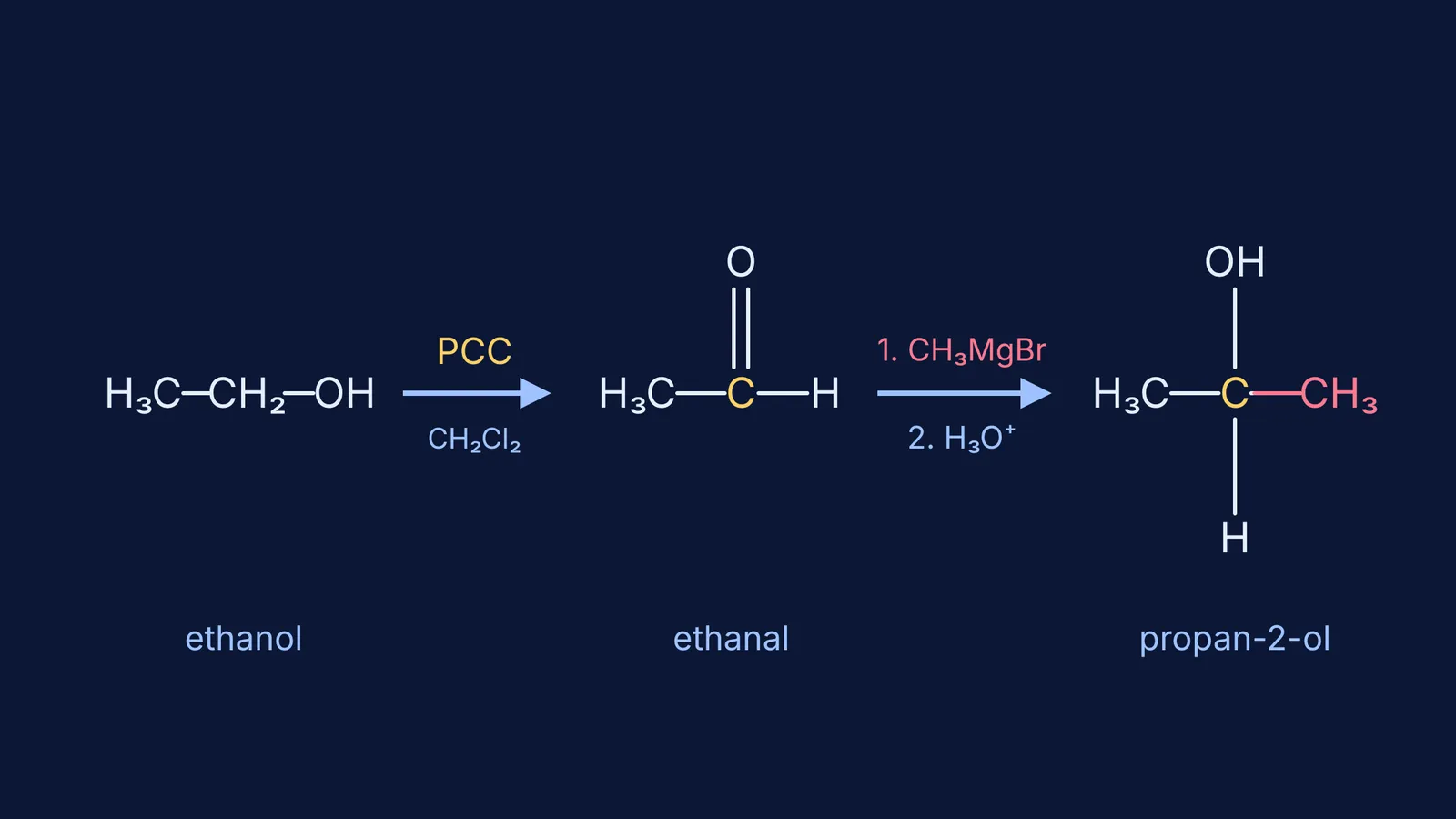
The standard answer does this in two stages. First turn the OH carbon into a carbonyl carbon, then attach a methyl group to it.
What are the steps to convert ethanol to propan-2-ol?
Oxidise ethanol to ethanal: CH3CH2OH + PCC (in CH2Cl2) gives CH3CHO
Add methylmagnesium bromide: CH3CHO + CH3MgBr (dry ether) gives (CH3)2CH-OMgBr
Hydrolyse: (CH3)2CH-OMgBr + H2O (dilute acid) gives (CH3)2CHOH + Mg(OH)Br
Steps 2 and 3 make up the second stage and are usually written over one arrow as "1. CH3MgBr, dry ether; 2. H3O+". The numbers mean an order: the Grignard reagent goes in first and the acid only afterwards.
Why use PCC and not acidified dichromate?
E. J. Corey and J. W. Suggs reported pyridinium chlorochromate in 1975, in a paper titled "Pyridinium chlorochromate. An efficient reagent for oxidation of primary and secondary alcohols to carbonyl compounds" (Tetrahedron Letters, Corey and Suggs75204-X)).
What matters for this conversion is where PCC stops. It takes a primary alcohol one step up to the aldehyde and, unlike chromic acid, does not oxidise that aldehyde on to a carboxylic acid (LibreTexts on PCC oxidation/Alcohols/Reactivity_of_Alcohols/The_Oxidation_of_Alcohols/Oxidation_by_PCC_(pyridinium_chlorochromate))). Water is the catch: the same page explains that water can add to the aldehyde to form a hydrate, which more PCC can then oxidise further.
That is why PCC is used in an organic solvent; dichloromethane at room temperature has been used in most cases (Organic Chemistry Portal).
If you write a strong oxidising agent such as acidified KMnO4 in step 1, your product reads as ethanoic acid, and the route no longer leads to propan-2-ol. For the side-by-side comparison, read our post on how PCC and KMnO4 oxidise primary alcohols differently.
How does the Grignard reagent add the extra carbon?
Victor Grignard shared the 1912 Nobel Prize in Chemistry "for the discovery of the so-called Grignard reagent" (Nobel Prize summary, 1912).
In CH3MgBr, the methyl carbon carries the electron-rich end of the carbon-magnesium bond and acts as a nucleophile. It attacks the carbonyl carbon of ethanal, which is electron-poor because oxygen pulls electron density towards itself. The C=O pi bond breaks, and you get a magnesium alkoxide. Dilute acid then protonates the oxygen to give the alcohol.
The pattern to remember: formaldehyde gives primary alcohols, other aldehydes give secondary alcohols, and ketones give tertiary alcohols (LibreTexts on Grignard reagents and carbonyls/17:_Alcohols_and_Phenols/17.05:_Alcohols_from_Carbonyl_Compounds-_Grignard_Reagents)). Ethanal is an aldehyde, so you get a secondary alcohol. The same source says these reactions must be carried out in a water-free environment, so "dry ether" is part of the answer, not decoration.
The same carbon-adding move appears in other chains, such as turning bromobenzene into benzoic acid with a Grignard reagent.
How can you check the answer before writing it?
Run three quick counts on your product:
Carbons: ethanal has 2, the Grignard reagent adds 1, so 3. Propan-2-ol has 3.
Where the OH sits: on the old carbonyl carbon, which now has a CH3 on each side. That is carbon 2.
Class of alcohol: that carbon is bonded to two carbons and one hydrogen, so the alcohol is secondary. In the lab, the Lucas test separates primary, secondary and tertiary alcohols.
Which mistakes cost marks in this conversion?
Writing acidified KMnO4 for step 1, which points to ethanoic acid instead of ethanal.
Writing CH3MgBr and H3O+ as if they go in together. Water or acid destroys the Grignard reagent before it reaches the aldehyde.
Using C2H5MgBr. That adds two carbons and gives butan-2-ol, not propan-2-ol.
Stopping after the Grignard step. Before hydrolysis you have a magnesium alkoxide salt, not an alcohol.
Leaving out "dry" before ether. The reagent only survives in a water-free solvent, so the word carries chemistry.
If you keep losing marks on reagent order rather than chemistry, the Fermi Problem Library has worked problems with a step-by-step solver that explains the reasoning rather than printing an answer. If nucleophilic addition itself feels shaky, the Fermi Concept Library gives each concept its own lesson and shows its place in the map.
Work through the butan-2-ol version on paper tonight, then check it with the three counts above.


