

On this page
Every geometric progression hides a symmetry that turns a long multiplication into two lines. The NCERT Class 11 Mathematics chapter on sequences and series defines a GP as a sequence in which each term bears a constant ratio r to the term before it, and gives the nth term as arⁿ⁻¹.
Why does pairing terms from both ends work?
Take the kth term from the start, arᵏ⁻¹. The kth term from the end is arⁿ⁻ᵏ. Multiply them and the powers of r add up to n − 1, so the product is a²rⁿ⁻¹.
The k has disappeared. Every pair of terms equidistant from the ends multiplies to the same number, a × arⁿ⁻¹, which is simply first × last.
This is the multiplication twin of a fact you may already use for arithmetic progressions, where terms equidistant from the ends of an AP have a constant sum.
What is the formula for the product of n terms of a GP?
If n is even, the n terms split into n/2 pairs, each worth first × last. If n is odd, the middle term is left over, and its square equals first × last. Either way you get one clean identity: P² = (first × last)ⁿ.
NCERT sets this as Exercise 8.2, Question 23 in the Class 11 chapter: if the first and nth terms of a GP are a and b, and P is the product of n terms, prove that P² = (ab)ⁿ. For positive a and r, the Wikipedia article on geometric progressions describes the product as the geometric mean of the first and last terms raised to the number of terms.
When every term is positive, that gives P = (first × last)^(n/2). For any GP, P = aⁿ × r^(n(n − 1)/2).
Worked example: eight terms
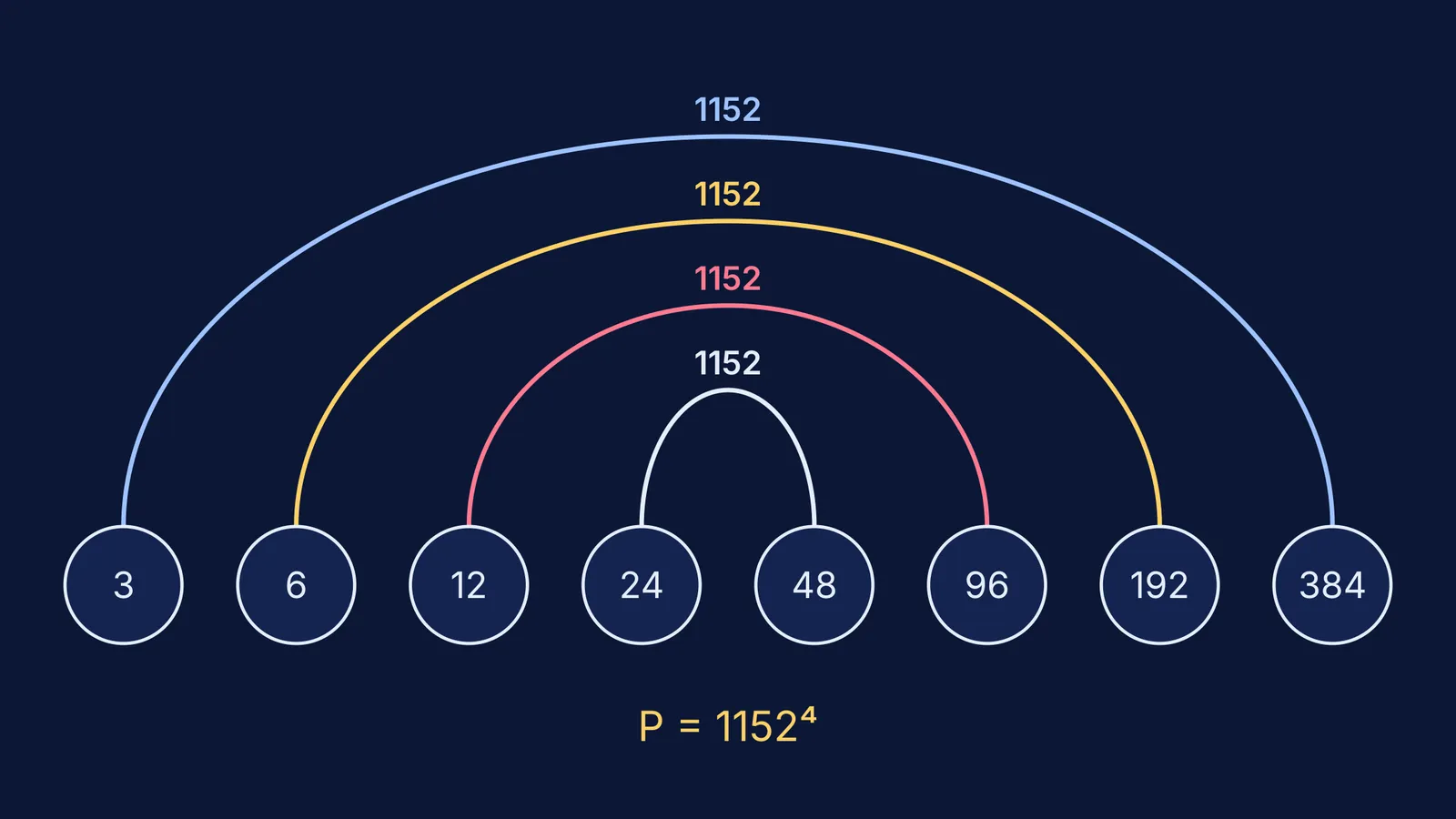
Find the product of the first 8 terms of 3, 6, 12, 24, ...
Here a = 3 and r = 2, so the last term is 3 × 2⁷ = 384.
Check the pairs: 3 × 384, 6 × 192, 12 × 96 and 24 × 48 all equal 1152.
Four pairs, so P = 1152⁴.
Cross-check: 1152 = 2⁷ × 3², so 1152⁴ = 3⁸ × 2²⁸, which matches aⁿ × r^(n(n − 1)/2).
For an odd count, take 1, 2, 4, 8, 16. The middle term is 4, so P = 4⁵ = 1024, and multiplying out 1 × 2 × 4 × 8 × 16 also gives 1024.
When does (first × last)^(n/2) give the wrong sign?
The square root hides the sign. Take 2, −6, 18. First × last is 36, and 36^(3/2) = 216, but the actual product is 2 × (−6) × 18 = −216.
Treat size and sign separately. Work out the size of P from the formula, then count the negative terms: an odd count makes P negative, an even count makes it positive. If a is positive and r is negative, the even-numbered terms are negative: n/2 of them for even n, (n − 1)/2 for odd n.
With an even n there is no root to take. For 2, −6, 18, −54, first × last is −108, and (−108)² = 11664, the product of the four terms.
Why take three terms in a GP as a/r, a, ar?
When a question gives the product of three terms, write them as a/r, a, ar: the r cancels and the product is a³.
NCERT's Example 9 in the same chapter uses exactly this: the sum of the first three terms of a GP is 13/12 and their product is −1.
Product: a³ = −1, so a = −1.
Sum: −1/r − 1 − r = 13/12, which rearranges to 12r² + 25r + 12 = 0.
Solve: r = −3/4 or r = −4/3.
The terms are 4/3, −1, 3/4 (in either order). Check: 16/12 − 12/12 + 9/12 = 13/12.
Five terms become a/r², a/r, a, ar, ar², with product a⁵.
A four-step checklist for GP product questions
Write down the first term, the last term and n. If the last term is missing, use arⁿ⁻¹.
Multiply first × last, and check one inner pair to confirm it matches.
Get the size of P from (first × last)^(n/2).
Count the negative terms and fix the sign.
If your answers still go wrong at step 2 or 4, the Fermi Problem Library has worked problems with a step-by-step solver that explains the reasoning rather than printing an answer. To revisit what a GP is, the Fermi Concept Library gives each mathematics concept its own lesson.
For sums rather than products, read our guide to the sum of n terms of a GP when r is less than 1, or practise building a progression with how to find a GP from its 3rd and 6th terms.


