

On this page
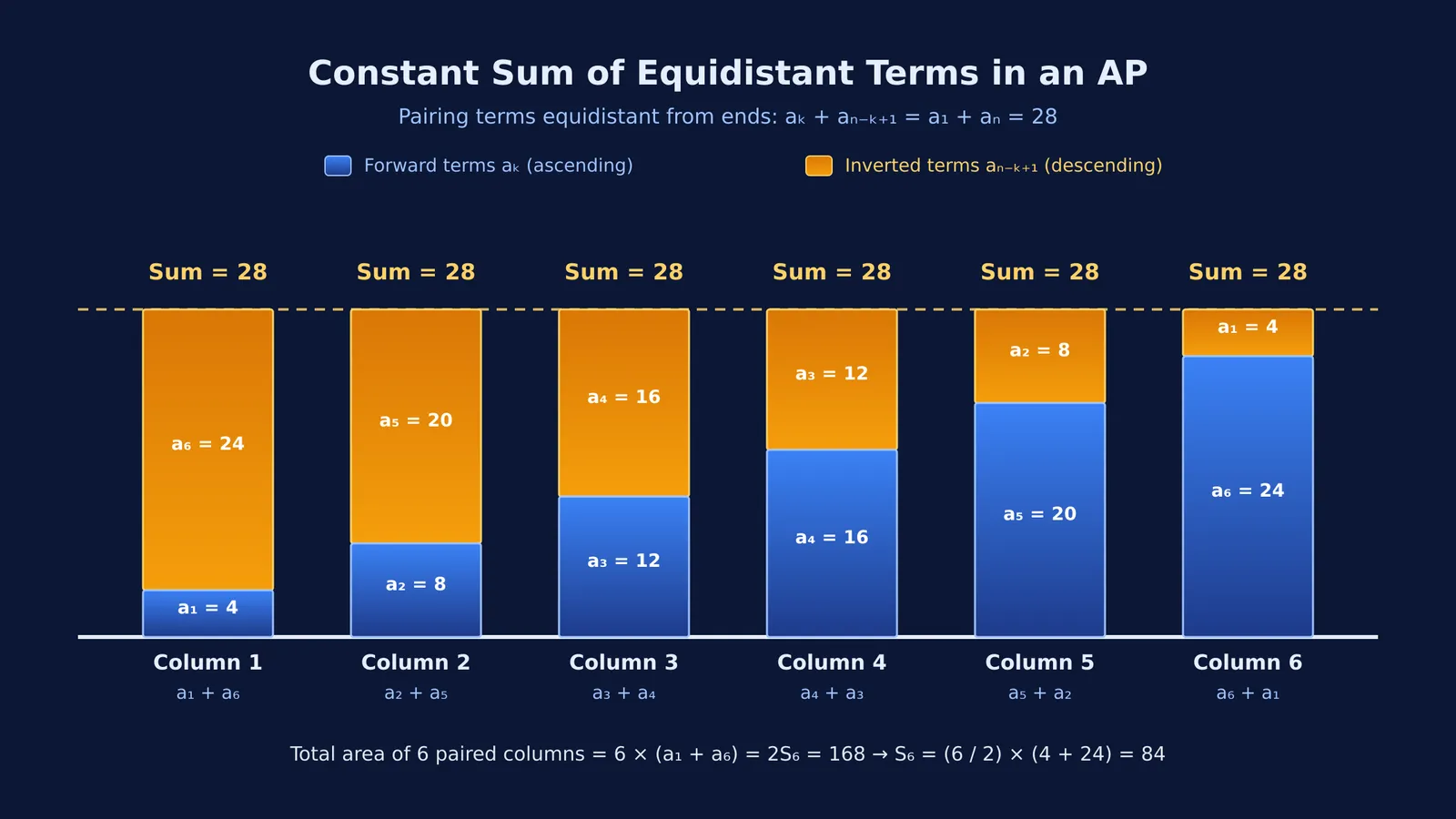
When you encounter an arithmetic progression (AP), it looks like a one-way ladder: you start at a₁, add a common difference d at each step, and climb to the final term aₙ. But beneath this step-by-step progression lies a reversible symmetry. The sum of the first and last terms, a₁ + aₙ, equals the sum of the second and second-to-last terms, a₂ + aₙ₋₁. Move two steps inward, and the sum remains unchanged.
This balance is the structural engine of arithmetic series, the geometric intuition behind Carl Friedrich Gauss's schoolroom summation, and a potent shortcut in competitive examinations.
Why is the sum of terms equidistant from the ends constant?
In any finite arithmetic progression of n terms (a₁, a₂, ..., aₙ) with common difference d, the kth term from the start is: aₖ = a₁ + (k − 1)d
The kth term counting backward from the end has index n − k + 1. Starting from the last term aₙ, this term is: aₙ₋ₖ₊₁ = aₙ − (k − 1)d
Adding these two terms causes the common difference offsets to cancel out: aₖ + aₙ₋ₖ₊₁ = [a₁ + (k − 1)d] + [aₙ − (k − 1)d] = a₁ + aₙ
Because k disappears from the sum, the total is invariant for every position from k = 1 to k = n: a₁ + aₙ = a₂ + aₙ₋₁ = a₃ + aₙ₋₂ = ... = 2a₁ + (n − 1)d
In educational research in *Revista Paranaense de Educação Matemática*, Augusto Mendes Duarte showed that using visual representations and manipulative materials helps students grasp why opposite terms balance and moves them beyond rote formulas. This balance also explains why teachers recommend choosing symmetric terms like a − d, a, a + d for unknown sequences.
How does the pairing trick derive the formula for Sₙ?
The classic schoolroom story of young Carl Friedrich Gauss summing 1 to 100 in seconds illustrates this principle. In *American Scientist*, Brian Hayes traced the anecdote to Wolfgang Sartorius von Waltershausen's 1856 memoir and documented over 100 historical variations. While Sartorius never specified which algorithm Gauss used, most popular accounts explain his speed through pairwise symmetry: either folding the sequence into pairs summing to 101 or writing the sequence twice.
Adding 1 + 100 = 101, 2 + 99 = 101, up to 50 + 51 = 101 yields 50 pairs of 101, or 5,050. For any general AP, write the series forward and backward: Sₙ = a₁ + a₂ + ... + aₙ Sₙ = aₙ + aₙ₋₁ + ... + a₁
Adding the two lines column by column gives: 2 Sₙ = (a₁ + aₙ) + (a₂ + aₙ₋₁) + ... + (aₙ + a₁)
Since every column equals (a₁ + aₙ), 2 Sₙ = n × (a₁ + aₙ), which simplifies to: Sₙ = (n / 2) × (a₁ + aₙ)
This derivation underpins arithmetic progressions in Class 10 and prevents missteps when recovering sequence terms from a sum formula.
How do competitive exams test this property without giving a or d?
Examiners frequently test this symmetry using underdetermined systems. Consider a classic JEE Main problem:
If a₁, a₂, ..., a₂₄ is an AP and a₁ + a₅ + a₁₀ + a₁₅ + a₂₀ + a₂₄ = 225, find the sum of the first 24 terms (S₂₄).
Expanding every term into a₁ + (k − 1)d produces 6a₁ + 69d = 225. Because this is one equation with two unknowns, solving for a₁ or d independently is impossible. However, grouping by equidistant indices reveals three identical pairs:
1 + 24 = 25
5 + 20 = 25
10 + 15 = 25
Since each pair sums to a₁ + a₂₄: 3 × (a₁ + a₂₄) = 225, so a₁ + a₂₄ = 75
Finding S₂₄ requires only this combined sum: S₂₄ = (24 / 2) × (a₁ + a₂₄) = 12 × 75 = 900
In the *Journal of Experimental Psychology: Learning, Memory, and Cognition*, Miriam Bassok and Keith J. Holyoak demonstrated that students who learn the algebraic structure of arithmetic progressions spontaneously transfer this knowledge to isomorphic physics problems like constant acceleration.
Worked problems in the Fermi Problem Library use a step-by-step solver that explains the reasoning rather than printing an answer.
How do you solve symmetric AP questions step by step?
When tackling sequence problems under exam pressure, apply this three-step strategy:
Match index sums. When an equation involves scattered terms, sum their indices in pairs. If p + q matches the target pair, their values sum to the same total.
Use the middle term in odd sequences. In an AP with 2m + 1 terms, the central term aₘ₊₁ is equidistant from both ends. Since 2 × aₘ₊₁ = a₁ + a₂ₘ₊₁, the sum of the series is simply Sₙ = n × aₘ₊₁.
Avoid finding parameters separately. When asked for a series sum, solve directly for (a₁ + aₙ) rather than splitting time calculating initial values or common differences.
The Fermi Concept Library maps every concept in physics, chemistry, biology, mathematics and computing, each with its own lesson and its place in the map. When practicing tricky problems, Fermi's AI tutor notices where a student is stuck and decides whether to explain, ask, or show.


