

On this page
Power sharing opens the Class 10 Democratic Politics textbook with one comparison: two democracies with divided populations, one that shared power and one that did not. Every fact below comes from the NCERT chapter "Power-sharing", so you can check each line against the book you will be examined on.
What is power sharing in Class 10?
In a democracy, NCERT says, political power should be distributed among as many citizens as possible, instead of resting in one person or group in one place (NCERT, Power-sharing). The chapter gives two kinds of reasons for it.
Prudential reason: sharing power reduces conflict between social groups and keeps political order stable.
Moral reason: power sharing is the spirit of democracy, because people affected by power have a right to be consulted on how they are governed.
The chapter's own exercises ask for one prudential and one moral reason, with an example, so learn both by name.
How did Belgium share power?
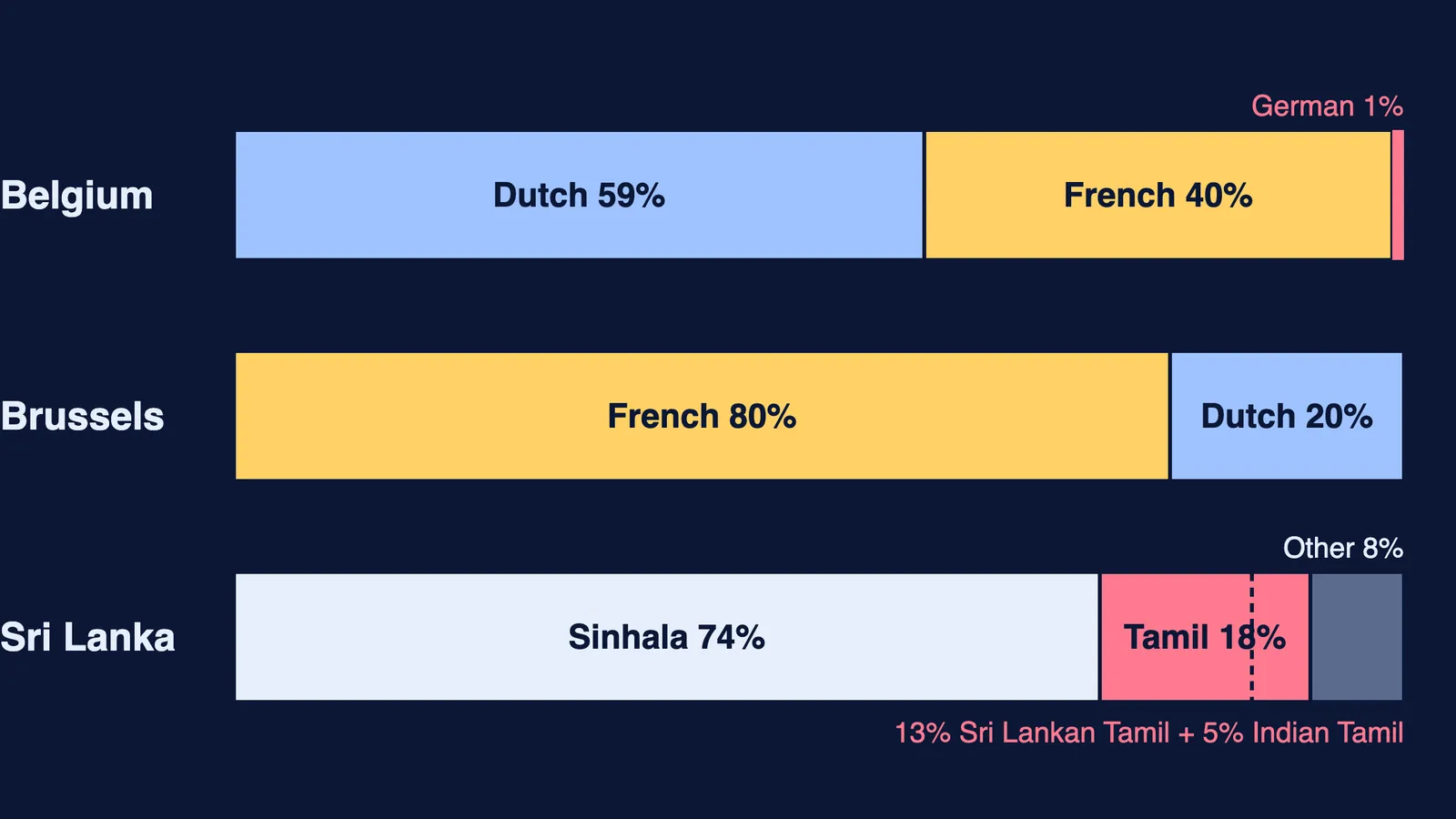
Belgium has a population of a little over one crore (NCERT). Of these, 59% live in the Flemish region and speak Dutch, 40% live in Wallonia and speak French, and 1% speak German. In Brussels the numbers flip: 80% speak French and 20% speak Dutch. The French-speaking minority was richer and more powerful, the Dutch speakers resented it, and tension grew in the 1950s and 1960s.
Belgium amended its constitution four times between 1970 and 1993. The model it built has four parts:
Equal numbers of Dutch- and French-speaking ministers in the central government; some special laws need a majority from each language group.
Many central powers given to the governments of the two regions, which are not subordinate to the centre.
A separate Brussels government with equal representation for both communities.
A community government, elected by each language community (Dutch, French and German) wherever its people live, with power over culture, education and language.
What went wrong in Sri Lanka?
Sri Lanka has about two crore people: 74% speak Sinhala and 18% speak Tamil, of whom 13% are Sri Lankan Tamils and the rest Indian Tamils (NCERT). After independence in 1948, its elected governments chose majoritarianism, the belief that the majority may rule however it wants, disregarding the minority.
In 1956 an Act made Sinhala the only official language.
Sinhala applicants were favoured for university places and government jobs.
A new constitution said the state shall protect and foster Buddhism.
Tamil demands for more autonomy for Tamil-populated provinces were repeatedly denied. By the 1980s, groups were demanding an independent Tamil Eelam, and the distrust became a civil war that ended in 2009.
What are the four forms of power sharing?
The NCERT chapter lists four arrangements found in modern democracies:
Among organs of government: legislature, executive and judiciary. This is horizontal distribution, and it creates checks and balances.
Among governments at different levels: Union, state, municipality, panchayat. This is vertical division, or federal division of power. Belgium did this; Sri Lanka refused it.
Among social groups: Belgium's community government and India's reserved constituencies are examples.
Among political parties, pressure groups and movements: through competition, coalition governments and interest groups.
To keep horizontal and vertical apart, picture a building: organs on the same floor share sideways; governments on different floors share up and down.
How do you write a long answer comparing the two?
Run both countries through the same five points, in the same order, so the examiner sees the comparison at a glance. The figures are from the NCERT chapter.
Social mix: 59% Dutch, 40% French in Belgium; 74% Sinhala, 18% Tamil in Sri Lanka.
Problem: a powerful French minority, and Dutch speakers outnumbered in Brussels; a large Sinhala majority.
Choice: accommodation versus majoritarianism.
Measures: four amendments and the four-part model; the 1956 Act, preferences and state support for Buddhism.
Result: Belgium avoided civic strife and a possible split on linguistic lines; Sri Lanka had a civil war until 2009.
End with the lesson in the callout above: it is the chapter's own conclusion. Then test yourself: Belgium's community government belongs to form 3, its state governments to form 2.
If turning a chapter into a revision plan is where you stall, Fermi's AI tutor can work out what you already know and build a plan for the session, checking understanding as it goes.
Next, revise our notes comparing the two movements in Nationalism in India, turn the Sri Lanka story into a cause-and-effect chart for a history chapter, and check any AI-quoted Article against the Constitution.


