On this page
If your potentiometer can't tell two nearly equal voltages apart, the fix lives in one number: the potential gradient, the volts dropped per metre of wire. The NCERT Class XII physics laboratory manual puts it plainly: "The length of potentiometer wire is increased to decrease φ. A lower value of φ makes the potentiometer more sensitive and accurate." Below we compare a 4 m and a 10 m wire with real numbers so you can see why.
What does sensitivity of a potentiometer mean?
A potentiometer works on one principle: with a steady current in a uniform wire, the potential difference between two points is proportional to the length between them, V = φl, where φ is the potential gradient (NCERT lab manual, Experiment 4). You slide the jockey until the galvanometer shows no deflection, and the balancing length l gives you the emf.
Sensitivity is how far the null point moves for a small change in the voltage you are measuring. The further it moves, the easier a small difference is to see on a millimetre scale.
Why does a longer wire increase sensitivity?
Spread the same voltage over more wire and each centimetre carries fewer millivolts. Since l = E/φ, a smaller φ means a longer balancing length for the same cell, and a reading error of a millimetre becomes a smaller fraction of it.
NCERT's error formula for comparing two cells, Δ(E1/E2)/(E1/E2) = Δl1/l1 + Δl2/l2, points the same way: longer balancing lengths shrink the relative error (NCERT lab manual). The same manual notes that the wire is often 100 cm, but for better accuracy it is also made 400 cm or 1000 cm long, and sometimes folded on the board to keep it compact.
Worked example: a 4 m wire vs a 10 m wire
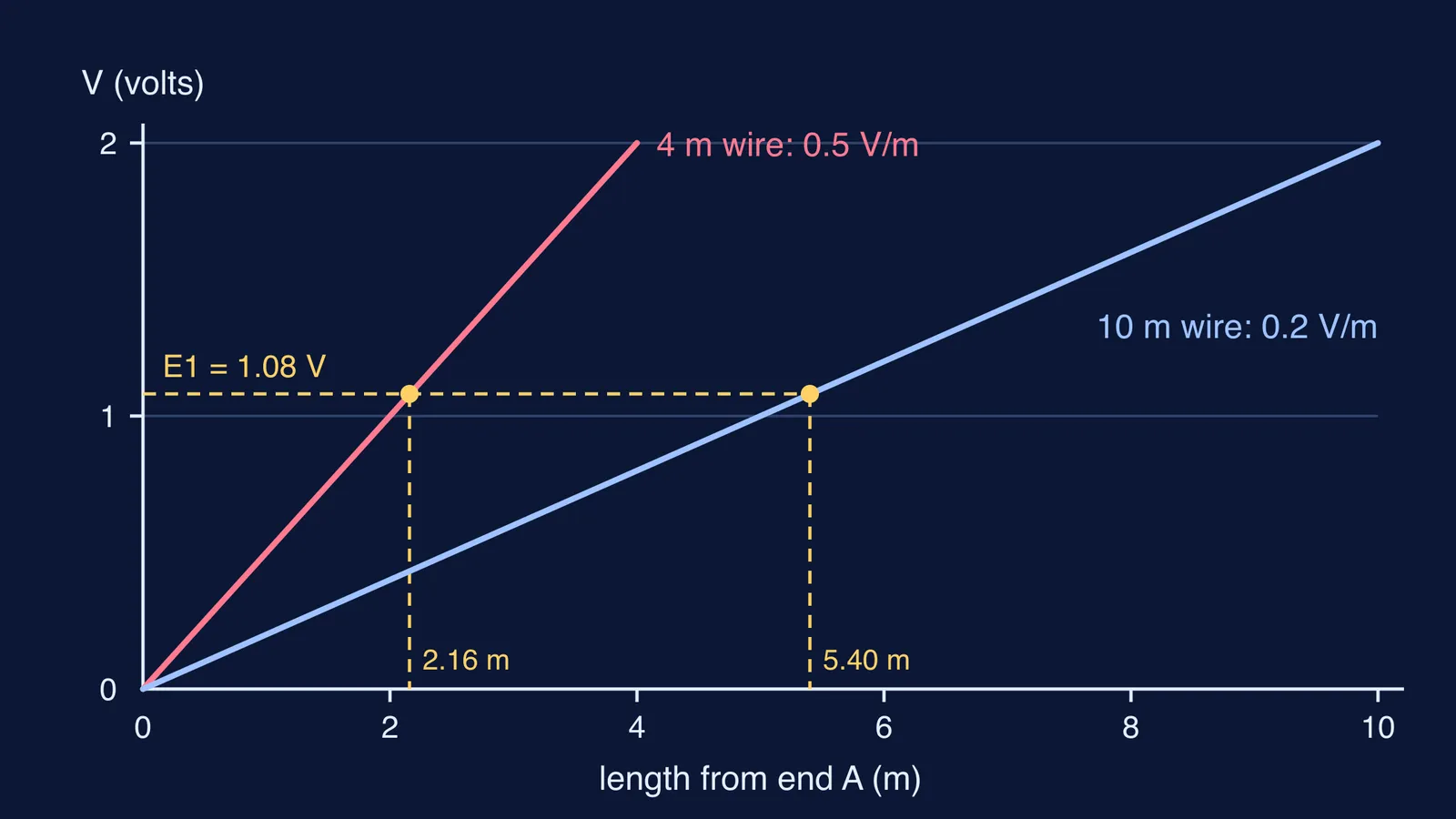
Assume the driving cell keeps 2.0 V across the whole wire in both cases (we ignore its internal resistance and the rheostat to keep the comparison clean). You want to measure a cell of emf 1.08 V, and you can locate the null point to about ±0.1 cm. Everything below follows from V = φl in the NCERT lab manual.
4 m wire
Potential gradient: φ = 2.0 V ÷ 4 m = 0.5 V/m, which is 5 mV per cm.
Balancing length: l = 1.08 V ÷ 0.5 V/m = 2.16 m, or 216 cm.
A ±0.1 cm reading error means ±0.5 mV, about 0.046% of the reading.
A 1 mV change in emf moves the null point 0.2 cm.
10 m wire
Potential gradient: φ = 2.0 V ÷ 10 m = 0.2 V/m, which is 2 mV per cm.
Balancing length: l = 1.08 V ÷ 0.2 V/m = 5.40 m, or 540 cm.
A ±0.1 cm reading error now means ±0.2 mV, about 0.019% of the reading.
A 1 mV change in emf moves the null point 0.5 cm.
The 10 m wire is 2.5 times as sensitive because its gradient is 2.5 times smaller. With a fixed voltage V across a wire of length L, φ = V/L, so sensitivity grows in direct proportion to the length.
How to increase sensitivity of a potentiometer without a new wire?
You rarely get to swap wires in a school lab, so change the current. The gradient equals the current times the resistance per metre of wire, so raising the rheostat resistance in the main circuit lowers the current and lowers φ.
There is a limit. The total drop across the wire, φL, must stay larger than the emf you are measuring, or no balance point exists. The NCERT manual says the driving battery must have a greater emf than the cells being compared for exactly this reason (NCERT lab manual). On a 4 m wire, cutting φ to 0.1 V/m leaves only 0.4 V across it, so a 1.08 V cell can never balance.
What should you check in a potentiometer question?
Write φ first, in V/m or mV/cm.
Ask what is held fixed. A longer wire with the same voltage across it lowers φ; a longer wire of the same material and thickness carrying the same current does not.
Check that φL is larger than the emf being measured, so a null point exists.
In the lab, expect a small range with no visible deflection; NCERT suggests taking the middle of that range as the balance point (NCERT lab manual).
Practical lists change, so check whether potentiometer experiments are on yours in the CBSE curriculum for 2026-27.
If your balancing lengths keep coming out wrong, try similar numericals in the Fermi Problem Library, where a step-by-step solver explains the reasoning rather than printing an answer. If V = φl itself feels shaky, every concept in the Fermi Concept Library has its own lesson and its place in the map, so you can step back to Ohm's law first.
Next time a question asks how to increase sensitivity, write one line: lower φ with a longer wire or a smaller current, keeping φL above the emf.