

On this page
A polyhouse is a greenhouse with a plastic skin. Tamil Nadu Agricultural University's greenhouse cultivation guide defines a greenhouse as "a structure covered with a transparent material for admitting natural light for plant growth". For the cover, the TNAU guide recommends ultraviolet-resistant low-density polyethylene and says a single film of 200 micron thickness is sufficient.
How does a polyhouse trap heat?
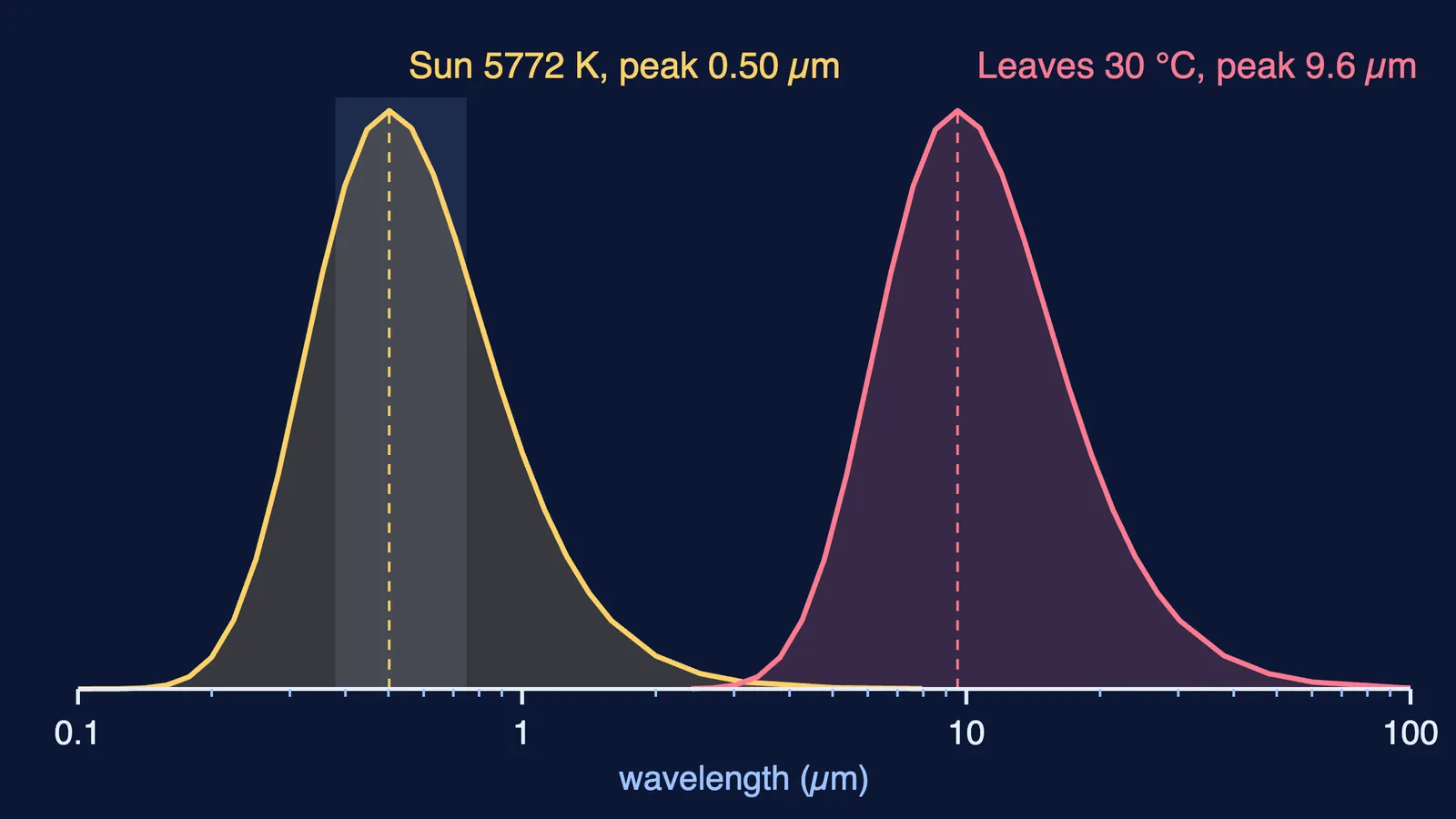
Heat comes in as one kind of radiation and tries to leave as another. Wien's displacement law says a hot body radiates most strongly at a wavelength λmax = b/T, where b = 2.898 × 10^-3 m K according to NIST's CODATA value.
Worked example:
The Sun's effective temperature is 5772 K, from NASA's Sun fact sheet.
Sunlight peaks at 2.898 × 10^-3 / 5772 = 5.0 × 10^-7 m, or 0.50 µm. That is visible light, which passes through clear plastic.
Leaves and soil at 30 °C are at about 303 K. They peak at 2.898 × 10^-3 / 303 = 9.6 × 10^-6 m, or 9.6 µm. That is infrared.
The outgoing wavelength is about 19 times the incoming one.
So a cover that passes visible light but blocks infrared would let heat in and hold it back. Test five predictions of this idea in our post on how the greenhouse effect works. If the two curves are hard to picture, the Fermi Simulation Lab has interactive simulations for ideas that are easier to see than read.
Is it trapped infrared or trapped air?
Scientists have argued for over a century about a second effect. In 1909 R. W. Wood compared a box under glass with one under rock salt, which lets infrared through. As quoted in Paul Arveson's 2023 review in the Journal of the Washington Academy of Sciences, Wood found "scarcely a difference of one degree" and concluded that heat lost by radiation is small next to heat lost by convection.
Arveson ran his own test with copper plates in two insulated boxes, one under glass and one under thin polyethylene film, which he notes is essentially transparent in the infrared to beyond 20 microns. The glass-covered box was on average 8 °C hotter. He concludes that a real greenhouse "is heated primarily by selective filtering of infrared radiation".
His film was far thinner than a 200-micron farm sheet, but the lesson holds: polyethylene is a much weaker infrared trap than glass. A polyhouse leans more on the second effect, the closed cover stopping warm air rising away, which is why opening the vents is the first way to shed heat.
How do farmers control temperature and humidity in a polyhouse?
The TNAU guide says greenhouses in India's plain and coastal regions need cooling. Its tools:
Vents, because the greenhouse "has to be thoroughly ventilated for control of temperature".
Evaporative cooling pads with exhaust fans (fan and pad), switched by a thermostat.
Foggers to raise humidity in houses without fans.
Polypropylene shade nets to cut the incoming light.
TNAU adds that the maximum relative humidity you can reach is 90%, and only in a fan-regulated greenhouse. The physics is latent heat: water that evaporates from a wet pad or a fog droplet takes heat from the air, so the air cools while its humidity rises.
Why add CO2 to a polyhouse?
Plants build sugar from carbon dioxide, as the KOH experiment on CO2 and photosynthesis shows. Outdoor air at Mauna Loa held 426.07 ppm of CO2 in September 2026, according to NOAA's monthly record.
A closed, sunlit crop can use CO2 faster than it leaks in. The UK's AHDB CO2 best practice guide says supplementing to 1,000 ppm during the day, while the vents are closed, is widely used. Once the vents open beyond 10%, the guide says growers aim only to hold the canopy at 400 ppm, because extra gas would be lost through the vents. So heat says open the vents, and CO2 says keep them shut.
What crops are grown in polyhouses in India?
Capsicum stands out. A report by Ranjana Roy and Ashok Gulati for ICRIER says red and yellow capsicum is grown mostly under polyhouses and shade nets. It also reports that about 2.64 lakh hectares came under protected cultivation in India under MIDH from 2014-15 to 2022-23, less than 0.2% of net sown area.
The same report estimates net returns from polyhouse capsicum and cucumber at about Rs 19.95 lakh per acre a year, nearly 30 times the paddy and wheat returns in Haryana (Rs 59,306 per acre). But one Uttar Pradesh grower in the study paid Rs 52 lakh to build one acre, Rs 17 lakh of it from a government subsidy, and the authors list high upfront cost and the know-how to manage temperature among the main challenges.
TNAU names roses, carnations and chrysanthemums among the important greenhouse flowers. ICRIER also credits drip irrigation for the growth; here is why drip irrigation saves water.
If Wien's law, latent heat or photosynthesis is shaky, the Fermi Concept Library covers every concept in physics, chemistry, biology, mathematics and computing.


