On this page
A female platypus lays eggs and then feeds her young on milk. That trips up many students, because "mammals give birth to live young" is often the first rule we learn. Learn what actually makes an animal a mammal, and the platypus and echidna stop being exceptions to memorise.
What are egg-laying mammals called?
Egg-laying mammals are called monotremes. The Australian Museum puts it plainly: along with echidnas, platypuses "are grouped in a separate order of mammals known as monotremes, which are distinguished from all other mammals because they lay eggs" (Australian Museum, Platypus).
The order has two families, Ornithorhynchidae (the platypus) and Tachyglossidae (the echidnas), and monotremes are restricted to Australia and New Guinea (Animal Diversity Web, Monotremata).
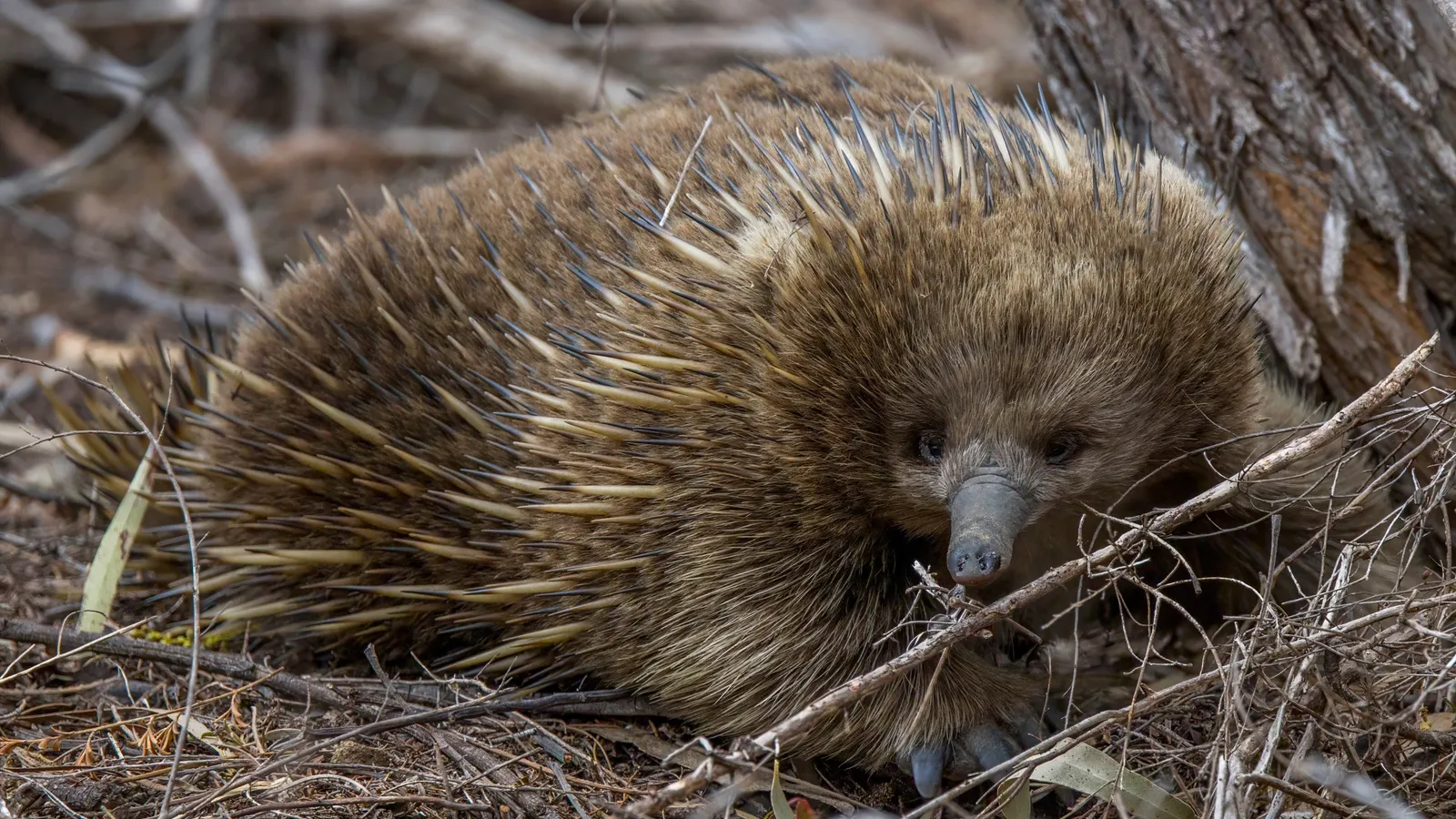
Five monotreme species live today: the duck-billed platypus and four species of echidna, one short-beaked and three long-beaked (WorldAtlas).
Why is the platypus a mammal if it lays eggs?
Because laying eggs is about how an animal reproduces, not about which group it belongs to. Monotremes pass the tests that define mammals (Animal Diversity Web, Monotremata):
Hair. The platypus has "dense dark brown to reddish brown fur", and its body is covered with dense waterproof fur that keeps it warm (Australian Museum, Platypus). A newly hatched echidna clings to hairs inside its mother's pouch (Australian Museum, Short-beaked Echidna).
Milk from mammary glands. Echidna mothers "do not have nipples or teats, but nurse young through pores connected to their paired mammary glands" (Animal Diversity Web, Short-beaked echidna). Young platypuses suckle from two milk patches covered by fur on the mother's belly (Australian Museum, Platypus).
Three middle-ear bones and a lower jaw made of a single bone (the dentary). Animal Diversity Web lists both as mammal features that monotremes share.
They also keep traits from their much older, reptile-like ancestors: they lay eggs, they have a cloaca (one opening for waste and reproduction) and their upper limb bones are held out to the side of the body (Animal Diversity Web, Monotremata). Male platypuses even carry a sharp spur about 12 millimetres long on each ankle, connected to a gland that produces venom (Australian Museum, Platypus).
For the full list of mammal traits, see our explainer on the features that define mammals, from hair to mammary glands.
How do platypus and echidna eggs hatch?
A female platypus lays 1 to 3 eggs, usually 2, after a 21-day gestation, and incubates them for possibly 10 days. When the young hatch she starts secreting milk (Australian Museum, Platypus).
A short-beaked echidna lays a single soft-shelled egg into her pouch, and it hatches 10 or 11 days later (Animal Diversity Web, Short-beaked echidna). The blind, hairless young suckles in the pouch for two or three months, then keeps suckling in a burrow for the next six months (Australian Museum, Short-beaked Echidna).
So both animals are oviparous. If the words oviparous, viviparous and ovoviviparous blur together, our guide to oviparous vs viviparous animals sorts them out.
What do platypus and echidna genomes show?
In 2008 a team led by Wesley Warren published a draft platypus genome in Nature. They described the animal as having "a fascinating combination of reptilian and mammalian characters" and found that its milk protein genes are conserved even though it lays eggs (Warren et al., Nature, 2008).
In 2021 a team led by Yang Zhou published reference genomes for both the platypus and the short-beaked echidna in Nature. The paper calls monotremes "the only extant mammalian outgroup to therians", meaning marsupials and placental mammals, and reports marked differences from them in lactation genes (Zhou et al., Nature, 2021).
In plain terms, monotremes branched off early in the mammal family tree. Marsupials such as the kangaroo took a different route; our post on how kangaroos raise young in a pouch covers that branch.
How do you answer "is it a mammal?" questions in an exam?
Use this four-step check for any odd animal:
Does it have hair or fur, even a little?
Does the mother feed her young on milk from mammary glands, with or without nipples?
Does it have three middle-ear bones and a single-bone lower jaw?
Only then ask how it reproduces: eggs, a pouch or a placenta.
If the answers to steps 1 to 3 are yes, it is a mammal, whatever step 4 says.
Worked example (assertion-reason style).
Assertion: The platypus is a mammal. Reason: The platypus lays eggs.
Step 1: Is the assertion true? Yes. It has fur and feeds its young on milk.
Step 2: Is the reason true? Yes.
Step 3: Does the reason explain the assertion? No. Laying eggs is a trait kept from reptile-like ancestors, so it cannot be why the platypus is a mammal. Answer: both are true, but the reason is not the correct explanation.
If animal classification still feels like a list to memorise, the Fermi Concept Library gives every concept in biology its own lesson and its place in the map. For practice, the Fermi Problem Library has worked problems with a step-by-step solver that explains the reasoning rather than printing an answer.