

On this page
It washes up on the beach looking like a single, balloon-like jellyfish. However, the Portuguese man of war is actually a floating city.
According to the National Oceanic and Atmospheric Administration (NOAA), the Portuguese man of war (*Physalia physalis*) is a siphonophore, not a jellyfish. Instead of being one animal, it is a highly integrated colony of genetically identical clones. These individual units are specialised for different tasks, allowing them to survive together on the ocean surface.
If you are studying for NEET, this organism is a classic example of the Animal classification exceptions that always appear in MCQs.
What is a siphonophore colony?
A siphonophore is a colonial organism made of specialised units called zooids. They develop from a single fertilised egg, but instead of dividing to form the organs of one animal, the cells form independent clones that stay attached to one another.
Because a single zooid cannot survive on its own, the colony divides the labour. They rely on a shared system to float, hunt, digest, and reproduce. Each clone sacrifices its independence to become a functional part of the whole colony. This makes the Portuguese man of war a fascinating bridge between single-celled life and complex multicellular animals.
What are the four zooids of a Portuguese man of war?
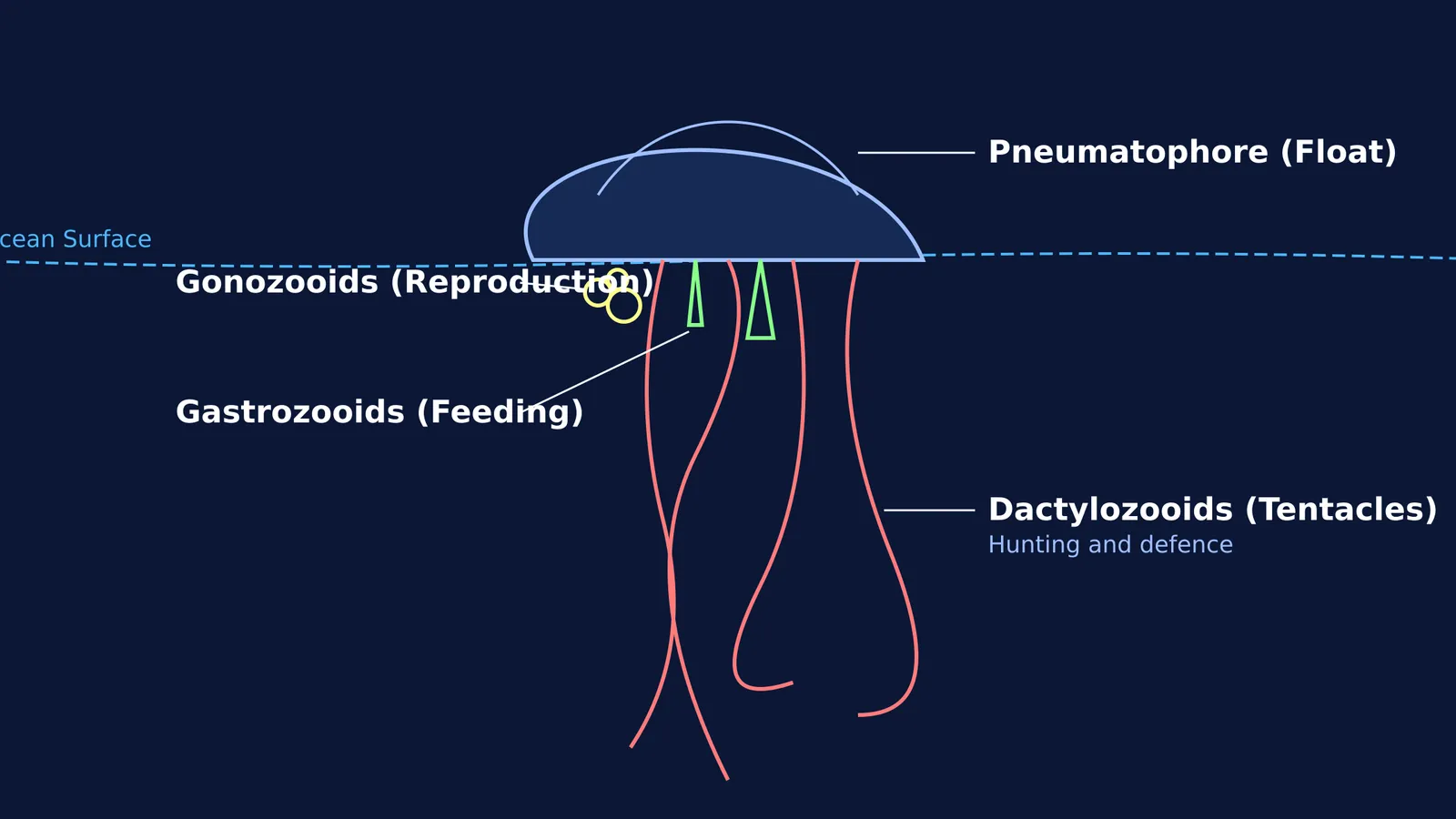
To keep the colony alive, the organism relies on four distinct types of polyps. The NOAA lists the following zooids:
The float (pneumatophore): This is the most visible part of the colony. It is a balloon-like, gas-filled bladder that sits up to 6 inches above the waterline (NOAA). It acts as a sail, catching the wind to move the colony across the ocean. The floats can be "left-handed" or "right-handed", which dictates the angle at which they sail (Wikipedia).
The tentacles (dactylozooids): These are the hunting and defence units. They trail below the float to ensnare small fish and crustaceans. They average 30 feet in length, but they can stretch up to an astonishing 100 feet in the water (NOAA).
The feeding polyps (gastrozooids): Once the tentacles capture prey, they pull it up to the gastrozooids. These polyps secrete digestive enzymes to break down the food, liquefying it so the nutrients can be absorbed and shared with the rest of the colony.
The reproductive polyps (gonozooids): These units handle the future of the colony by producing eggs and sperm. Reproduction is external; the gonozooids release gametes into the water, where they combine to form new larvae that eventually bud into new colonies.
Why is it grouped with cnidarians?
If it is a colony of clones and not a true jellyfish, why is it placed in the same phylum? Both true jellyfish and the Portuguese man of war belong to the phylum Cnidaria. They are both diploblastic, which is a key concept covered in Diploblastic vs Triploblastic Animals: Germ Layers and Examples.
Most importantly, they share the defining weapon of the phylum: stinging cells called nematocysts. The tentacles of *Physalia physalis* are packed with these microscopic, venom-filled harpoons. When a fish brushes against the tentacle, the nematocysts fire instantly, injecting a neurotoxin that paralyses the prey. According to Wikipedia, these nematocysts remain highly potent and can deliver painful stings for hours or even days after the colony washes ashore or the tentacles are detached.
Despite these similarities, true jellyfish belong to the class Scyphozoa (the swimming medusae), while *Physalia* belongs to the class Hydrozoa.
Keeping classes and exceptions straight is hard when memorising the animal kingdom. If you need help building these memory structures, Fermi's AI tutor teaches rather than just answers. It holds a line of reasoning across a whole session, notices where a student is stuck, and decides whether to explain, ask, or show. You can see how each phylum connects in the Fermi Concept Library, which has every concept in biology, each with its own lesson and its place in the map.
How do you tell a siphonophore from a true jellyfish?
When classifying organisms in the lab or tackling a Taxonomy vs Systematics vs Classification: What NCERT Says question, use this three-point checklist to tell them apart:
Body structure: Is it a single, continuous animal (jellyfish) or a colony of cloned zooids working together (siphonophore)?
Method of movement: Does it actively pulse its bell to swim through the water (jellyfish) or float passively using a wind-blown gas bladder (siphonophore)?
Taxonomic class: Does it belong to Scyphozoa (true jellyfish) or Hydrozoa (siphonophore)?
Next time you see a picture of a Portuguese man of war, you will know you are not looking at a single creature, but an entire society of specialists working as one.


