On this page
Open an old bottle of phenol in a school lab and the white crystals are often tinged pink. The NIOSH Pocket Guide describes phenol as a colourless to light-pink crystalline solid, and the reason for that range is a slow reaction with the air.
Why does phenol turn pink when exposed to air?
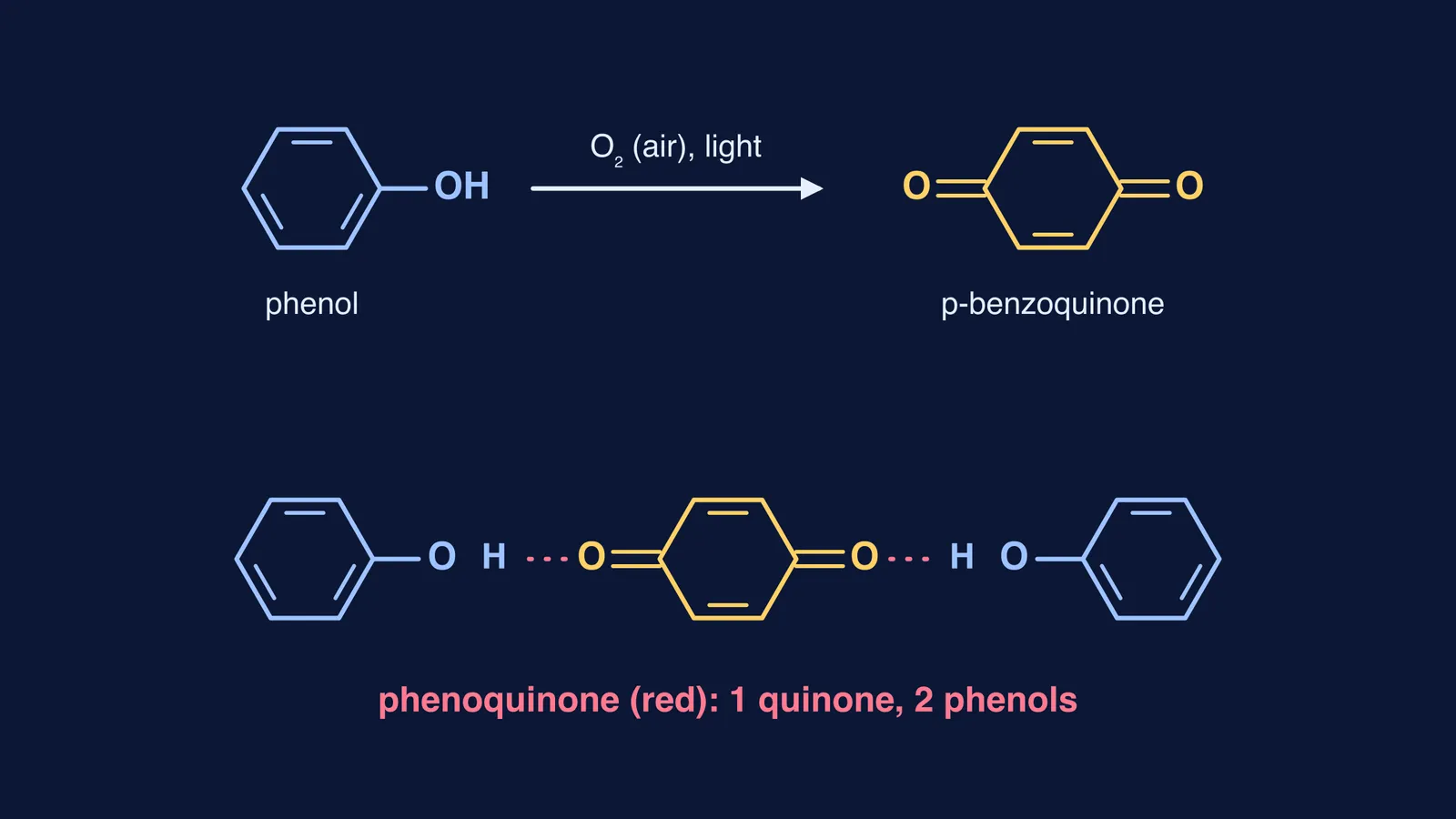
Phenol is easy to oxidise because the -OH group pushes electron density into the benzene ring. Slowly, oxygen from the air, helped by light, converts a small fraction of the phenol into p-benzoquinone.
The Merck Index, quoted on PubChem's phenol record, says phenol is "prone to redden on exposure to air and light, hastened by presence of alkalinity."
That last part matters. In base, phenol becomes the phenoxide ion, which is even richer in electrons and oxidises faster. A supplier's handling guide for lab-grade phenol says the rate of oxidation increases with increasing pH, temperature and buffer concentration.
So the three things that speed up the pink colour are air, light and alkali, with warmth on top.
What is phenoquinone, and why is it red?
Here is the surprising part: p-benzoquinone on its own is yellow, not pink. The pink comes from what the quinone does next.
Phenoquinone is a 1:2 complex of one p-benzoquinone molecule with two phenol molecules, held together by hydrogen bonds, according to a 2026 crystal-structure study in Acta Crystallographica Section E by Royappa, Tan and Johnston.
The same paper states that "phenol itself is colorless and p-benzoquinone is yellow, whereas the cocrystals of phenoquinone are dark red," and that phenoquinone is responsible for the faint pink colour of impure phenol. The authors grew red needles of phenoquinone within 10 minutes by gently melting the two solids together, with no solvent.
Why red? In the complex, an electron can jump from the electron-rich phenols to the electron-poor quinone when the pair absorbs light. This is called a charge-transfer transition. The study's calculations place the lowest-energy absorptions at about 530 and 535 nm, which is green light. Take green out of white light and what reaches your eye looks red to pink.
Because only a tiny amount of quinone forms, you see a faint pink, not dark red.
Does pink phenol still work as a reagent?
A faintly pink bottle is still mostly phenol; a trace of a strongly coloured impurity is enough to show. Whether that trace matters depends on the job.
Qualitative school tests such as the neutral ferric chloride test for phenol: the colour can confuse your observation, so tell your teacher and use a fresh sample if one is available.
Quantitative work (preparing a solution of known concentration, measuring a rate): the impurity changes the real amount of phenol, so use pure material.
Biology labs that extract DNA or RNA with phenol: suppliers sell a redistilled, high-purity grade and note that oxidised phenol typically appears yellow or red once saturated with water or buffer.
Remember that phenol is toxic and causes burns on skin contact, as the same supplier guide warns, so handle any bottle, pink or not, with gloves and your teacher's supervision.
How do you purify phenol that has turned pink?
The usual fix is distillation. Phenol boils at about 182 °C (the value listed on PubChem from the ILO-WHO International Chemical Safety Cards), so collecting the fraction that distils near that temperature separates phenol from the coloured oxidation products. Some labs prefer to distil at lower temperature using distillation under reduced pressure. This is a job for a teacher or lab staff, not a student at home.
Preventing the pink is easier than removing it. The supplier guide gives these storage conditions for its lab-grade phenol:
Keep it cold: store at 2 to 8 °C.
Keep it dark: use an amber or foil-wrapped bottle.
Keep air out: crystalline phenol is packed under nitrogen; close the cap tightly after use.
Keep it away from base: buffers used to equilibrate the phenol should not exceed pH 8.0.
Add an antioxidant if the method allows: 8-hydroxyquinoline at 0.1% w/w.
Watch the date: the guide gives crystalline phenol a stability of 3 to 6 months under these conditions.
Each step blocks one cause: cold slows the reaction, dark removes light, nitrogen removes oxygen, and low pH keeps phenol out of its easily oxidised phenoxide form.
How do you remember this for board exams and JEE?
This question often shows up as a "give reasons" item. A full answer has three parts: name the oxidising agent (air, helped by light), name the first product (p-benzoquinone), and name the coloured species (phenoquinone, a charge-transfer complex of one quinone with two phenols). Add the storage fix if the marks allow.
For the wider chapter, our overview of alcohols, phenols and ethers ties phenol's acidity, ring reactions and tests together. If the idea of a charge-transfer complex or phenoxide stability still feels shaky, the Fermi Concept Library gives each chemistry concept its own lesson and shows where it sits in the map, so you can fill the gap before the next test.