

On this page
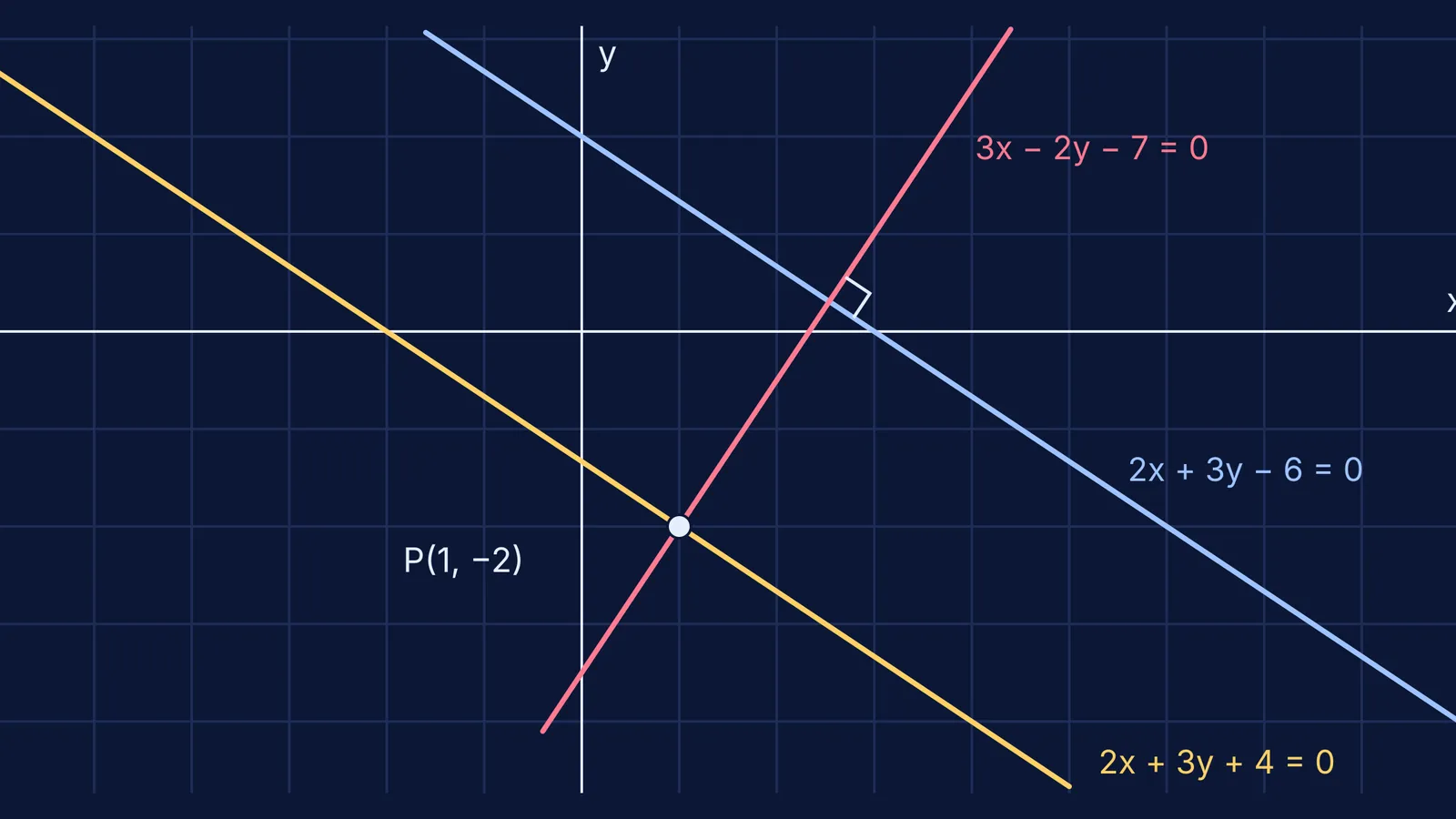
You are given a line, say 2x + 3y − 6 = 0, and a point, say P(1, −2), and asked for the line through P that is perpendicular to the first one. The usual route (find the slope, flip it, change its sign, use point-slope form, clear fractions) has a minus sign to drop at every step. Here is a shorter one with no slopes.
How do you find a line perpendicular to a given line through a point?
Swap the coefficients of x and y, change one sign, and let the point decide the constant.
Start from the given line ax + by + c = 0.
Write the perpendicular family as bx − ay + k = 0.
Substitute the given point (x₁, y₁) for x and y.
Solve that one equation for k and write the final line.
Worked example, with 2x + 3y − 6 = 0 and P(1, −2):
Swap and change a sign: 3x − 2y + k = 0.
Put in P: 3(1) − 2(−2) + k = 0, so 3 + 4 + k = 0 and k = −7.
Answer: 3x − 2y − 7 = 0.
To check, P gives 3 + 4 − 7 = 0, so it lies on the new line. The two slopes are −2/3 and 3/2, and their product is −1.
Why does swapping a and b give a perpendicular line?
Rearranging ax + by + c = 0 as y = (−a/b)x − c/b shows that its slope is −a/b, as long as b is not zero. The line bx − ay + k = 0 rearranges to y = (b/a)x + k/a, so its slope is b/a (with a not zero). Multiply them: (−a/b)(b/a) = −1.
Two non-vertical lines are perpendicular if and only if their slopes multiply to −1, as section 9.2.2 of the NCERT Class 11 Mathematics chapter on straight lines proves. The same section shows that two non-vertical lines are parallel if and only if their slopes are equal.
Changing k slides a line without turning it, so bx − ay + k = 0 is the whole family of perpendicular lines, and the point picks one. The swap even handles a vertical line: x − 4 = 0 (a = 1, b = 0) gives −y + k = 0, the horizontal line y = k.
How do you find a line parallel to a given line through a point?
Keep a and b exactly as they are and replace only the constant: ax + by + k = 0.
With the same example, the line through P(1, −2) parallel to 2x + 3y − 6 = 0:
Keep the coefficients: 2x + 3y + k = 0.
Put in P: 2(1) + 3(−2) + k = 0, so 2 − 6 + k = 0 and k = 4.
Answer: 2x + 3y + 4 = 0.
NCERT's Exercise 9.3, question 10 asks you to prove that the line through (x₁, y₁) parallel to Ax + By + C = 0 is A(x − x₁) + B(y − y₁) = 0 (NCERT Straight Lines chapter). That is this method with k worked out as −(Ax₁ + By₁).
Try it on two NCERT questions
Cover the working and try these from the same exercise first.
Exercise 9.3, question 6: the line parallel to 3x − 4y + 2 = 0 through (−2, 3). Write 3x − 4y + k = 0. Then 3(−2) − 4(3) + k = 0 gives −18 + k = 0, so k = 18 and the line is 3x − 4y + 18 = 0.
Exercise 9.3, question 7: the line perpendicular to x − 7y + 5 = 0 with x-intercept 3. An x-intercept of 3 means the line passes through (3, 0). Swap: 7x + y + k = 0. Then 21 + 0 + k = 0, so k = −21 and the line is 7x + y − 21 = 0.
What mistakes should you check for?
Swapping without changing a sign. bx + ay + k = 0 is not perpendicular to a slanted line: the slopes multiply to +1, not −1.
Keeping the old constant. The new line has its own k.
Substituting into the given line instead of the new family.
Hidden points. An x-intercept of 3 is the point (3, 0); write it down before any algebra.
Not checking. The point must give exactly 0 in your final line.
If your k still does not match the answer key, the Fermi Problem Library has worked problems with a step-by-step solver that explains the reasoning rather than printing an answer, so you can see where your working went off.
The perpendicular through a point is also the first step in finding the image of a point in a line and the reflection of a line in another line, and the fix-the-constant idea settles a line with equal intercepts on both axes too.


