

On this page
If a question says a line "cuts off equal intercepts on the axes", the usual move is to write x + y = a, substitute the point and move on. That is often only half the answer.
What is the equation of a line with equal intercepts on the axes?
Start from the intercept form. NCERT's Class 11 Maths chapter on Straight Lines (section 9.3.5) states that the line making intercepts a and b on the x- and y-axes is x/a + y/b = 1.
Put b = a and multiply through by a:
x/a + y/a = 1
x + y = a
So every line with equal, non-zero intercepts has slope −1, and the extra condition in the question (a point, an area, a distance) picks out one value of a.
The same NCERT chapter asks exactly this in Exercise 9.2, question 11: find the equation of a line that cuts off equal intercepts on the coordinate axes and passes through the point (2, 3).
Worked example: equal intercepts through (2, 3)
Write the family: x + y = a.
Substitute the point: 2 + 3 = a, so a = 5.
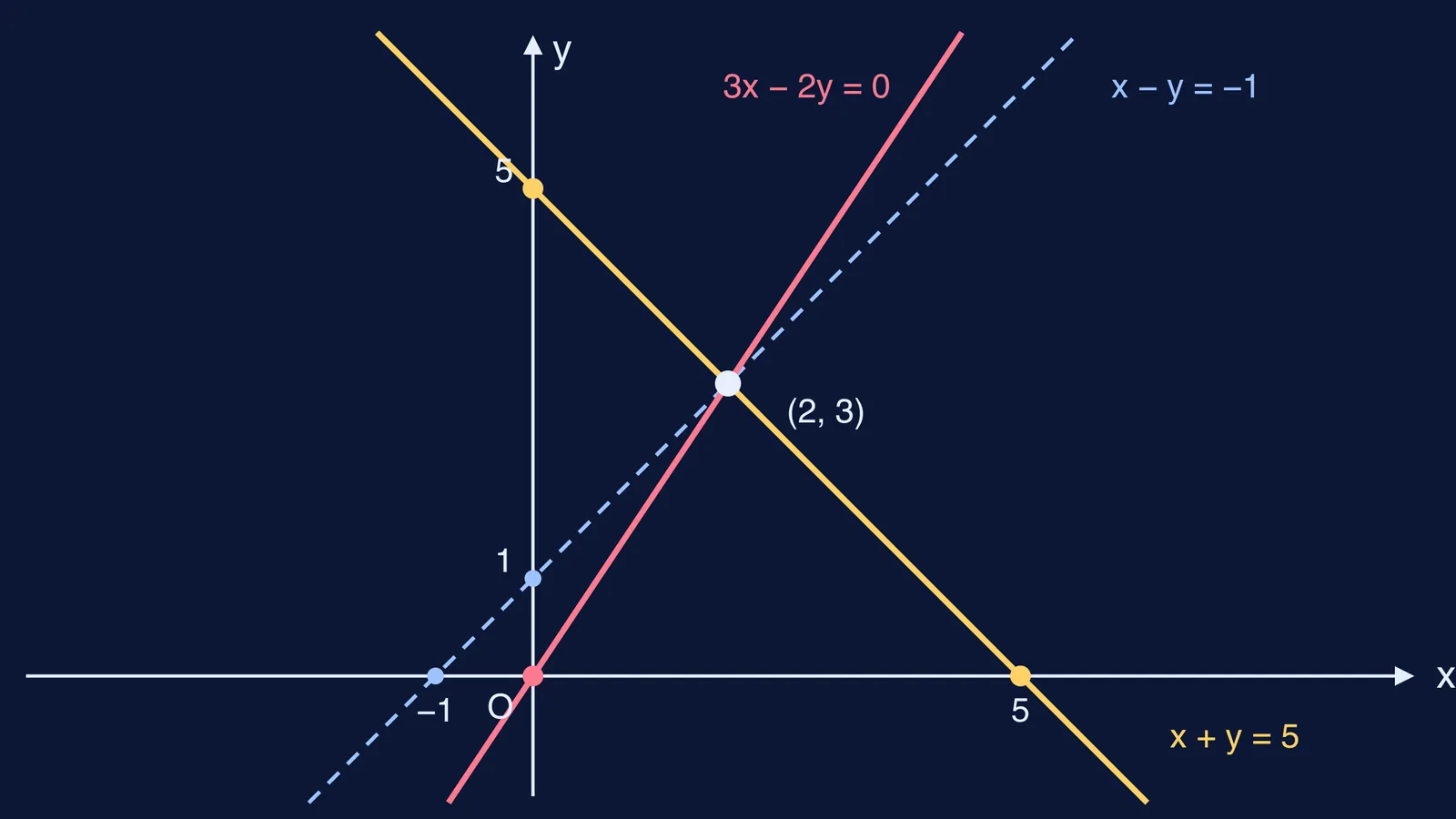
First line: x + y = 5. It meets the axes at (5, 0) and (0, 5), so the intercepts are equal, as required.
Now ask the question that is easy to skip: can both intercepts be zero?
A line through the origin meets both axes at (0, 0), so its x-intercept and y-intercept are both 0, which are equal.
The line through (0, 0) and (2, 3) has slope 3/2, so y = 3x/2, or 3x − 2y = 0.
The complete answer is x + y = 5 or 3x − 2y = 0.
Why does the line through the origin get missed?
Because the method hides it: the moment you write x/a + y/a = 1, you have thrown away the case a = 0 without noticing. Whether the origin line counts depends on the wording and on the convention you are marked against. A habit that protects you either way:
If the question says "non-zero intercepts", leave the origin out.
If it says "equal intercepts" with no restriction, include the origin line, or at least mention it in a written answer.
If it says "equal in magnitude" or "numerically equal", add a third family, x − y = a, where the intercepts are a and −a. Through (2, 3) that gives x − y = −1, which cuts the axes at (−1, 0) and (0, 1).
What if the intercepts are in a given ratio?
Use one unknown, not two. If the x- and y-intercepts are in the ratio m : n, write them as mk and nk. Then x/(mk) + y/(nk) = 1, which simplifies to nx + my = mnk.
Example: a line through (2, 3) has intercepts in the ratio 2 : 3.
The intercepts are 2k and 3k, so the line is x/(2k) + y/(3k) = 1, or 3x + 2y = 6k.
Substitute (2, 3): 6 + 6 = 6k, so k = 2.
The intercepts are 4 and 6, and the line is 3x + 2y = 12, or x/4 + y/6 = 1.
Check: 3(2) + 2(3) = 12. It works.
The origin line again has intercepts 0 and 0, but 0 : 0 is not a ratio, so it is normally left out here. Equal intercepts is simply the ratio 1 : 1.
For other intercept conditions, such as "the sum of the intercepts is 9" (Exercise 9.2, question 12 in the same chapter), see our guide to intercept form problems with sums and bisected segments. For the bigger picture of the point-slope, slope-intercept and normal forms, read straight lines in coordinate geometry: forms, distances and angles.
A four-step check before you write the final answer
Name the family. Equal: x + y = a. Equal in magnitude: also x − y = a. Ratio m : n: nx + my = mnk.
Use the condition to fix the one unknown.
Test the origin. Does a line through (0, 0) satisfy the wording? If yes, find it from the given point.
Sketch it. Mark both intercepts on rough axes. A quick sketch, as in drawing the graph of a linear equation from its intercepts, catches sign errors before they cost you.
If you keep losing marks to a missed case rather than a wrong formula, work through similar questions in the Fermi Problem Library, where a step-by-step solver explains the reasoning rather than printing an answer. If the intercept form itself feels shaky, it has its own lesson in the Fermi Concept Library, alongside every other concept in mathematics.
Next time you see "equal intercepts", look for two lines before you write one.


