

On this page
In coordinate geometry, the equation of a straight line can take many forms depending on what information you are given. When you know where the line cuts the x and y axes, the simplest way to find its equation is to use the intercept form.
According to the CBSE Academic curriculum for Class 11, coordinate geometry makes up 12 marks of the mathematics theory paper. A large part of this unit tests your ability to translate word problems into equations. Two classic problems you will encounter are finding a line when you know the sum of its intercepts, and finding a line when the segment between the axes is bisected by a specific point.
Here is how to set up and solve both types.
What is the intercept form of a line?
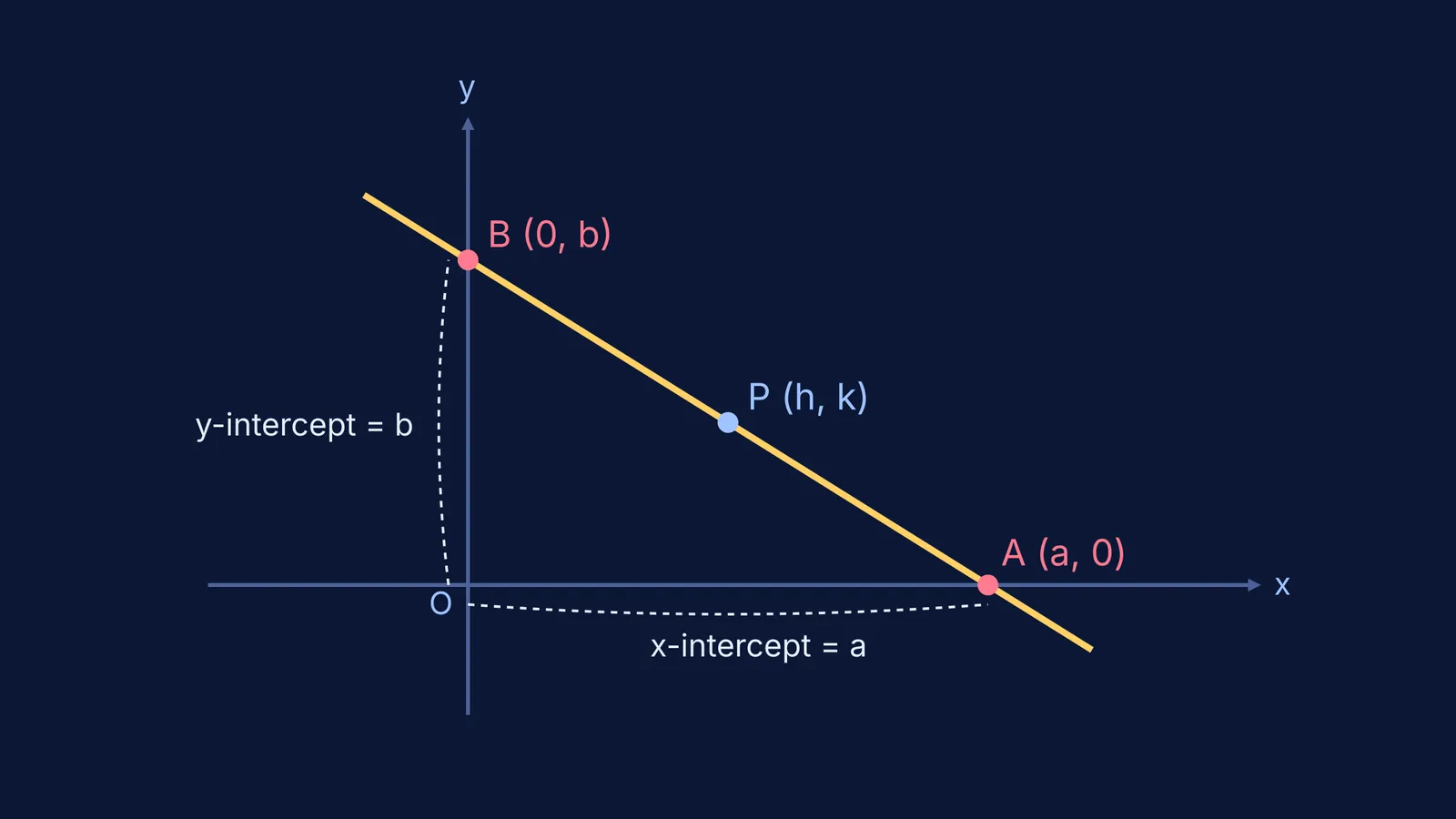
If a straight line cuts the x-axis at a distance a from the origin and the y-axis at a distance b from the origin, its equation is:
x/a + y/b = 1
In this formula, a is the x-intercept and b is the y-intercept. This means the line passes through the points (a, 0) and (0, b).
If you are missing the basics of how coordinates map to equations, the Fermi Concept Library has every concept in mathematics and physics, each with its own lesson and its place in the map. (For a broader look at line equations, see our guide to straight lines in coordinate geometry).
How do you solve sum of intercepts problems?
A typical exam question gives you a point that the line passes through and a condition linking its two intercepts.
The problem: Find the equation of the line that passes through the point (2, 2) and cuts off intercepts on the coordinate axes whose sum is 9.
The solution:
Let the x-intercept be a and the y-intercept be b. The equation is x/a + y/b = 1.
The problem states that the sum of the intercepts is 9. Therefore, a + b = 9, which means b = 9 − a.
Substitute this into the equation:
x/a + y/(9 − a) = 1
The line passes through the point (2, 2). Substitute x = 2 and y = 2:
2/a + 2/(9 − a) = 1
Solve for a by finding a common denominator:
[2(9 − a) + 2a] / [a(9 − a)] = 1 (18 − 2a + 2a) / (9a − a²) = 1 18 / (9a − a²) = 1 18 = 9a − a²
Rearrange this into a standard quadratic equation:
a² − 9a + 18 = 0
Factorise the quadratic:
(a − 6)(a − 3) = 0 So, a = 6 or a = 3.
Now, find the corresponding y-intercepts:
If a = 6, then b = 9 − 6 = 3. The equation is x/6 + y/3 = 1, which simplifies to x + 2y = 6.
If a = 3, then b = 9 − 3 = 6. The equation is x/3 + y/6 = 1, which simplifies to 2x + y = 6.
Both lines satisfy the conditions, so there are two possible answers.
What if the intercept segment is bisected at a point?
Another standard question asks for the equation of a line when the portion of it intercepted between the axes is bisected at a given point (h, k).
Let the line meet the x-axis at A(a, 0) and the y-axis at B(0, b). The segment intercepted between the axes is the line segment AB. If the point (h, k) bisects this segment, it is the midpoint of AB.
Using the midpoint formula: x-coordinate of midpoint = (a + 0) / 2 = h, so a = 2h. y-coordinate of midpoint = (0 + b) / 2 = k, so b = 2k.
Substitute a = 2h and b = 2k back into the intercept form (x/a + y/b = 1): x/(2h) + y/(2k) = 1
Multiply the entire equation by 2 to simplify: x/h + y/k = 2
This is a useful shortcut. If an exam question tells you the intercept segment is bisected at the point (3, 4), you do not need to work out the midpoint algebra from scratch. You can jump straight to x/3 + y/4 = 2.
What is a good checklist for intercept problems?
When you encounter locus problems in coordinate geometry or need to find a line from its intercepts, use this framework:
Draw a rough sketch: Mark the intercepts A(a, 0) and B(0, b) on the axes to picture the geometry.
Write the baseline equation: Always start with x/a + y/b = 1.
Translate the words: Turn the English constraints (like "sum is 9" or "bisected at P") into algebraic equations involving a and b.
Substitute the point: If the line passes through a specific point, plug its coordinates in for x and y.
Solve the system: You will usually be left with a linear or quadratic equation in terms of a single variable.
If you are practising these methods and get stuck setting up the algebra, the Fermi Problem Library has a step-by-step solver that explains the reasoning rather than printing an answer.


