

On this page
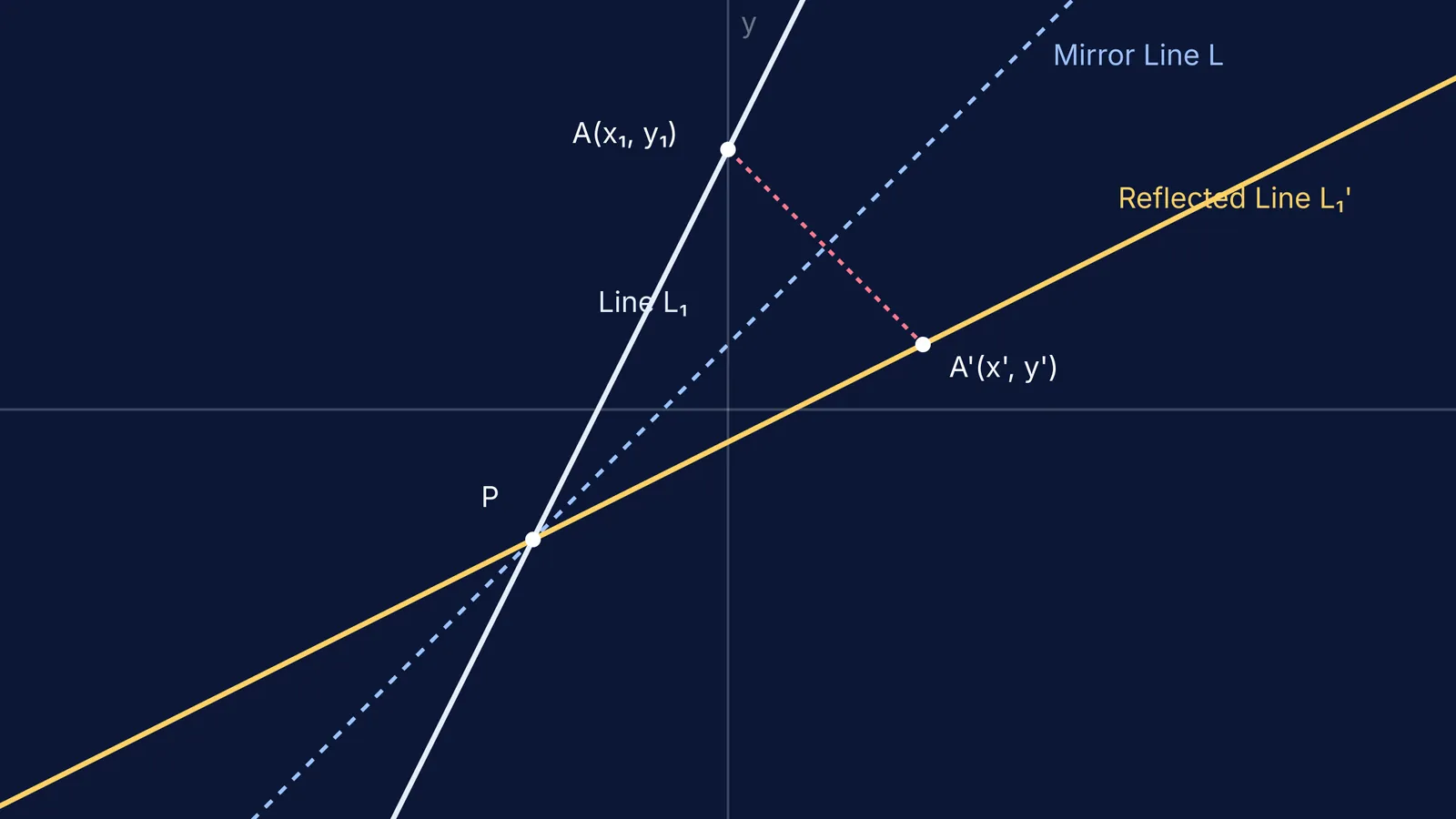
In mathematics, a reflection is a mapping from a space to itself that acts as an isometry, keeping the points on the mirror line fixed (Wikipedia)). Reflecting one straight line across another straight line produces a third straight line. The mirror line acts as the angle bisector between the original line and its reflection.
If the lines are parallel, the reflected line is also parallel. But when the lines intersect, the intersection point lies on the mirror itself, meaning the point is its own reflection. The geometry requires careful steps, similar to calculating how many normals can be drawn to a parabola from a point.
How to find the reflection of a line in another line?
The most reliable way to find the equation of a reflected line relies on finding two points:
Find the intersection point: Solve the equations of the original line and the mirror line simultaneously. Let us call this point P.
Pick a second point: Choose any easy point on the original line, let us call it A(x₁, y₁).
Find the image of the second point: Calculate the reflection A'(x', y') of point A across the mirror line ax + by + c = 0 using the formula:
(x' - x₁) / a = (y' - y₁) / b = -2(ax₁ + by₁ + c) / (a² + b²)
Write the equation: The reflected line is the line passing through the intersection point P and the image point A'.
A worked example of line reflection
Let us put this method into practice. Suppose we want to find the reflection of the line 2x - y + 4 = 0 in the mirror line x - y + 1 = 0.
Step 1: Find the intersection Solving 2x - y + 4 = 0 and x - y + 1 = 0 gives x = -3 and y = -2. The intersection point P is (-3, -2).
Step 2: Pick a point on the original line Let us set x = 0 in the original line 2x - y + 4 = 0. This gives y = 4. Our point A is (0, 4).
Step 3: Find its image in the mirror The mirror line is x - y + 1 = 0, so a = 1, b = -1, and c = 1. Using the point image formula for A(0, 4): (x' - 0) / 1 = (y' - 4) / -1 = -2(1(0) - 1(4) + 1) / (1² + (-1)²)
x' / 1 = (y' - 4) / -1 = -2(-3) / 2 = 3
This gives x' = 3 and y' = 1. The image point A' is (3, 1).
Step 4: Equation of the reflected line The reflected line passes through P(-3, -2) and A'(3, 1). The slope is (1 - (-2)) / (3 - (-3)) = 3 / 6 = 1/2.
The equation is y - 1 = 1/2 (x - 3), which simplifies to x - 2y - 1 = 0.
If you get tangled in calculations during exam prep, the Fermi Problem Library has worked problems with a step-by-step solver that explains the reasoning rather than printing an answer.
Why does the image point formula work?
The formula for the image of point A(x₁, y₁) across the mirror line ax + by + c = 0 relies on two geometric facts:
The line segment AA' is perpendicular to the mirror line.
The midpoint of AA' lies exactly on the mirror line.
Because AA' is perpendicular to the mirror line, the product of their slopes must be -1. Setting up equations for the slope and midpoint gives the exact coordinates of the image point A'. Memorising this formula saves crucial minutes during a timed exam.
Can you use the angle bisector method?
There is a second way to solve these problems without finding the image of a point. Because the mirror exactly bisects the angle between the lines, you can use the angle bisector formula. However, intersecting lines have two bisectors, so you must carefully choose the correct one.
If the original line is L₁ = 0 and the mirror is L = 0, the reflected line belongs to the family of lines L₁ + λL = 0. You can find the constant λ because L = 0 is their angle bisector. For deeper explorations of the family of lines, the Fermi Concept Library contains every concept in physics, chemistry, biology, mathematics and computing, each with its own lesson and its place in the map.
In exams like JEE Main, the point image method is often faster and less prone to sign errors. Whichever method you choose, it is a good idea to sketch the graph before you plot it to ensure your result makes visual sense.


