On this page
Hang upside down, take a sip of water, and you can still swallow it, even though your stomach is now above your mouth. Food doesn't fall down the oesophagus. A wave of muscle squeezes it along, and that works whichever way up you are.
What is peristalsis?
In NASA's words, peristalsis consists of wave-like muscle contractions that move food through the digestive tract.
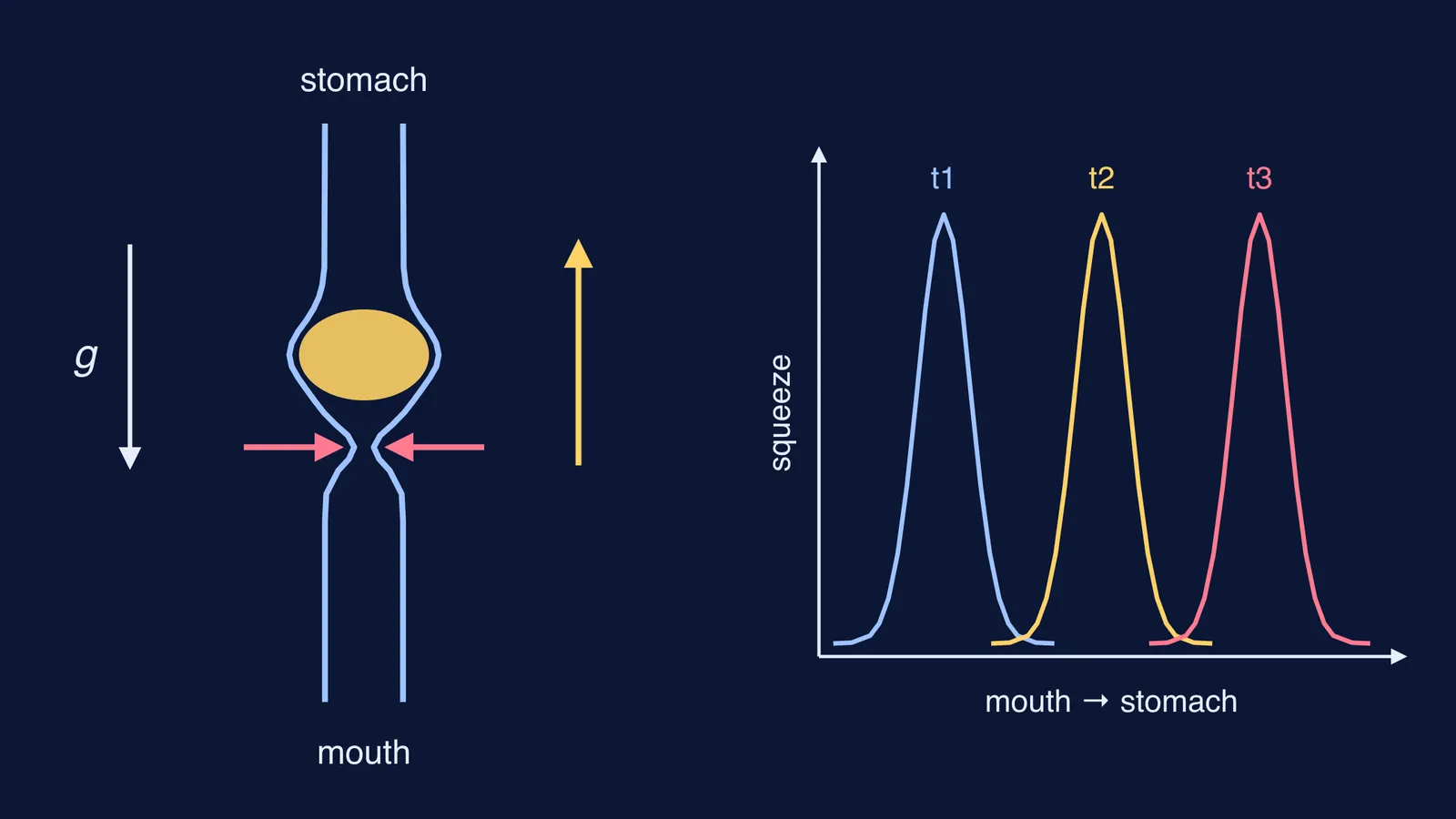
In the oesophagus, the ring of muscle just behind the swallowed lump of food (the bolus) tightens while the muscle just ahead relaxes. The tight ring travels towards the stomach, pushing the bolus ahead of it, like squeezing toothpaste along a tube.
A few numbers from the open textbook OpenStax Anatomy and Physiology:
The oesophagus is about 25 cm (10 inches) long.
Its muscle changes along its length: skeletal muscle in the upper third, a mix of skeletal and smooth muscle in the middle third, and smooth muscle in the lower third.
A whole swallow, from mouth to stomach, takes about 4 to 8 seconds for solid food and about 1 second for very soft food and liquids.
A review by Raj Goyal and Arun Chaudhury of Harvard Medical School, Physiology of normal esophageal motility, describes the order of events: primary peristalsis is inhibition followed by excitation. In plain words, the muscle relaxes first to make room, then contracts. The lower oesophageal sphincter, the valve into the stomach, stays shut through the muscle's own tone and opens when nerves relax it. More in our explainer on the sphincters of the digestive tract.
Can food go down when you're upside down?
Yes, and researchers have tested swallowing upside down. In a study published in 2017 in the journal Dysphagia, Sarah Rosen and colleagues put 10 healthy adults on an inversion table at six angles, from upright (0°) to fully upside down (180°). At each angle, every participant swallowed a 5 mL sip of water three times while a thin pressure probe recorded the throat and the top of the oesophagus. The paper reports that all participants completed the tasks without complication.
The valve at the top of the oesophagus kept opening and closing properly when the participants were inverted. Pressure behind the soft palate, which seals off the nose, was higher when they were lying flat or inverted than when they were upright or tilted at 45°. The authors concluded that the brainstem's swallowing reflex may adjust for body position so the swallow still gets done. The probe did not reach the lower oesophagus, so the study measured the start of the swallow, not the food's arrival in the stomach.
For the airway side of a swallow, see how the epiglottis stops food entering the windpipe.
Does gravity help at all?
A little, when you are upright. A 2013 study of 21 healthy volunteers in the Journal of Neurogastroenterology and Motility compared swallows sitting up and lying down. The authors note that when a person is lying down, moving the bolus depends entirely on the oesophagus. Without the help of gravity, they saw more failed swallows and very weak waves in that position, and the bolus moved faster when upright. On average, though, the squeeze itself was stronger lying down.
An older study by Kaye and Wexler (1981) also found that contractions along the oesophagus were stronger lying down than upright, and that how long each wave lasted changed little with position. Gravity is a helper, not the engine.
How do astronauts swallow in space?
The same way. On 20 February 1962, during the first American orbital flight, John Glenn ate a tube of apple sauce and took a pill for a digestion experiment. NASA notes that in microgravity the body relies completely on peristalsis, and that food can move more slowly along the gut without gravity's help.
How to write this answer in an exam
For a 3-mark "Why can we swallow while lying down or upside down?" question, hit these four points in order:
Name the process: food moves through the oesophagus by peristalsis.
Define it: wave-like contractions of the muscle in the oesophagus wall.
Give the mechanism: muscle behind the bolus contracts while muscle ahead relaxes, so the bolus is pushed towards the stomach.
Link to the question: the push comes from muscle, not gravity, so it works in any position, even in space.
Common mistakes to avoid:
Saying the food "slides down". It is pushed.
Forgetting the relaxation ahead of the bolus. A full answer mentions both halves of the wave.
Calling the oesophagus wall all smooth muscle. The upper part also has skeletal (striated) muscle. Our guide to striated, smooth and cardiac muscle sets out the differences.
For related ideas such as sphincters, the Fermi Concept Library has a lesson for each concept in biology and shows where it sits in the map. When you get an "explain why" question wrong, the Fermi Problem Library works through problems step by step and explains the reasoning, rather than just printing an answer.