

On this page
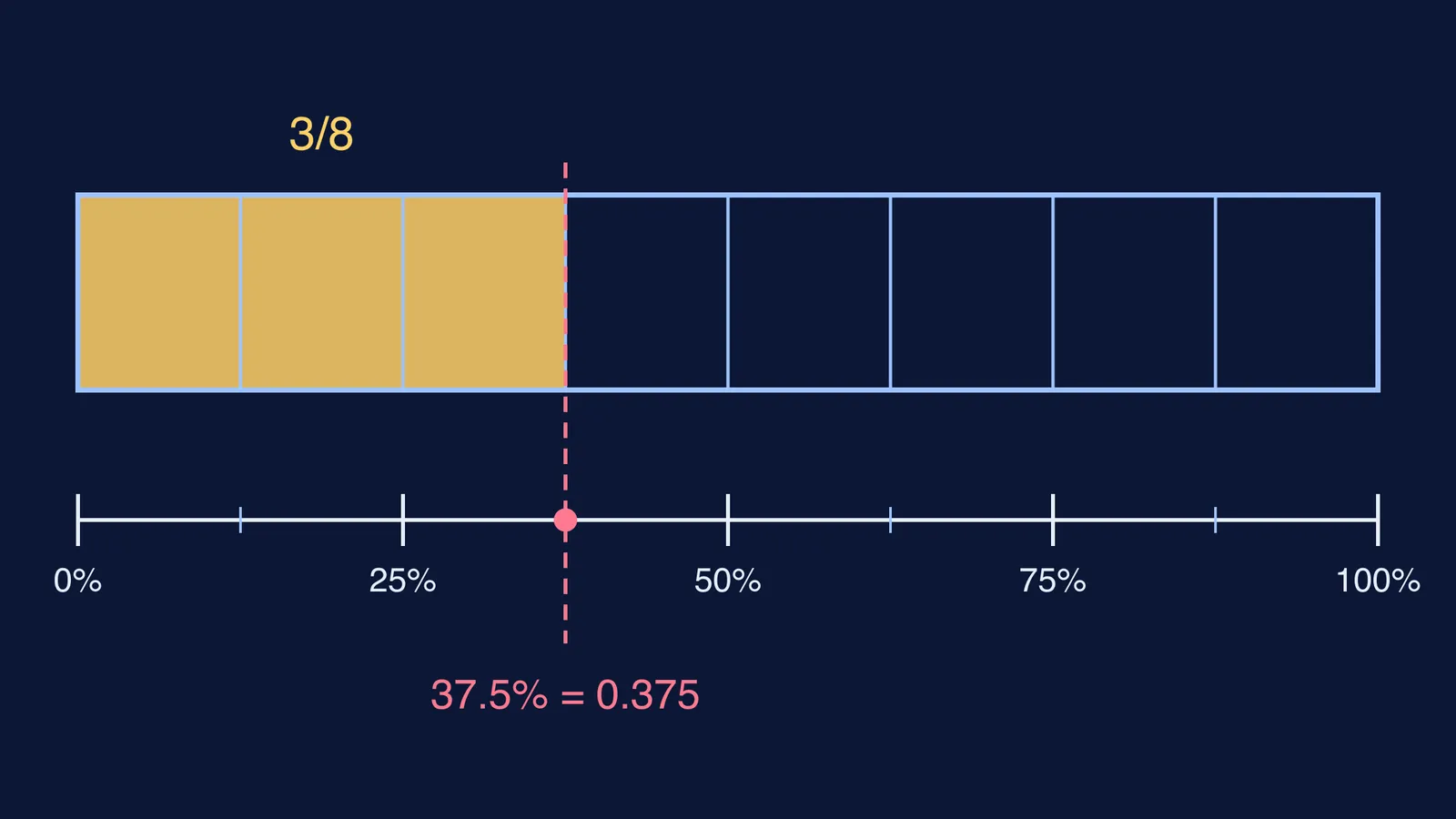
A percentage, a fraction and a decimal are three ways of writing the same amount. 37.5%, 3/8 and 0.375 all mean three parts out of eight. Once you can move between them without a calculator, discount questions and data-handling sums get quicker.
How do you convert a percentage to a fraction and a decimal?
Percent means "per hundred", so any percentage is a fraction with 100 underneath: 37.5% = 37.5/100.
NCERT's Grade 7 textbook Ganita Prakash, Part II, Chapter 4 describes decimals as the natural extension of the Indian place value system for fractions with denominators 10, 100, 1000 and so on. The same chapter gives the rule for dividing by 100: move the decimal point left by as many places as there are zeroes, so 24 ÷ 100 = 0.24.
That gives a two-step method:
Percentage to decimal: divide by 100, which means moving the point two places left. 37.5% becomes 0.375.
Decimal to fraction: write the digits over 10, 100 or 1000 (one zero per decimal place), then simplify. 0.375 = 375/1000.
To simplify 375/1000, divide top and bottom by 125 (their highest common factor): 375 ÷ 125 = 3 and 1000 ÷ 125 = 8. So 37.5% = 0.375 = 3/8. Dividing by 5 three times gets you there too.
Why does 3/8 come out as exactly 0.375?
Keep halving. 1/2 = 0.5, half of that is 1/4 = 0.25, and half again is 1/8 = 0.125. Three eighths is 3 × 0.125 = 0.375, which is 37.5%.
Each eighth adds 12.5%, so the odd eighths step up by 25%: 1/8 = 12.5%, 3/8 = 37.5%, 5/8 = 62.5% and 7/8 = 87.5%. If multiplying decimals still feels shaky, our guide on why the decimal places add up when you multiply decimals shows where 3 × 0.125 comes from.
Fractions in simplest form whose denominators use only 2s and 5s, such as 8, 20, 25 and 40, end neatly as decimals. Others, such as 3, 6, 7 and 9, give decimals that repeat forever. That is why 1/3 is written as 33⅓% rather than a tidy decimal.
Which fraction-percent pairs are worth memorising?
Each comes from dividing the top by the bottom and multiplying by 100. Knowing them saves time in tests.
Halves and quarters: 1/2 = 50%, 1/4 = 25%, 3/4 = 75%
Fifths: 1/5 = 20%, 2/5 = 40%, 3/5 = 60%, 4/5 = 80%
Eighths: 1/8 = 12.5%, 3/8 = 37.5%, 5/8 = 62.5%, 7/8 = 87.5%
Tenths and twentieths: 1/10 = 10%, 1/20 = 5%
Small ones: 1/25 = 4%, 1/40 = 2.5%, 1/16 = 6.25%
Thirds and sixths: 1/3 = 33⅓%, 2/3 = 66⅔%, 1/6 = 16⅔%, 5/6 = 83⅓%
The awkward ones: 1/9 = 11.11...%, 1/11 = 9.09...%, 1/12 = 8⅓%
Knowing 1/9 ≈ 11.1% also helps you spot a trap. In buying 10 items for ₹9 and selling 9 for ₹10, 11.1% is the tempting wrong answer; the profit is 19/81, about 23.46%.
Why is it worth getting fluent with fractions now?
A 2012 study in Psychological Science by Robert Siegler and colleagues analysed large, nationally representative data sets from the United States and the United Kingdom (Siegler et al., 2012). It found that elementary school students' knowledge of fractions and of division predicted their algebra knowledge and overall mathematics achievement in high school, 5 or 6 years later. That link held even after controlling for other maths knowledge, general intellectual ability, working memory, and family income and education.
It does not show that drilling percentages raises marks, but it does suggest fractions are a foundation, not a topic you finish and forget.
How can you get faster in 10 minutes a day?
Try this plan for two weeks.
Minutes 1-3: write one family from the list above from memory, such as the eighths, then check it.
Minutes 4-7: convert five fresh percentages both ways, such as 62.5%, 4%, 0.5%, 120% and 16⅔%. Write the decimal and the simplified fraction for each.
Minutes 8-10: for each mistake, say aloud which step went wrong.
Watch for three common slips:
Moving the point only once: 37.5% is 0.375, not 3.75.
Mixing up 0.5% and 50%: 0.5% = 0.005 = 1/200, while 50% = 1/2.
Reading digits as a percentage: 3/8 is not 38%. Divide first.
Percentages above 100 give mixed numbers: 125% = 1.25 = 5/4 = 1¼. See our guide to mixed and improper fractions.
If the idea of a decimal as a fraction of 10, 100 or 1000 still feels unclear, the Fermi Concept Library has a lesson for every concept in mathematics, each with its place in the map. If you keep getting conversions wrong in word problems, the Fermi Problem Library has worked problems with a step-by-step solver that explains the reasoning rather than printing an answer.
Start with the eighths today: 12.5, 37.5, 62.5, 87.5.


