

On this page
Here is a classic exam question: a man buys 10 toffees for ₹9 and sells 9 toffees for ₹10. Find his profit per cent. A tempting first answer compares ₹9 with ₹10 and gives 11.1%. That answer is wrong, and the reason it is wrong is the whole lesson.
The two prices are for different numbers of articles. ₹9 buys 10 toffees, but ₹10 sells only 9. Both the money and the count change, so you cannot compare the two prices until they cover the same number of toffees.
Why can't you just compare ₹9 and ₹10?
NCERT's Class 8 Mathematics Exemplar, Unit 9: Comparing Quantities has a solved example on lemons bought at ₹60 a dozen and sold at ₹40 per 10. Its plan is the one you need here: "either convert C.P. of 1 dozen into C.P. of 10 lemons or convert S.P. of 10 lemons into S.P. of 1 dozen".
The same page states the rule that sets the denominator: "Gain/Loss are always calculated on the basis of C.P." So profit per cent is profit divided by cost price, times 100, worked out for the same number of articles.
How do you find the profit percent using the same number of articles?
Here is the toffee question, step by step.
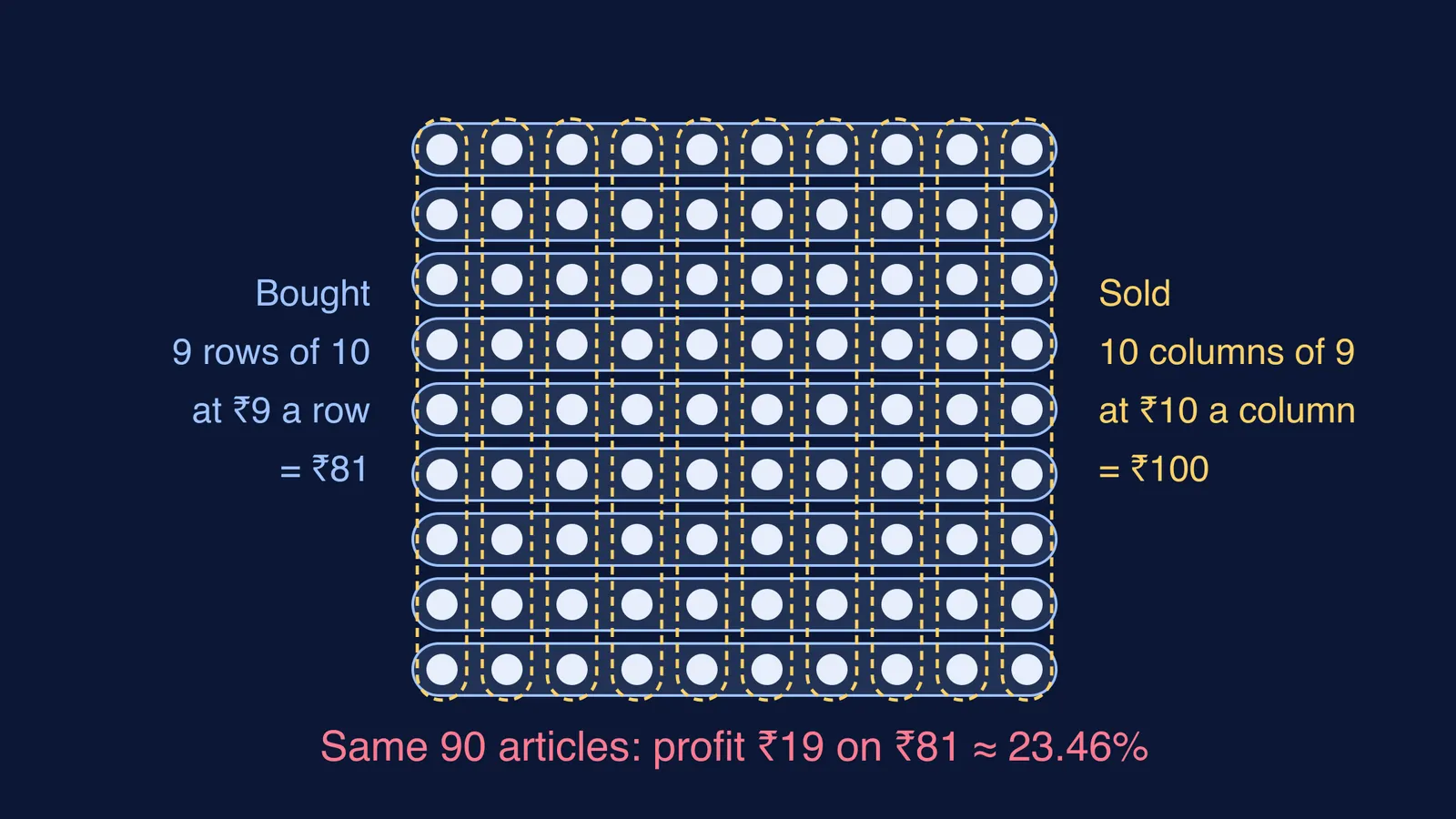
Choose a number of articles that both deals divide into evenly. The LCM of 10 and 9 is 90.
Cost of 90 toffees: 90 ÷ 10 = 9 lots, and 9 × ₹9 = ₹81.
Selling price of 90 toffees: 90 ÷ 9 = 10 lots, and 10 × ₹10 = ₹100.
Profit = ₹100 − ₹81 = ₹19.
Profit per cent = 19 ÷ 81 × 100 = 23 37/81%, which is about 23.46%.
Can you work it out per article instead?
Yes, and you get the same answer if you keep fractions. One toffee costs ₹9/10 and sells for ₹10/9. The profit on one toffee is 10/9 − 9/10 = 19/90 rupees. Divide by the cost of one toffee: (19/90) ÷ (9/10) = 19/81, which is 23.46% again.
Rounding the selling price to ₹1.11 gives ₹0.21 on ₹0.90, or 23.33%, which may match no option. Keep fractions until the last line.
Is there a one-line formula?
There is, and it is just the equal-count trick written in letters. Say you buy a articles for ₹x and sell b articles for ₹y. Take a × b articles. They cost b × x and sell for a × y. So:
Profit per cent = (a × y − b × x) ÷ (b × x) × 100
For the toffees, a = 10, x = 9, b = 9 and y = 10: (100 − 81) ÷ 81 × 100 ≈ 23.46%. If the answer comes out negative, it is a loss.
Check the formula against NCERT's lemons (a = 12, x = 60, b = 10, y = 40): (480 − 600) ÷ 600 × 100 = −20%. That is the 20% loss the Exemplar's worked solution reaches.
What if the cost price of A equals the selling price of B?
This is the same idea in disguise. The NCERT Exemplar asks what happens if the cost price of 10 shirts equals the selling price of 8, and its answer is a profit of 25%. Selling 8 shirts brings in what 10 shirts cost. Those 8 shirts cost 8 shirts' worth, so the profit is 2 shirts' worth on that cost: 2 ÷ 8 × 100 = 25%.
Its pens example runs the other way: selling 50 pens loses the selling price of 10 pens. So 50 pens cost what 60 pens sell for, and the loss is 10 ÷ 60 × 100 = 50/3%, NCERT's answer.
A 30-second check before you mark the answer
Do both prices now refer to the same number of articles?
Did you divide by the cost price, not the selling price?
Is the sign right? Selling price above cost price means profit.
Does the size make sense? Each toffee sells for about ₹1.11 and costs ₹0.90, so you gain about ₹0.21 on ₹0.90, a little under a quarter of the cost. 23% fits; 11% does not.
Did you keep fractions until the last step?
Unsure which price goes in the denominator? Read profit percentage on cost price versus selling price. Related traps: why equal profit and loss at the same selling price is always a loss and marked price, discount and profit word problems.
If you keep landing on the wrong answer and cannot see where the method breaks, the Fermi Problem Library has worked problems with a step-by-step solver that explains the reasoning rather than printing an answer. If percentages themselves feel shaky, the Fermi Concept Library covers every concept in mathematics, each with its own lesson.


