

On this page
A common trap in quantitative aptitude exams involves a trader selling two items for the exact same price. One is sold at a 10% profit, and the other is sold at a 10% loss according to GeeksforGeeks. When first encountering this scenario under the time pressure of a competitive exam, the intuitive guess is that the net result is zero—that the profit exactly balances out the loss, resulting in no profit and no loss.
In reality, the transaction always ends in an overall financial loss for the trader. This counterintuitive result is a staple of placement tests, banking exams and management entrance tests precisely because it tests your conceptual understanding of percentages rather than just your calculation speed.
If you often fall for traps in percentage word problems, Fermi's AI tutor works out what you already know and builds a plan for the session, so you can trace back to where your confusion starts.
Here is why identical profit and loss percentages on the same selling price guarantee a loss, and the shortcut to calculate it quickly.
What is the shortcut formula?
When two items are sold at the same selling price, with one yielding a gain of x% and the other a loss of x%, the seller always incurs an overall loss. The magnitude of this loss depends only on the percentage itself. It is given by the direct formula x²/100%.
For example, if the common profit and loss percentage is 10%, the net loss is 10² / 100, which equals 1%.
If a trader sells two watches at a 20% profit and a 20% loss, the net loss is 20² / 100, which equals 4%.
This formula saves you from doing long, multi-step calculations during an exam. However, if you only memorise it without understanding the underlying logic, you might misapply it when exam conditions change even slightly. Read more about this in Why memorising physics formulas fails, and what to do instead.
Why does a 10% profit and 10% loss mean an overall loss?
To see why the shortcut works, remember that profit and loss percentages are calculated on the cost price, not the final selling price.
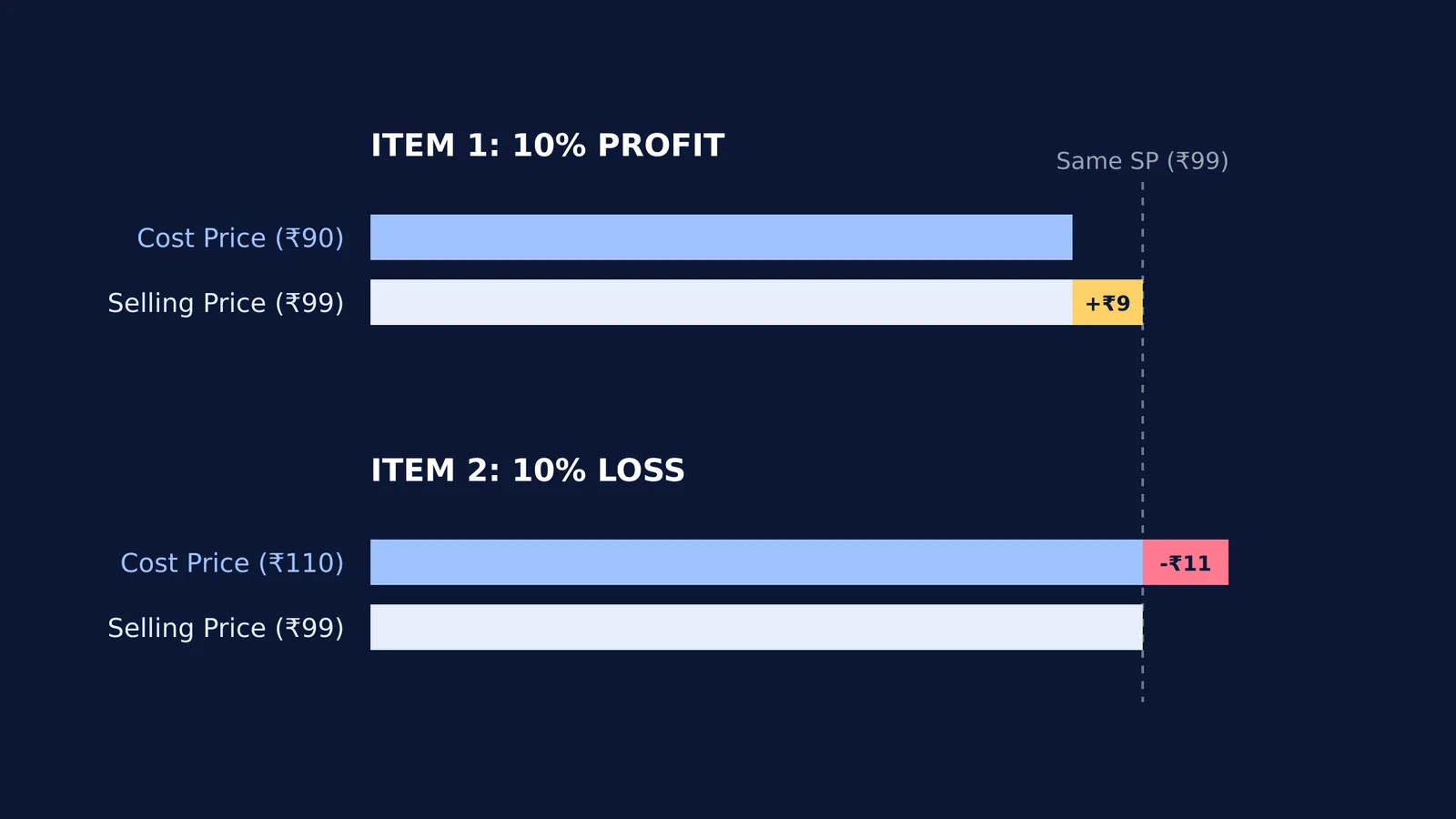
Let's assume the final selling price for both items is ₹99.
The item sold at a 10% profit: To sell for ₹99 with a 10% markup, the cost price must have been ₹90. The 10% profit on ₹90 is ₹9.
The item sold at a 10% loss: To sell for ₹99 after a 10% markdown, the cost price must have been higher: ₹110. The 10% loss on ₹110 is ₹11.
Comparing the absolute values reveals the core of the problem. The absolute loss amount (₹11) is strictly greater than the absolute profit amount (₹9).
Because the x% loss is calculated on a larger base (the higher starting cost price) and the x% profit is calculated on a smaller base (the lower starting cost price), the absolute value of the loss always overshadows the absolute value of the profit.
In our example, the total cost price of the two items is ₹200 (₹90 + ₹110). The total revenue from selling both items is ₹198 (₹99 + ₹99). The overall net loss is therefore ₹2, which is exactly 1% of the total ₹200 cost price.
If you struggle to hold the steps of a derivation in your head, the Fermi Problem Library has worked problems with a step-by-step solver that explains the reasoning rather than printing an answer.
What happens with the same cost price?
The confusion surrounding this topic usually arises because students mix up two different exam questions that sound similar but are mathematically entirely different.
If you buy two items at the same cost price (say, ₹100 each) and sell one at a 10% profit (₹110) and the other at a 10% loss (₹90), your total revenue is ₹200. Since your total cost price was also ₹200, the profit and loss exactly cancel each other out.
In this specific case, there is genuinely no overall profit or loss.
The x²/100 rule only applies when the selling price is identical. To train yourself to spot which condition a question is asking for, try mixing up your problem sets instead of doing twenty identical problems in a row. You can find a schedule for this in Interleaved practice: why mixing problem types works, with a plan.
How do you derive the loss formula?
Here is how to prove the shortcut algebraically for any percentage x, as demonstrated in quantitative aptitude resources.
Let the selling price of each item be S.
The cost price of the first item (sold at x% profit) is S / (1 + x/100).
The cost price of the second item (sold at x% loss) is S / (1 - x/100).
The total selling price for the transaction is simply 2S.
To find the total cost price, add the two individual cost expressions together: Total Cost Price = S / (1 + x/100) + S / (1 - x/100)
By finding a common denominator, this simplifies to: Total Cost Price = 2S / (1 - (x/100)²)
Since the term (x/100)² is always positive, the denominator (1 - (x/100)²) is always less than 1. Dividing 2S by a number smaller than 1 means the total cost price is strictly greater than the total selling price 2S.
Therefore, the transaction is always a financial loss.
To find the actual percentage, you subtract 2S from the total cost price to get the absolute loss, and then divide by the total cost price. The 2S and the denominator cancel out neatly during the division, leaving exactly (x/100)², proving the overall loss percentage is always x²/100%.


