

On this page
If you open a Class 8 mathematics textbook and an accounting handbook, you will find two different definitions for the same words. When an exam question says an item was sold at a twenty per cent profit, it means something entirely different from what a business manager means by a twenty per cent profit margin.
The difference comes down to the base number used for the calculation: the cost price or the selling price. Confusing the two is a classic trap in both school examinations and retail pricing.
Why is the mathematics convention profit on cost price?
In the school curriculum, profit percentage is always calculated on the cost price (CP) unless the problem explicitly states otherwise. The National Council of Educational Research and Training (NCERT) textbook for Class 8 establishes this rule clearly, defining profit percentage as the profit divided by the cost price, multiplied by 100.
In this system, the cost price is your baseline (100%). If you buy a bag for ₹500 and sell it for ₹600, your profit is ₹100.
Because the base is the cost price, the calculation is 100 / 500, giving a profit of 20%.
If a student gets stuck on word problems where the base is not explicitly stated, the Fermi Problem Library has worked problems with a step-by-step solver that explains the reasoning for the first step.
What is the business convention for profit margin on sales?
Outside the classroom, finance teams and investors use a different metric to measure efficiency: the profit margin (or gross margin). According to the Corporate Finance Institute, profit margin is the percentage of the selling price (SP) that is profit.
Using the same bag from the previous example: you made ₹100 profit on a selling price of ₹600. Your profit margin is 100 / 600, or 16.67%.
Why do businesses do this? A company wants to know how much of every rupee of *revenue* it gets to keep after covering the cost of the goods. If the margin is 16.67%, it means 16.67 paise of every sales rupee is profit, and the rest goes to paying the supplier.
In business terminology, the mathematics textbook's "profit percentage" is called markup. It tells the sales team how much to add to the cost to reach the final price.
If you want to review how these terms fit into broader financial math, our guide to percentages, discounts and interest in Class 8 covers the fundamentals, and we discuss how to translate these concepts in our article on helping your child with maths word problems.
What is the 50% markup trap?
The most common real-world mistake happens when someone conflates the two bases, as highlighted by business accounting guides.
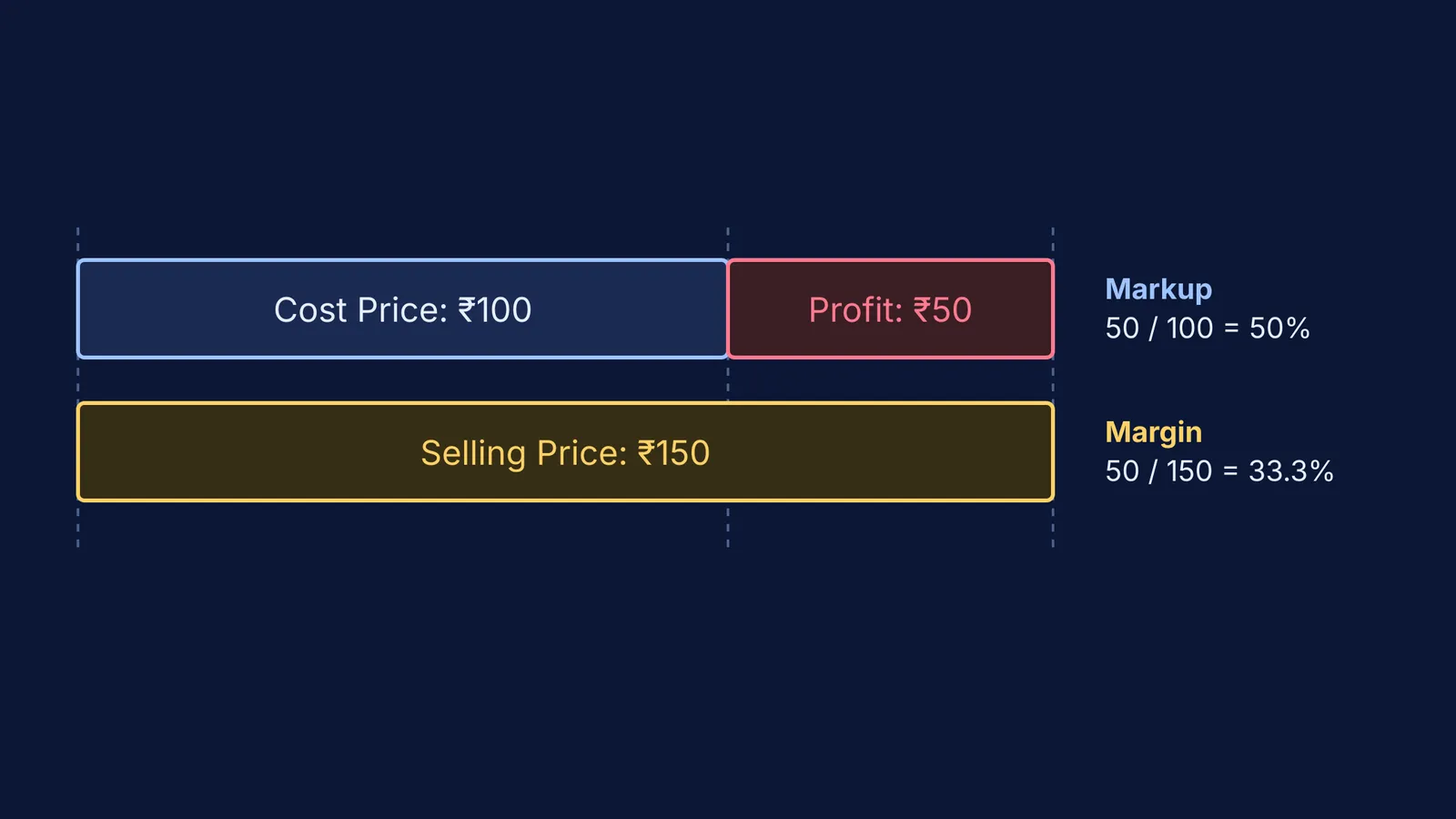
Imagine you run a shop and want a 50% profit margin. You buy a product for ₹1,000. You apply a 50% markup, adding ₹500 to the cost, and set the selling price at ₹1,500.
Have you achieved a 50% margin? No.
Your profit is ₹500, but your selling price is ₹1,500. Your profit margin is 500 / 1,500, which is only 33.3%. By confusing markup with margin, you have underpriced the item. To actually achieve a 50% margin, you would need to sell the item for ₹2,000 (a profit of ₹1,000, which is a 100% markup).
How do you convert between margin and markup?
If you know one percentage and need to find the other, you can use standard conversion formulas (where the percentages are written as decimals, such as 0.20 for 20%), as taught in introductory finance:
Margin to Markup: Markup = Margin / (1 - Margin)
Markup to Margin: Margin = Markup / (1 + Markup)
If a shopkeeper wants a 20% profit margin on sales, what markup (profit percentage on cost) should they apply?
Margin = 0.20
Markup = 0.20 / (1 - 0.20)
Markup = 0.20 / 0.80 = 0.25
The shopkeeper must apply a 25% markup to the cost price to achieve a 20% margin on the selling price. The Fermi Concept Library covers every concept in mathematics with its own lesson, allowing you to explore the algebra behind these formulas.


