

On this page
Cost Price (CP), Selling Price (SP), and Marked Price (MP) are the three pillars of commerce maths problems. The rules are strict about which base to use:
Profit or loss is always calculated as a percentage of the Cost Price (the money the shopkeeper spent).
Discount is always calculated as a percentage of the Marked Price (the price tag shown to the customer).
This distinction, outlined in Chapter 7 of the Class 8 NCERT Mathematics textbook, is where most mistakes happen. A 10% discount and a 10% profit do not cancel each other out, because they are 10% of different numbers. If a shopkeeper buys a shirt for 100, marks it up to 110, and then gives a 10% discount on the 110, the final selling price is 99, resulting in a loss of 1.
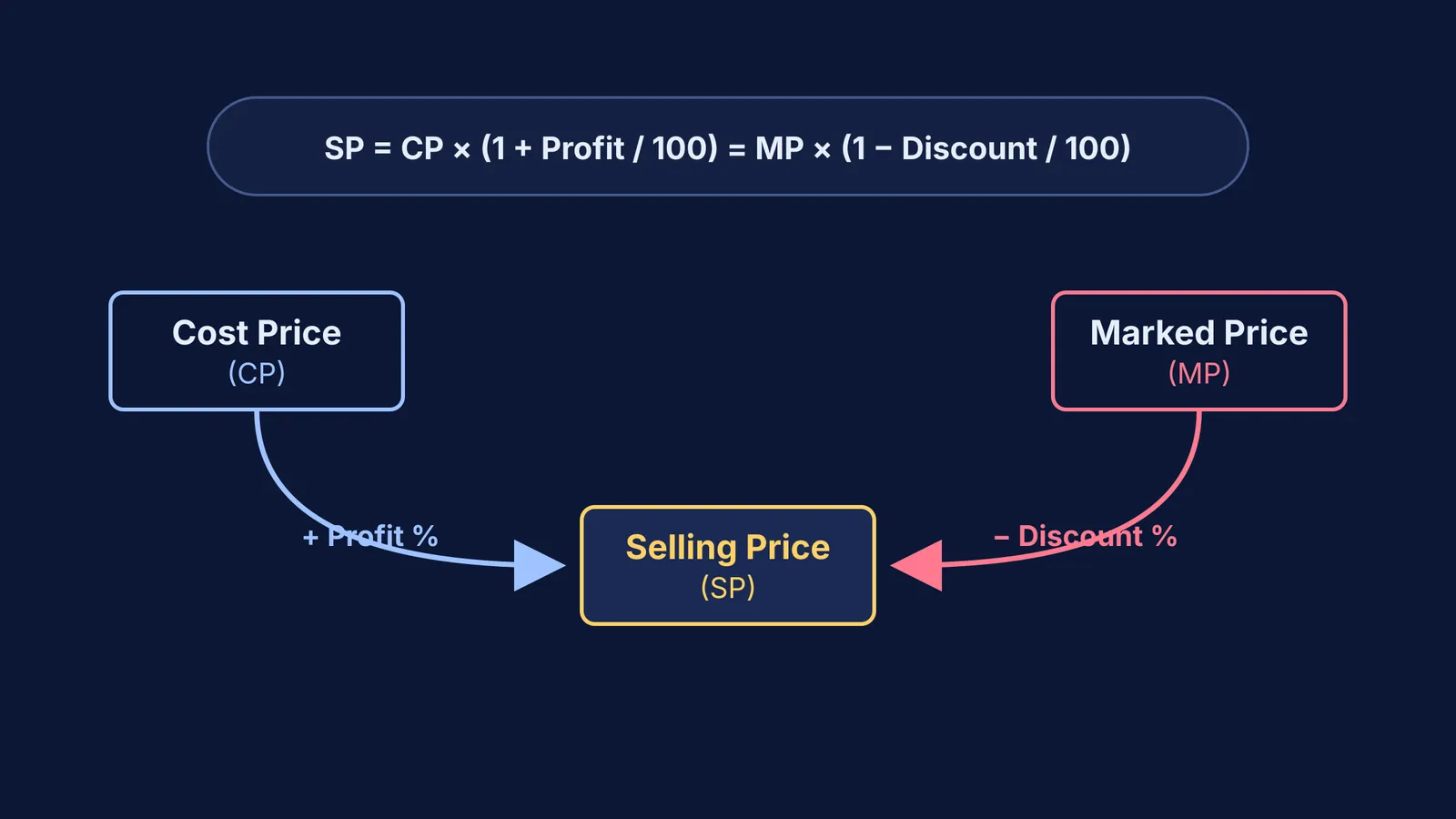
The golden equation linking all four
The Selling Price (SP) is the bridge between the buyer's view (discount) and the seller's view (profit). Because the final amount of money changing hands is the same, we can write SP in two ways and set them equal:
SP = CP × (1 + Profit/100) SP = MP × (1 − Discount/100)
So: CP × (1 + Profit/100) = MP × (1 − Discount/100)
If a problem gives you three of these percentages or values, this single equation will find the fourth.
How do you find the markup over cost price?
A classic exam question from the NCERT syllabus asks: "A shopkeeper wants to offer a 10% discount on the marked price and still make a 20% profit. How much above the cost price should the goods be marked?"
When no actual money value is given, assume the Cost Price is 100.
Find the Selling Price: A 20% profit on a CP of 100 means the SP must be 120.
Set up the discount equation: The SP is also the Marked Price after a 10% discount. So, 90% of the MP equals 120.
Solve for MP: MP × (90/100) = 120, which gives MP = 120 × (100/90) = 133.33.
The shopkeeper must mark the goods at 33.33% above the cost price.
If you are stuck on setting up the equation, Fermi's AI tutor works out what you already know and builds a plan for the session, guiding you to construct the algebraic steps yourself instead of just showing you the answer.
Working with actual values
Let's apply the rule to a real-world scenario where overheads are involved, as taught in the NCERT curriculum. If a dealer buys a bicycle for ₹5,000, spends ₹500 on repairs, and wants to make a ₹550 profit after giving a 12% discount, what should the marked price be?
Find the true CP: Overhead expenses must be added to the buying price. The true CP is 5,000 + 500 = ₹5,500.
Find the SP: To make a profit of ₹550, the SP must be 5,500 + 550 = ₹6,050.
Find the MP: The SP of 6,050 is the price after a 12% discount. Therefore, 88% of the MP is 6,050.
MP = 6,050 × (100/88) = ₹6,875.
This step-by-step logic applies to any problem in this chapter. For more complex scenarios, the Fermi Problem Library has worked problems with a step-by-step solver that explains the reasoning rather than printing an answer.
How do you create a plan for word problems?
When faced with a long paragraph about shopkeepers, taxes, and faulty scales, it is easy to get lost. You can use a structured approach to break it down.
First, list the given values clearly under the headings CP, SP, MP, Profit, and Discount. If a value is missing, write it as a variable like *x*. This simple translation from English to algebra is half the battle. If you find translating word problems difficult, there are strategies for helping your child with maths word problems that involve asking guiding questions rather than rushing to the calculation.
Second, check for overheads. Any money spent on transport, repairs, or packaging before the item is sold must be added to the raw buying price to find the true Cost Price.
Finally, remember that sales tax or GST is added at the very end. The tax is calculated on the discounted Selling Price, not the Marked Price, as detailed in the NCERT syllabus.
How do successive discounts work?
Shops often advertise successive discounts, a concept in the NCERT textbook, such as "50% + 20% off". This does not mean a 70% discount. The first discount is applied to the Marked Price, and the second discount is applied to the new, reduced price.
If an item is marked at 100:
A 50% discount reduces it to 50.
A further 20% discount is calculated on the 50, reducing it by 10.
The final Selling Price is 40, meaning the single equivalent discount is 60%, not 70%.
Successive discounts are a common trap when comparing quantities in Class 8, and understanding them prevents mistakes in both exams and real-life shopping.


