

On this page
A number like 2⅔ hides a plus sign, and the classic mistake with mixed numbers comes from forgetting it. Here are the two conversion steps, a worked multiplication, and a quick exam check.
What is a mixed fraction, exactly?
NCERT's Class 6 textbook, Ganita Prakash, defines it plainly: "A mixed number or mixed fraction contains a whole number (called the whole part) and a fraction that is less than 1 (called the fractional part)." (NCERT Ganita Prakash, Grade 6, Chapter 7)
The same chapter writes 8/3 = 2 + 2/3 and then calls that number "two and two thirds", written 2⅔. So 2⅔ means 2 + ⅔. An improper fraction such as 8/3 has a numerator larger than its denominator; it is the same number written as one fraction.
How do you convert a mixed fraction to an improper fraction?
Use two steps:
Multiply the whole number by the denominator. For 2⅔: 2 × 3 = 6. Those are the thirds hiding inside the 2 wholes.
Add the numerator and keep the same denominator: 6 + 2 = 8, so 2⅔ = 8/3.
One more: 4½ becomes (4 × 2 + 1)/2 = 9/2. The denominator never changes, because you are still counting halves or thirds; only the total count changes.
How do you convert an improper fraction back to a mixed fraction?
Divide the numerator by the denominator.
The quotient is the whole part.
The remainder goes over the same denominator.
For 47/9 (one of NCERT's own practice items): 47 ÷ 9 = 5 remainder 2, so 47/9 = 5 2/9. Check by going forwards: 5 × 9 + 2 = 47. If the remainder is 0, the answer is a whole number; 12/4 is just 3.
Why can't you multiply the whole parts and fraction parts separately?
Take 2½ × 1⅓. The tempting shortcut is 2 × 1 = 2 and ½ × ⅓ = ⅙, giving 2⅙. It is wrong.
The right way is to convert first: 2½ = 5/2 and 1⅓ = 4/3, so 5/2 × 4/3 = 20/6 = 10/3 = 3⅓.
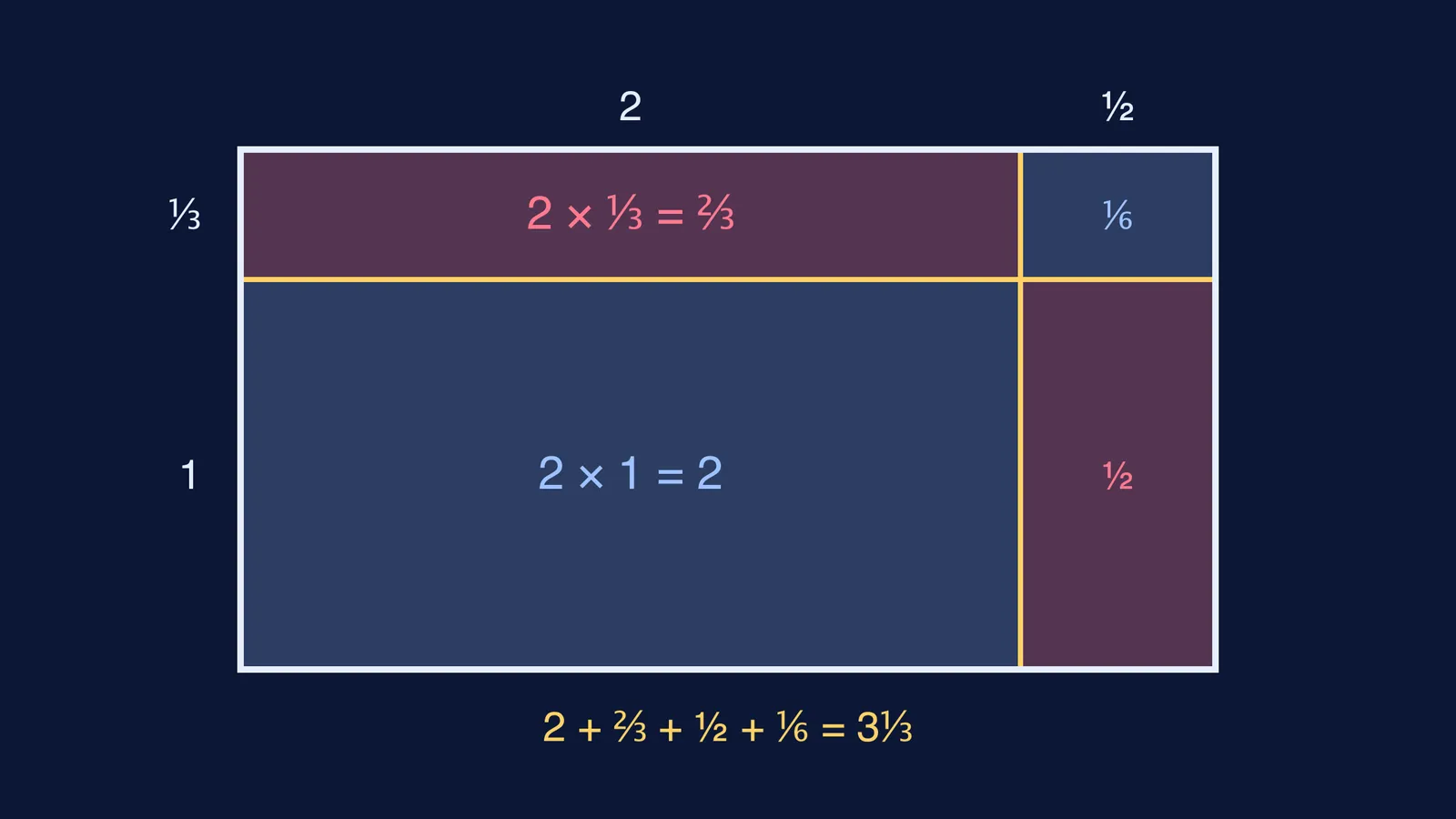
The shortcut is short by 1⅙. Because each mixed number is a sum, multiplying them is like multiplying two brackets, (2 + ½) × (1 + ⅓). That gives four products, not two:
2 × 1 = 2
2 × ⅓ = ⅔
½ × 1 = ½
½ × ⅓ = ⅙
Add them: 2 + ⅔ + ½ + ⅙ = 3⅓. The shortcut keeps only the first and last pieces and drops the two cross pieces, ⅔ and ½, which add up to exactly the missing 1⅙. Draw a 2½ by 1⅓ rectangle split at the whole-number lines and you can see all four pieces; our post on multiplying fractions with an area model builds that picture step by step.
Division follows the same rule: convert, then multiply by the reciprocal (see why we flip and multiply when dividing fractions). For regrouping when you subtract, see subtracting mixed numbers with borrowing.
Why does this small skill matter later?
Fractions are not a Class 6 topic you leave behind. A study of large, nationally representative long-term data sets from the US and UK found that elementary school students' knowledge of fractions and of division predicted their algebra knowledge and overall maths achievement in high school, 5 or 6 years later, even after controlling for other maths knowledge, general intellectual ability, working memory, and family income and education (Siegler and colleagues, Psychological Science, 2012).
The US Institute of Education Sciences fractions guide, whose panel was chaired by the same researcher, makes this a teaching recommendation: "Help students understand why procedures for computations with fractions make sense." (IES What Works Clearinghouse practice guide) Knowing that a mixed number is a sum is exactly that kind of why.
A five-line exam checklist
See a mixed number in a product or quotient? Convert it to an improper fraction first.
Cancel common factors before multiplying, to keep numbers small.
Multiply numerators, multiply denominators.
Convert back to a mixed number if the question asks.
Estimate: 2½ × 1⅓ is a bit more than 2½ × 1 = 2½ and less than 3 × 2 = 6, so 3⅓ is believable and 2⅙ is not.
If you want more practice of this kind, the Fermi Problem Library has worked problems with a step-by-step solver that explains the reasoning rather than printing an answer, so you can see where a conversion step went wrong. For a refresher on the idea underneath, the Fermi Concept Library gives each mathematics concept its own lesson.


