

On this page
You are looking at 5 1/4 − 2 2/3. The whole numbers are easy: 5 − 2. The fractions are the problem, because 1/4 is smaller than 2/3 and you cannot take a bigger piece from a smaller one. Many students stall here. There are two reliable ways out.
What are the two ways to subtract mixed numbers?
Researchers who studied how middle-school students solve these problems describe two methods, identified by Klein and colleagues in 1981 and summarised by Mislevy, Almond, Yan and Steinberg (UAI 1999):
Method A (improper fractions): convert both mixed numbers to improper fractions, subtract, then simplify.
Method B (borrowing): subtract the whole numbers and the fractions as two separate small problems, borrowing 1 from the first whole number when its fraction is too small.
That work re-analysed data Kikumi Tatsuoka collected from middle-school students; a widely used version of her fraction subtraction data set holds 536 responses to 20 items. Looking at the 325 students judged to use borrowing, Mislevy and colleagues report that earlier analyses found separating the whole number from the fraction to be a prerequisite for borrowing. In plain terms: if you do not yet see 5 1/4 as "5 and a quarter", borrowing will not make sense.
How do you borrow when subtracting mixed numbers?
Borrowing means taking 1 whole from the whole-number part and rewriting it as a fraction with the same denominator. One whole is 12/12, or 4/4, or 8/8: whatever matches.
Worked example: 5 1/4 − 2 2/3.
Make the denominators match. The LCM of 4 and 3 is 12, so the problem becomes 5 3/12 − 2 8/12.
Compare the fractions. 3/12 is smaller than 8/12, so you need to borrow.
Borrow 1 from the 5. It becomes 4, and the borrowed 1 becomes 12/12. Add it to the fraction: 3/12 + 12/12 = 15/12. Now you have 4 15/12 − 2 8/12.
Subtract each part. Wholes: 4 − 2 = 2. Fractions: 15/12 − 8/12 = 7/12.
Answer: 2 7/12. Check that 7/12 is already in simplest form (it is).
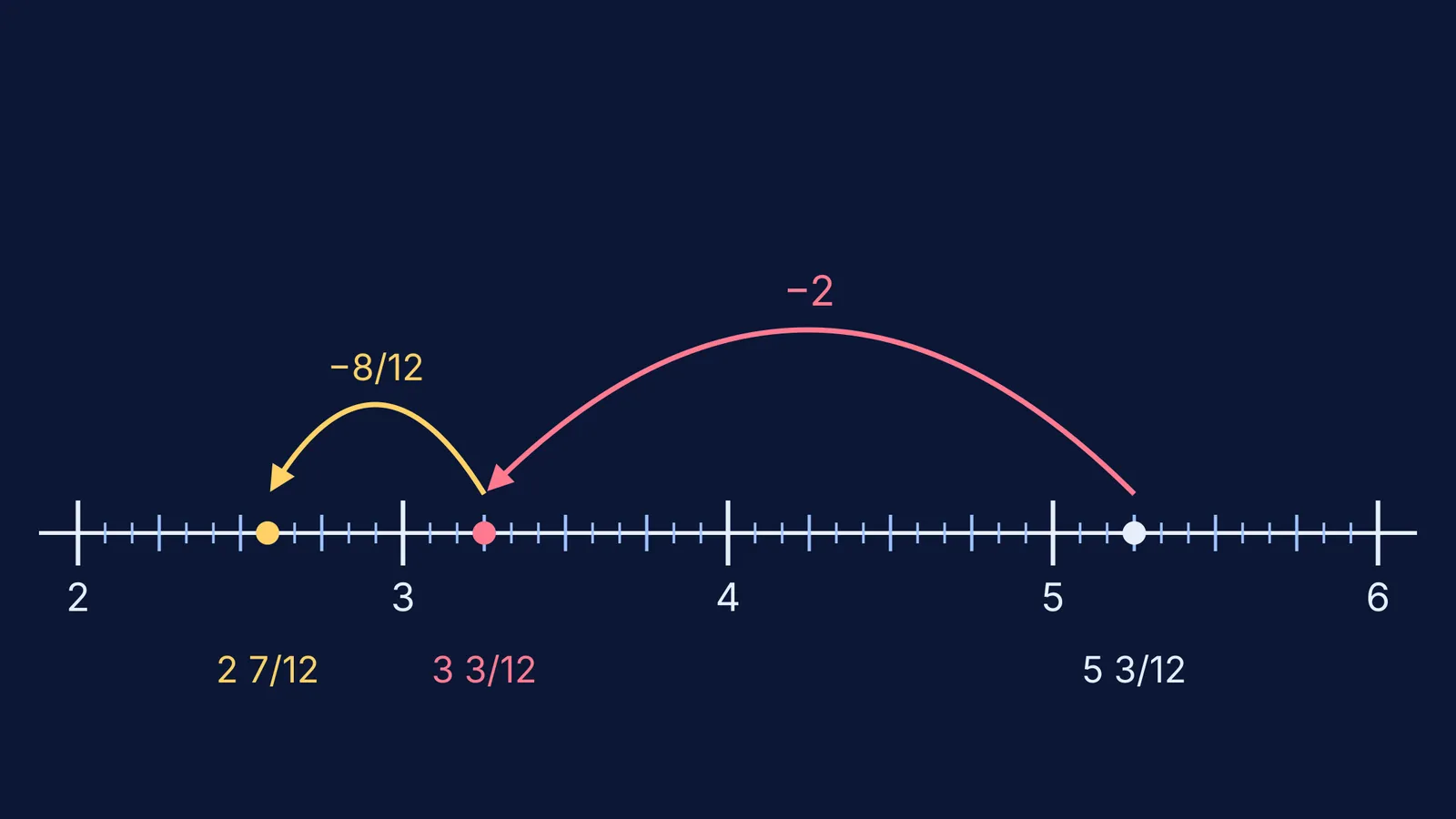
The diagram at the top shows the same thing on a number line: jump back 2 wholes from 5 3/12 to 3 3/12, then 8/12 more. That second jump crosses the 3, which is exactly why you needed to borrow.
Two other slips are worth checking for. One is flipping the fractions to subtract the smaller from the larger (2/3 − 1/4), which gives 3 5/12 instead of 2 7/12. The other is forgetting that the 5 became 4 after borrowing. If matching the denominators is the shaky step, our guide to adding unlike fractions with the LCM goes through it slowly.
When should you convert to improper fractions instead?
Method A avoids borrowing entirely. Same problem: 5 1/4 = 21/4 and 2 2/3 = 8/3. With denominator 12, that is 63/12 − 32/12 = 31/12, which is 2 7/12. Same answer, no borrowing.
Use this quick rule to choose:
Small whole numbers, awkward fractions: improper fractions. 3 − 1 2/5 becomes 15/5 − 7/5 = 8/5 = 1 3/5, with no need to borrow from a whole number that has no fraction.
Large whole numbers: borrow. For 47 1/8 − 19 5/8, improper fractions give 377/8 − 157/8 = 220/8, and you still have to divide back to 27 1/2. Borrowing gives 46 9/8 − 19 5/8 = 27 4/8 = 27 1/2 with smaller numbers.
Multiplying or dividing mixed numbers: always convert to improper fractions first.
Addition: the mirror image of borrowing is carrying. 3 5/6 + 1 3/4 = 4 + 10/12 + 9/12 = 4 19/12 = 5 7/12.
Whichever you use, finish by reducing the fraction, as in our post on equivalent fractions and simplest form using the HCF.
Why does this small skill matter?
Fractions are not a topic you finish in Class 6. A longitudinal study by Siegler and colleagues in Psychological Science (2012) found that elementary students' knowledge of fractions and division uniquely predicted their algebra knowledge and overall maths achievement in high school, 5 or 6 years later, even after accounting for other factors such as working memory and family income.
A good practice routine is to solve each problem both ways and check that the answers match. If they don't, the mismatch tells you which step to look at. When you want more problems like this with each step explained, the Fermi Problem Library has worked problems with a step-by-step solver that explains the reasoning rather than printing an answer. If the gap is the idea of a fraction itself, the Fermi Concept Library has a lesson for each mathematics concept. For broader struggles, see our guide for when a child is confused by fractions in Class 6.
Try it now: 6 1/5 − 3 1/2. (Answer: 2 7/10.)


