

On this page
A penguin cannot lift itself off the ground, yet biology textbooks put it in the same class as sparrows and eagles. That is because "bird" is defined by a body plan, not by the ability to fly. Penguins kept the body plan and traded flight for something they need more: swimming fast and deep for food.
What makes a penguin a bird if it cannot fly?
Birds are vertebrates with feathers, a horny beak with no teeth, and large-yolked, hard-shelled eggs, according to Animal Diversity Web's account of class Aves.
Penguins tick each box. The University of Waikato's Science Learning Hub notes that penguins "have the key features of birds such as feathers, no teeth and a beak" (Science Learning Hub). Animal Diversity Web's penguin account adds that females lay one to two whitish eggs per clutch (ADW: Sphenisciformes).
Flight is not on the list. Penguins are not even an odd one out among seabirds: flightlessness has evolved independently in at least five seabird lineages (Elliott et al., PNAS 2013).
Why can't penguins fly?
Their wings became flippers. In penguins, the wing skeleton is flattened and partially fused, according to Animal Diversity Web.
Elliott and colleagues list how penguins rebuilt themselves for the water: a shorter wingspan, larger wing bones, more body mass, muscles tuned for slow wingbeats and extra myoglobin to store oxygen (PNAS 2013).
Why not keep both skills? The same team tested the trade-off on thick-billed murres, seabirds of about 1 kg that both fly in air and "fly" underwater with their wings. Flying cost murres about 31 times their basal metabolic rate, sustained for up to 5 hours a day while breeding, and their flight costs were among the highest recorded for any vertebrate, while their dives were cheap (Elliott et al., PNAS 2013). The study also notes that living and fossil wing-propelled diving birds are flightless above about 1 kg and can fly below it.
How do dense bones help penguins dive?
Many birds have air spaces inside their bones. Skeletal pneumaticity is "a key feature" of bird structure, says a 2023 study by Burton, Benson and Field in Proceedings of the Royal Society B. If you have read how air sacs make bird bones hollow, penguins are the reverse case.
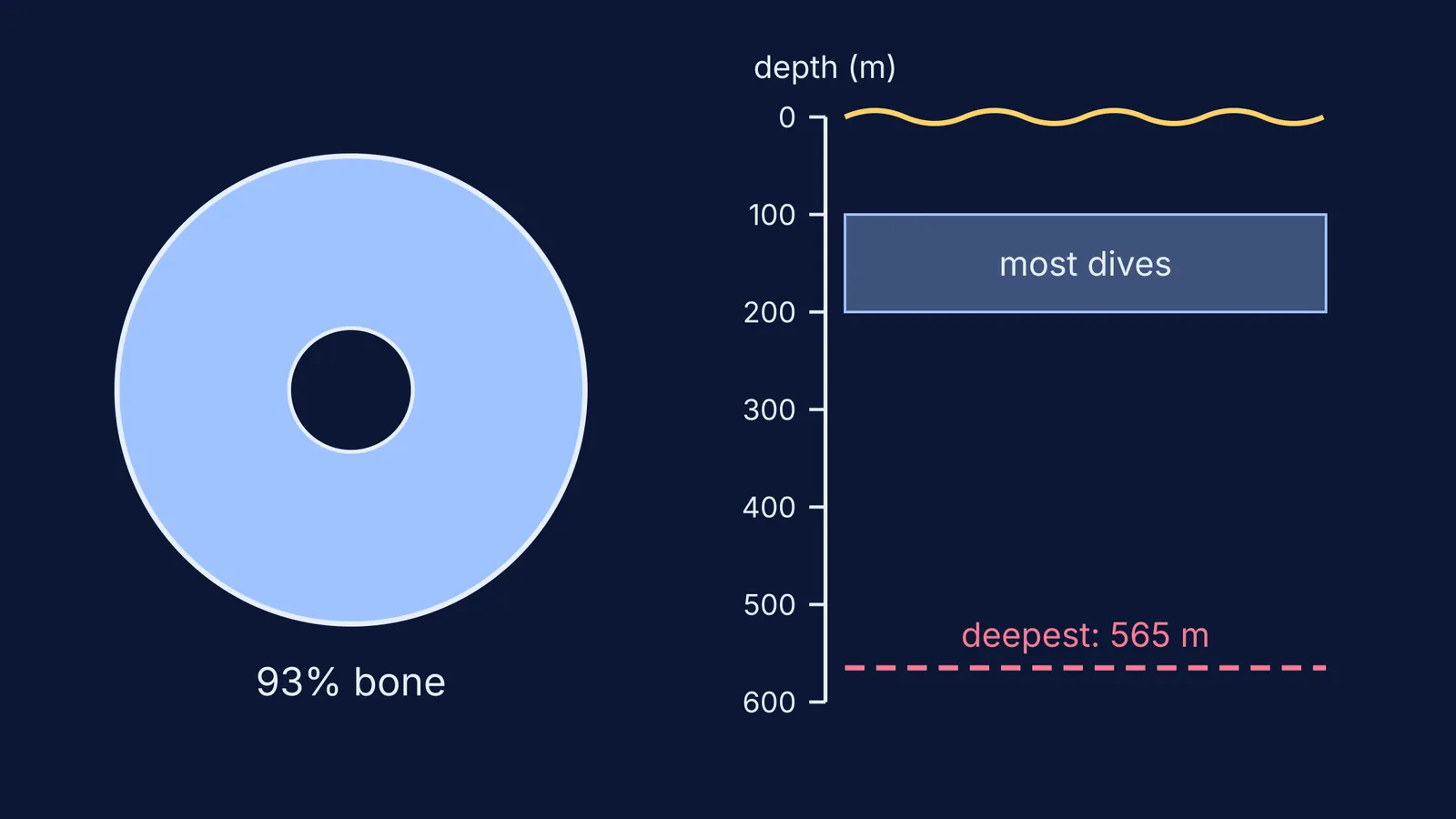
The same study found that diving birds have denser skeletons, with less air and thicker bone. A macaroni penguin (*Eudyptes chrysolophus*) had the highest share of bone in its upper wing bone (the humerus) of all the birds sampled: 93% of the bone's volume (Burton et al., 2023). The authors suggest that because penguins no longer fly, heavier bone could replace marrow and help keep them neutrally buoyant.
This is Archimedes' principle at work. Air adds volume with almost no mass, so it pushes a diver up. Fish manage this with a gas-filled organ, as our post on the swim bladder and buoyancy explains. Penguins cut the air instead.
It pays off. Emperor penguins usually dive to 100 to 200 m, their deepest recorded dive reached 565 m, and an average dive lasts three to six minutes, according to the Australian Antarctic Division.
How do you write this answer in a biology exam?
A question like "Penguins cannot fly. Why are they still classified as birds?" rewards a two-part answer: prove the class, then explain the exception. Use this checklist.
Feathers? Yes.
Beak with no teeth? Yes.
Hard-shelled eggs? Yes, one or two per clutch (ADW).
What changed? Wings became flattened, partly fused flippers.
Why? Flipper wings and dense bones suit diving, and flying as well would cost a heavy diver too much energy.
A model three-mark answer:
"Penguins are birds because they have feathers and a toothless beak and lay hard-shelled eggs, the defining features of class Aves. Flight is not a defining feature. Their wings are modified into stiff flippers for swimming, and their bones are dense rather than air-filled, which reduces buoyancy and helps them dive."
The answer never says "birds are animals that fly". That definition breaks on penguins and lets in bats, which our post on why a bat is a mammal, not a bird takes apart clue by clue.
Where should you go next?
This question hides a physics idea, buoyancy, inside a biology one. To see how class Aves, density and buoyancy connect, the Fermi Concept Library covers every concept in physics, chemistry, biology, mathematics and computing, each with its own lesson and its place in the map. Next time an animal seems to break the rule, start with the traits that define its group, then explain what changed and why.


