

On this page
You know the simple pendulum formula. Then a question drops the bob into a beaker of water and asks for the new period. The string and mass are unchanged, so what changed? Buoyancy. Once you see how it works, the hollow-bob and denser-liquid versions follow.
Why does a pendulum swing slower in a liquid?
For small swings, the period of a simple pendulum is T = 2π√(L/g), and OpenStax University Physics notes that the period is nearly independent of amplitude when the angle is less than about 15°.
In a liquid, the bob feels a second steady force. Archimedes' principle says the buoyant force on an object equals the weight of the fluid it displaces (OpenStax University Physics). For a bob of volume V fully under the surface, that force is ρ_liquid·V·g, pointing straight up.
Now keep two things apart:
What pulls the bob back to the centre: weight minus buoyancy, (ρ_bob − ρ_liquid)·V·g. Both forces are vertical and constant, so they act like one smaller weight.
What resists being moved: the full mass m = ρ_bob·V.
Divide the net downward force by the mass and you get the effective gravity: g_eff = g(1 − ρ_liquid/ρ_bob).
If buoyancy feels shaky, see our explainer on why objects weigh less in water.
What is the formula for the time period with the bob in a liquid?
Put g_eff into the usual formula:
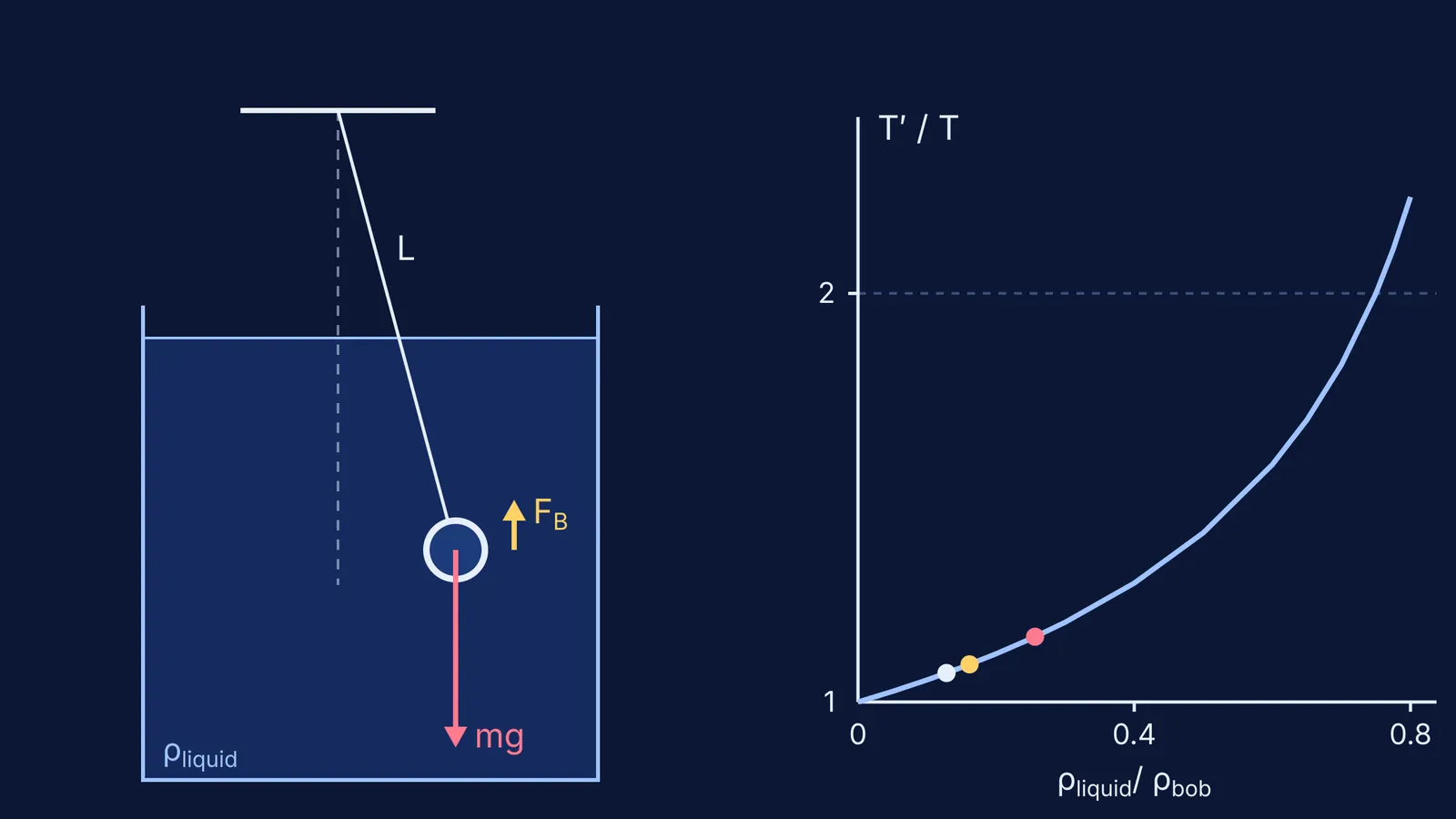
T′ = 2π√(L / [g(1 − ρ_liquid/ρ_bob)]) = T / √(1 − ρ_liquid/ρ_bob)
Many JEE-style questions give the bob's relative density σ = ρ_bob/ρ_liquid instead. Then T′ = T√(σ/(σ − 1)). If σ = 5, for example, T′ = T√(5/4), about 1.12T.
This is the textbook model. It assumes the bob is fully immersed, the string's own buoyancy is negligible, the swings are small, and drag is ignored. In a real beaker, drag drains energy quickly, which turns the motion into a damped oscillation, and the period you time will not match the formula exactly.
Worked example: a steel bob in water and in glycerin
Take a pendulum whose period in air is 2.00 s. Densities from the OpenStax density table: steel 7.8 × 10³ kg/m³, brass 8.44 × 10³ kg/m³, water 1.000 × 10³ kg/m³, glycerin 1.26 × 10³ kg/m³.
Steel in water: ρ_liquid/ρ_bob = 1000/7800 = 0.128, so g_eff = 0.872g and T′ = 2.00/√0.872 ≈ 2.14 s.
Steel in glycerin: the ratio is 1260/7800 = 0.162, so g_eff = 0.838g and T′ = 2.00/√0.838 ≈ 2.18 s. A denser liquid means a longer period.
Brass in water: the ratio is 1000/8440 = 0.118, so g_eff = 0.882g and T′ ≈ 2.13 s. A denser bob means a smaller change.
How does a hollow bob change the period?
In air, a hollow bob and a solid bob of the same size have the same period, because mass cancels. In a liquid they do not.
What counts is the bob's average density: total mass divided by its outer volume. Buoyancy depends on the outer volume, which is the same for both, but the hollow bob has less weight to fight it.
Suppose the steel ball from the example is hollowed out until it has half its mass. Using steel at 7.8 × 10³ kg/m³ from the OpenStax table, its average density falls to 3.9 × 10³ kg/m³. In water the ratio becomes 1000/3900 = 0.256, so g_eff = 0.744g and T′ = 2.00/√0.744 ≈ 2.32 s. Same size, same string, clearly slower.
What happens if the liquid is as dense as the bob, or denser?
As ρ_liquid approaches ρ_bob, the factor (1 − ρ_liquid/ρ_bob) shrinks to zero. Nothing pulls the bob back, so the period grows without limit and the bob simply stays where you leave it. If the liquid is denser still, the bob floats up. A steel bob in mercury, listed at 13.6 × 10³ kg/m³ in the OpenStax table, would rise until the string is taut above it: an upside-down pendulum, not the usual kind.
The same habit of replacing g with an effective g solves other pendulum problems, such as a pendulum in a car turning on a circular road.
A checklist before you write T′
Is the bob fully immersed? The simple formula needs the buoyant force to stay constant.
Which density is the bob's? For a hollow bob, use mass divided by outer volume.
Is the liquid less dense than the bob? If not, there is no ordinary pendulum.
Write T′ = T/√(1 − ρ_liquid/ρ_bob) in symbols first, then substitute. A common slip is dividing the densities the wrong way round.
If you set up the forces correctly but slip in the algebra, the Fermi Problem Library has worked problems with a step-by-step solver that explains the reasoning rather than printing an answer. To rebuild buoyancy or simple harmonic motion from the ground up, the Fermi Concept Library gives each physics concept its own lesson.


