

On this page
Imagine a pendulum hanging from the roof of a car. When the car drives steadily in a straight line, the bob hangs straight down. But when the car takes a sharp turn on a circular road, the pendulum swings outward and tilts.
Why does it tilt, and how does the turn change the speed of its swing? The answer lies in replacing the normal pull of gravity with a new vector called effective gravity, or g_eff.
Why does the pendulum swing outward?
When a car takes a circular curve of radius r at a speed v, it is constantly accelerating toward the centre of the circle. This is centripetal acceleration.
However, from the perspective of someone inside the car (a non-inertial reference frame), it feels like there is a force pushing everything outward. This fictitious "pseudo force" is the centrifugal force. According to classical mechanics, its acceleration is exactly v²/r acting horizontally outward [[1]](https://en.wikipedia.org/wiki/Centripetal_force).
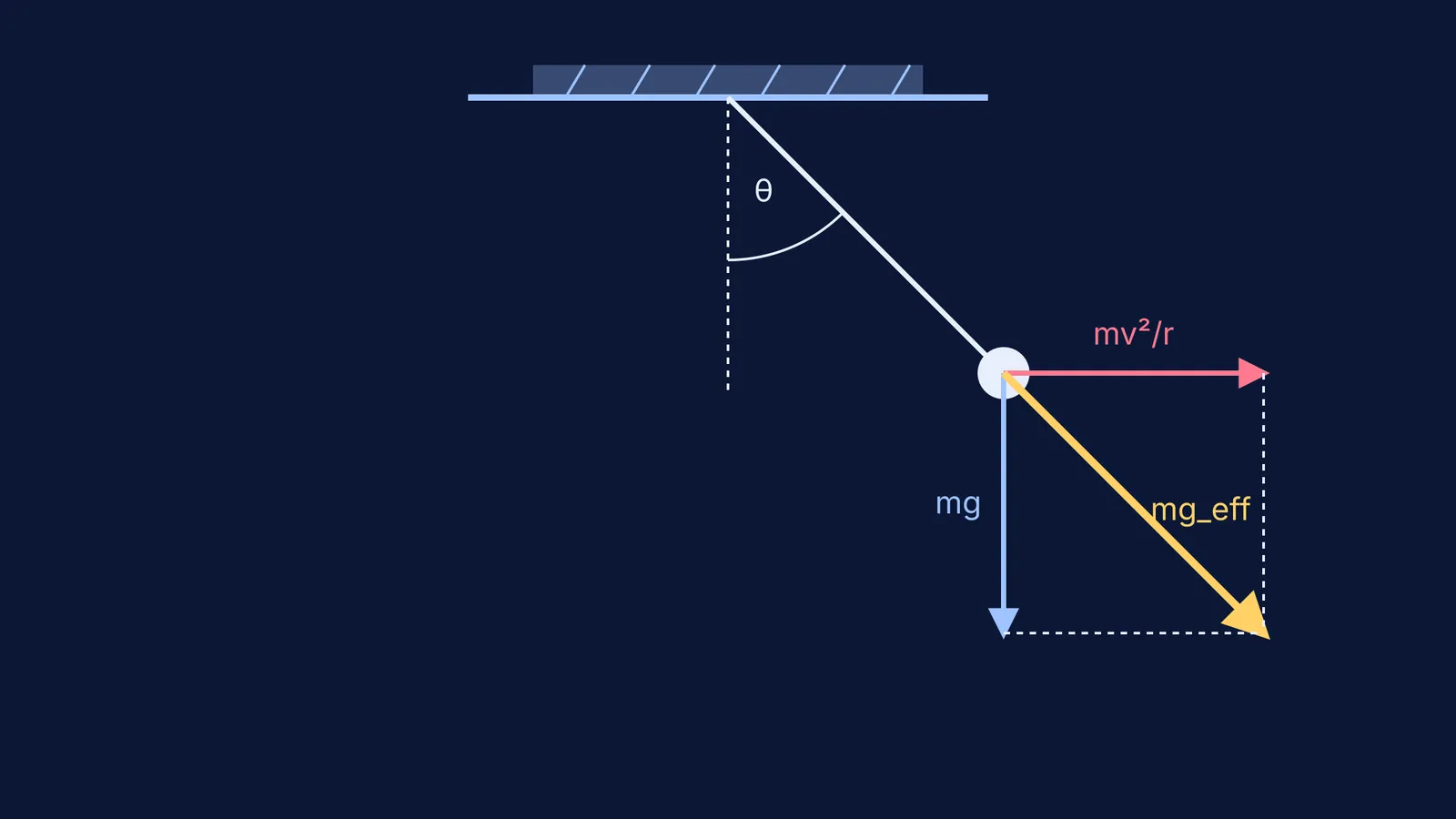
The pendulum bob therefore feels two distinct forces:
True gravity (mg) pulling straight down.
Centrifugal force (mv²/r) pulling horizontally outward.
The angle of the swing: tan θ = v²/rg
To stay in equilibrium inside the turning car, the pendulum string tilts at an angle θ away from the vertical. The tension (T) in the string has to balance both gravity and the centrifugal force.
If we break the tension into components:
The vertical component balances gravity: T cos θ = mg
The horizontal component balances the outward force: T sin θ = mv²/r
Dividing the horizontal equation by the vertical one cancels out the tension and the mass: tan θ = v² / rg
This is the exact same equation engineers use when banking roads to prevent cars from skidding.
Effective gravity: g_eff = √(g² + (v²/r)²)
Because gravity and the centrifugal force act at 90° to each other, they add together like the sides of a right-angled triangle.
The resultant force is the effective gravity (g_eff). Using the Pythagorean theorem: g_eff = √(g² + (v²/r)²)
Since g_eff is always larger than normal gravity (g), the bob effectively feels "heavier" while the car is turning.
For instance, imagine a car turning a sharp curve of radius 20 metres at 14 m/s (about 50 km/h). The centripetal acceleration is v²/r = 196 / 20 = 9.8 m/s². Because this is exactly equal to the acceleration of gravity (g), the centrifugal force pulling outward equals the true gravity pulling downward.
In this scenario, the pendulum will tilt at exactly 45° (since tan θ = 9.8 / 9.8 = 1), and the effective gravity becomes √(9.8² + 9.8²) = 13.8 m/s².
How does it change the time period?
If you push the pendulum and let it swing back and forth while the car is in the curve, its time period changes.
The standard time period of a simple pendulum is T = 2π √(l/g). In the accelerating car, you simply replace g with g_eff: T = 2π √(l / √(g² + (v²/r)²))
Because the denominator is larger than normal gravity, the time period T shrinks. In our numerical example above, the time period of the pendulum would drop to about 0.84 of its normal value. The pendulum swings significantly faster than it would in a parked car. You will see a similar effect if you add a horizontal electric force; you can read our worked example of a pendulum in an electric field to see the parallels.
When the car also accelerates forward
JEE and NEET problems often combine motions. If the turning car is also pressing the accelerator to speed up, it introduces a third acceleration vector (tangential acceleration, a_t) pointing forward.
Because a_t is perpendicular to both gravity (down) and the centrifugal force (sideways), you add it in 3D: g_eff = √(g² + (v²/r)² + a_t²)
If you have concept gaps about how orthogonal forces combine, the Fermi Concept Library has every concept in physics, each with its own lesson and its place in the map. And if you are stuck on a difficult non-inertial frame question, the Fermi Problem Library provides worked problems with a step-by-step solver that explains the reasoning rather than printing an answer.
The next time you face a pendulum in a moving vehicle, follow a simple plan:
Identify the car's acceleration and draw a pseudo force in the opposite direction.
Find the resultant g_eff using vector addition.
Plug g_eff into your standard pendulum formulas.
Whether the bob is in a turning car, a lift, or a rocket, the method never changes. (For another variation, check out how to find simple pendulum string tension at any angle.)


