On this page
Ask most people how a pearl forms and you will hear the same story: a grain of sand gets into an oyster, and the oyster coats it. The real hero is a thin sheet of tissue called the mantle.
How are pearls formed in oysters?
The mantle is the layer of tissue that lines the inside of a mollusc's shell, and its outer cells build the shell itself. For a refresher, see our post on the mantle, radula and other features of Mollusca. A pearl forms when some of those shell-building cells end up in the wrong place.
An irritant or injury gets past the mantle. The Gemological Institute of America (GIA) says natural pearls form in the mantle tissue of certain molluscs "usually around a microscopic irritant, and always without human help of any kind" (GIA).
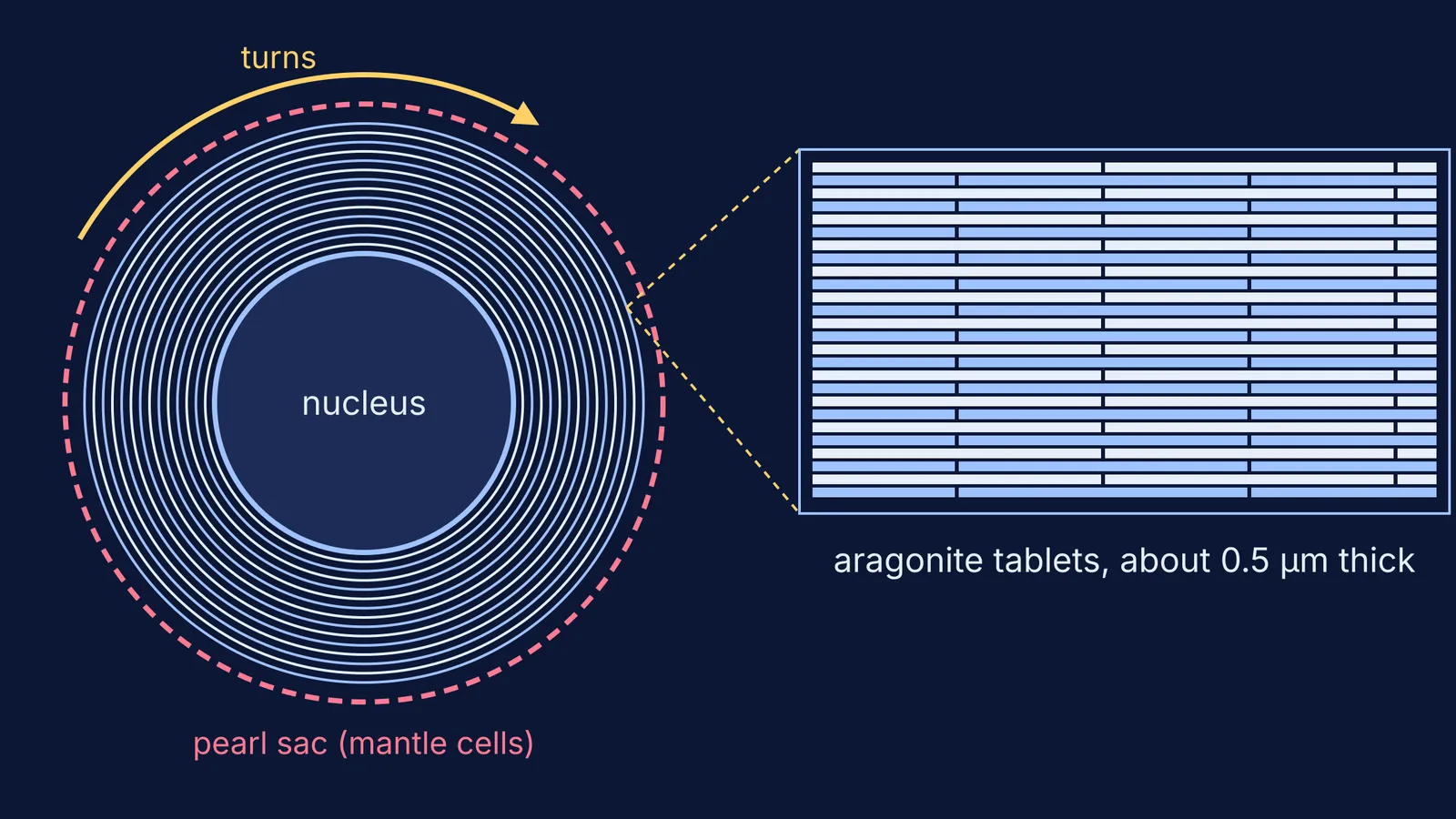
Mantle epithelial cells grow around it and form a closed bag called the pearl sac.
The sac does what mantle cells always do: it secretes nacre, but inward, onto the object, instead of onto the shell.
Layer after layer builds up, and the pearl grows from the inside out.
In cultured pearl oysters, "the external epithelial cells of the graft multiply to form a pearl sac, a single epithelium, around the nucleus" (Gueguen et al., Royal Society Open Science, 2015). No mantle cells, no nacre, no pearl.
What is nacre made of?
Nacre, or mother-of-pearl, is the same material that lines the inside of many shells. In mussel nacre, the mineral comes as polygonal aragonite tablets about 10-20 µm wide and 0.5 µm thick, with up to 3% by weight of organic molecules (Otter et al., Nature Communications, 2023). Aragonite is a crystal form of calcium carbonate, CaCO3, the same compound as limestone and chalk.
The same study describes organic sheets about 30 nm thick between the tablets (Otter et al., 2023). Think of a brick wall: hard mineral bricks, thin organic mortar.
The shine is physics. Nacre's transparent aragonite tablets, bonded by an ultra-thin organic layer, produce interference colours (Salman et al., PNAS, 2021). It is the same effect you see in a soap bubble, explained in our post on why soap films show colours.
Natural vs cultured pearls: what is the difference?
The biology is the same; only the start is different. In a cultured pearl, GIA explains, a technician takes mantle tissue from a sacrificed mollusc of the same species and inserts it with a shell bead into the host's gonad, or inserts several pieces of mantle tissue without beads into the host's mantle (GIA). The tissue grows into a sac and coats the bead with nacre.
The pearl also moves. Using a magnetic nucleus and magnetic sensors in black-lip pearl oysters, Gueguen and colleagues showed the nucleus starts turning at least 40 days after grafting and keeps turning until harvest, at a mean of 1.27 degrees per minute across four oysters (Gueguen et al., 2015). They linked steady rotation about one axis to pearls with faint rings.
India has its own chapter here. The Central Marine Fisheries Research Institute (CMFRI) produced free spherical cultured pearls at Tuticorin in July 1973 using the mantle graft technique (CMFRI/FAO pearl culture manual).
How many nacre layers are in a pearl?
Layers. Suppose a nacre coat is 0.5 mm thick. That is 500 µm. In mussel nacre one tablet is about 0.5 µm thick and one organic sheet about 0.03 µm (Otter et al., 2023), so each layer is about 0.53 µm. 500 / 0.53 = about 940 layers of tablets, close to 1,000.
Turning speed. At the mean of 1.27 degrees per minute (Gueguen et al., 2015), one full turn takes 360 / 1.27 = about 283 minutes, or roughly 4 hours 43 minutes.
Turns per day. 1.27 x 1,440 minutes = about 1,829 degrees, so a little over 5 turns a day.
The 0.5 mm coat is assumed; real coats vary, and individual oysters turned at 0.40 to 2.10 degrees per minute.
How do you write this answer in a biology exam?
For "How is a pearl formed?", give four parts.
Name the organism and tissue: a pearl oyster (a mollusc), and its mantle.
State the trigger: an irritant or injury carries mantle epithelial cells inward.
Describe the process: the cells form a pearl sac that secretes nacre (aragonite, a form of calcium carbonate, plus organic matrix) in concentric layers.
Contrast: natural pearls form by accident; cultured pearls start from a bead and mantle graft placed by a person.
Add a quick cross-section like the diagram at the top of this page. If calcium carbonate chemistry or the mollusc body plan is where you get stuck, the Fermi Concept Library gives each concept in biology and chemistry its own lesson and shows where it sits in the map. For practice questions, the Fermi Problem Library has worked problems with a step-by-step solver that explains the reasoning rather than printing an answer.
Next time someone tells you the grain-of-sand story, tell them about the mantle.