On this page
No instrument reads out electronegativity directly. Chemists calculate it from other measurements, and the two classic scales start from different ones.
What is the difference between the Pauling and Mulliken scales?
The Pauling scale is built from bond energies. In his 1932 paper in the Journal of the American Chemical Society, Linus Pauling compared the energy of an A–B bond with the energies of the A–A and B–B bonds. If A and B pulled on electrons equally, the A–B bond would be about as strong as the average of the other two. It is usually stronger, and the extra energy grows as the electronegativity difference grows.
On the Pauling scale, the electronegativity difference between two atoms is 0.102 times the square root of that extra bond energy in kJ/mol (LibreTexts on Pauling electronegativity/Physical_Properties_of_Matter/Atomic_and_Molecular_Properties/Electronegativity/Pauling_Electronegativity)). Because the formula only gives differences, the scale needs a fixed reference point. In the commonly used table, hydrogen is 2.20 and fluorine is 3.98 (electronegativity data page)).
The Mulliken scale is built from a single, isolated atom. In his 1934 paper in The Journal of Chemical Physics, Robert Mulliken proposed that electronegativity is the average of an atom's ionisation energy and electron affinity. The logic is easy to feel: ionisation energy says how tightly the atom holds its own electrons, and electron affinity says how much energy it releases on taking an extra one.
Still mixing up electron affinity and electronegativity? Our explainer on electronegativity versus electron gain enthalpy separates them.
Why don't Pauling and Mulliken values match?
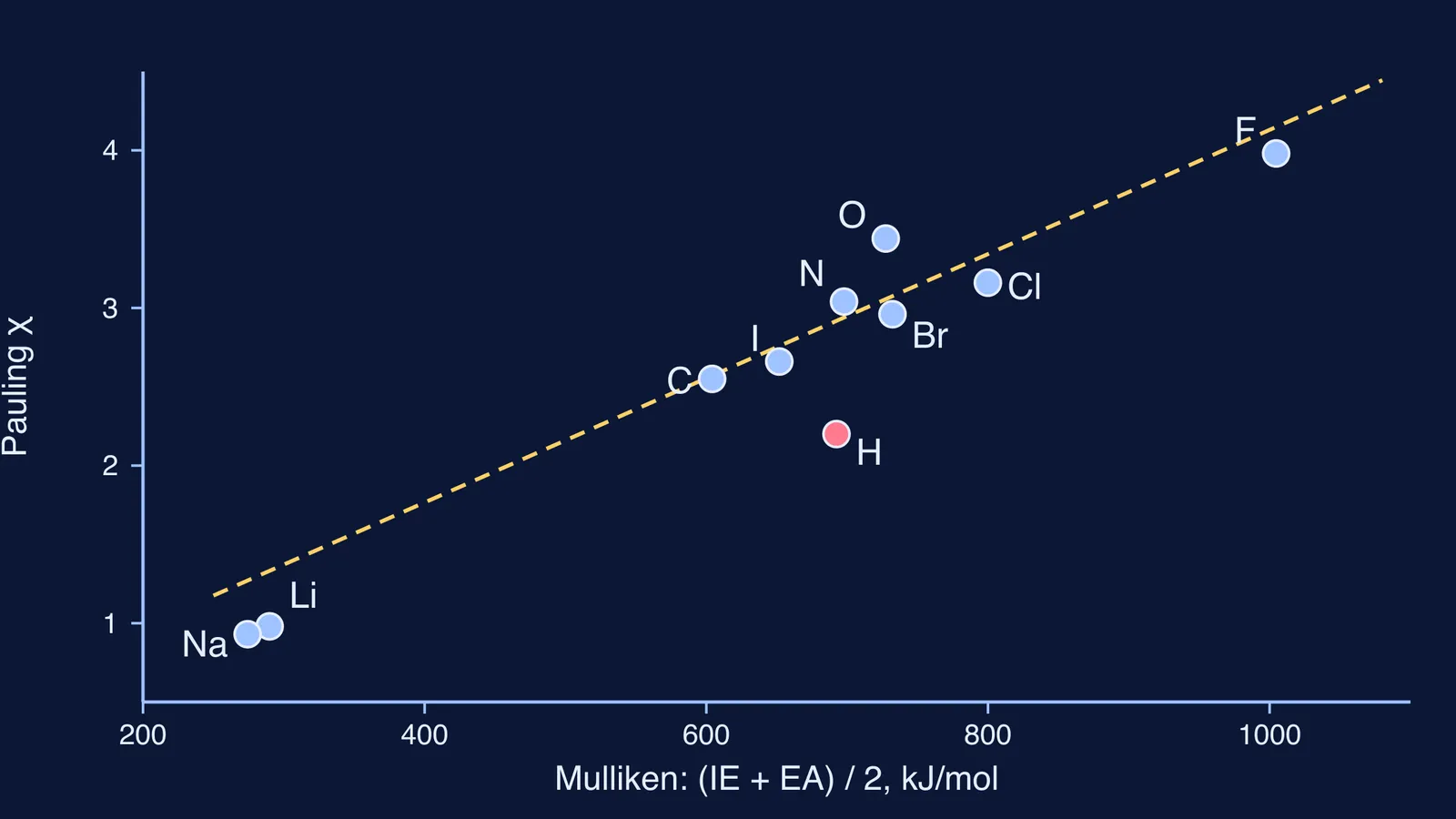
Different units. A Mulliken value is an energy, so chlorine comes out near 800 kJ/mol, not 3.16. To compare, you rescale. One published fit is χ(Pauling) = 0.00197 × (IE + EA) + 0.19, with energies in kJ/mol (Chemistry LibreTexts, Mulliken electronegativity/Physical_Properties_of_Matter/Atomic_and_Molecular_Properties/Electronegativity/Mulliken_Electronegativity)).
Different situations. Mulliken describes a lone atom; Pauling, an atom inside bonds. Mulliken's own abstract notes that his values vary with the atom's valence state (Mulliken, 1934).
Different data. Mulliken needs electron affinities, which were known for only 57 elements as of 2006 (Chemistry LibreTexts/Physical_Properties_of_Matter/Atomic_and_Molecular_Properties/Electronegativity/Mulliken_Electronegativity)). Pauling needs reliable bond energies, and different tables give slightly different ones.
Worked example: chlorine on both scales
Pauling route, using bond energies from the Wired Chemist table: H–H 432, Cl–Cl 240 and H–Cl 428 kJ/mol.
Expected H–Cl energy if the bond were non-polar: (432 + 240) / 2 = 336 kJ/mol.
Extra energy: 428 − 336 = 92 kJ/mol.
Difference: 0.102 × √92 = 0.102 × 9.59 ≈ 0.98.
Chlorine ≈ 2.20 + 0.98 = 3.18, close to the tabulated 3.16 (electronegativity data page)).
Mulliken route, using chlorine's first ionisation energy of 1251.2 kJ/mol (ionisation energy table) and electron affinity of 348.6 kJ/mol (electron affinity data page)):
Mulliken value: (1251.2 + 348.6) / 2 = 799.9 kJ/mol.
On the Pauling-like scale: 0.00197 × 1599.8 + 0.19 ≈ 3.34.
So you get 3.18 from bonds, 3.34 from atomic data and 3.16 in the table. Same neighbourhood, not the same number.
Do the two scales agree on trends?
For the main patterns, yes. Run the same conversion on the halogens with the data above and you get F 4.15, Cl 3.34, Br 3.07 and I 2.76; the Pauling table) gives F 3.98, Cl 3.16, Br 2.96 and I 2.66. The order is identical and the gaps are similar. That makes sense: an atom that holds its own electrons tightly and welcomes an extra one also makes bonds more polar.
One detail worth knowing: chlorine's electron affinity (348.6 kJ/mol) is higher than fluorine's (328.2 kJ/mol), yet fluorine's much larger ionisation energy (1681.0 versus 1251.2 kJ/mol) keeps it on top on the Mulliken scale too. Data: electron affinities) and ionisation energies.
The agreement is not perfect pair by pair. Hydrogen converts to 2.92 on Mulliken's data, above iodine's 2.76, while Pauling places hydrogen at 2.20, below iodine's 2.66. So "trends agree" means across periods and down groups, not every single comparison. The same caution applies to rules of thumb: the 1.7 cut-off for ionic bonds is only a rough guide.
How should you answer Pauling vs Mulliken in an exam?
Cover these five points:
Basis: Pauling uses bond dissociation energies; Mulliken uses ionisation energy plus electron affinity.
Output: Pauling gives differences, anchored to a reference value; Mulliken gives an absolute energy.
Why numbers differ: units, atom in a molecule versus free atom, and valence state.
What agrees: the trends across a period and down a group.
If you calculate: write the formula, keep units in kJ/mol or eV throughout, and state which conversion you used.
If electronegativity, ionisation enthalpy and bond polarity feel like separate chapters, the Fermi Concept Library gives each concept its own lesson and shows its place in the map. When you want practice, the Fermi Problem Library has worked problems with a step-by-step solver that explains the reasoning rather than printing an answer.
For the person behind the first scale, read Linus Pauling: electronegativity, bonds and two unshared Nobels.