

On this page
Students mix these two up all the time. Both generally grow stronger across a period and weaker down a group, and fluorine and chlorine sit near the top of both lists. But they answer different questions. One describes an atom inside a bond. The other describes a lone atom in the gas phase. Once you see that, the famous chlorine-versus-fluorine question stops being a trick.
What is the difference between electronegativity and electron gain enthalpy?
In the NCERT Class 11 Chemistry chapter on periodicity, electron gain enthalpy (ΔegH) is the enthalpy change when an electron is added to a neutral gaseous atom to form a negative ion: X(g) + e⁻ → X⁻(g).
The same chapter defines electronegativity as a qualitative measure of the ability of an atom in a chemical compound to attract shared electrons to itself.
The key words are "gaseous atom" in the first definition and "in a chemical compound" in the second. NCERT also notes that electronegativity, unlike electron gain enthalpy, is not a measurable quantity, and that an element's electronegativity changes with the element it is bonded to.
Electron gain enthalpy: an isolated atom, an energy change, measured, in kJ mol⁻¹, with a sign (negative when energy is released).
Electronegativity: a bonded atom, a tendency, read off a scale (Pauling, Mulliken-Jaffe or Allred-Rochow), with no unit and no sign.
What units do they use, and why does the sign confuse people?
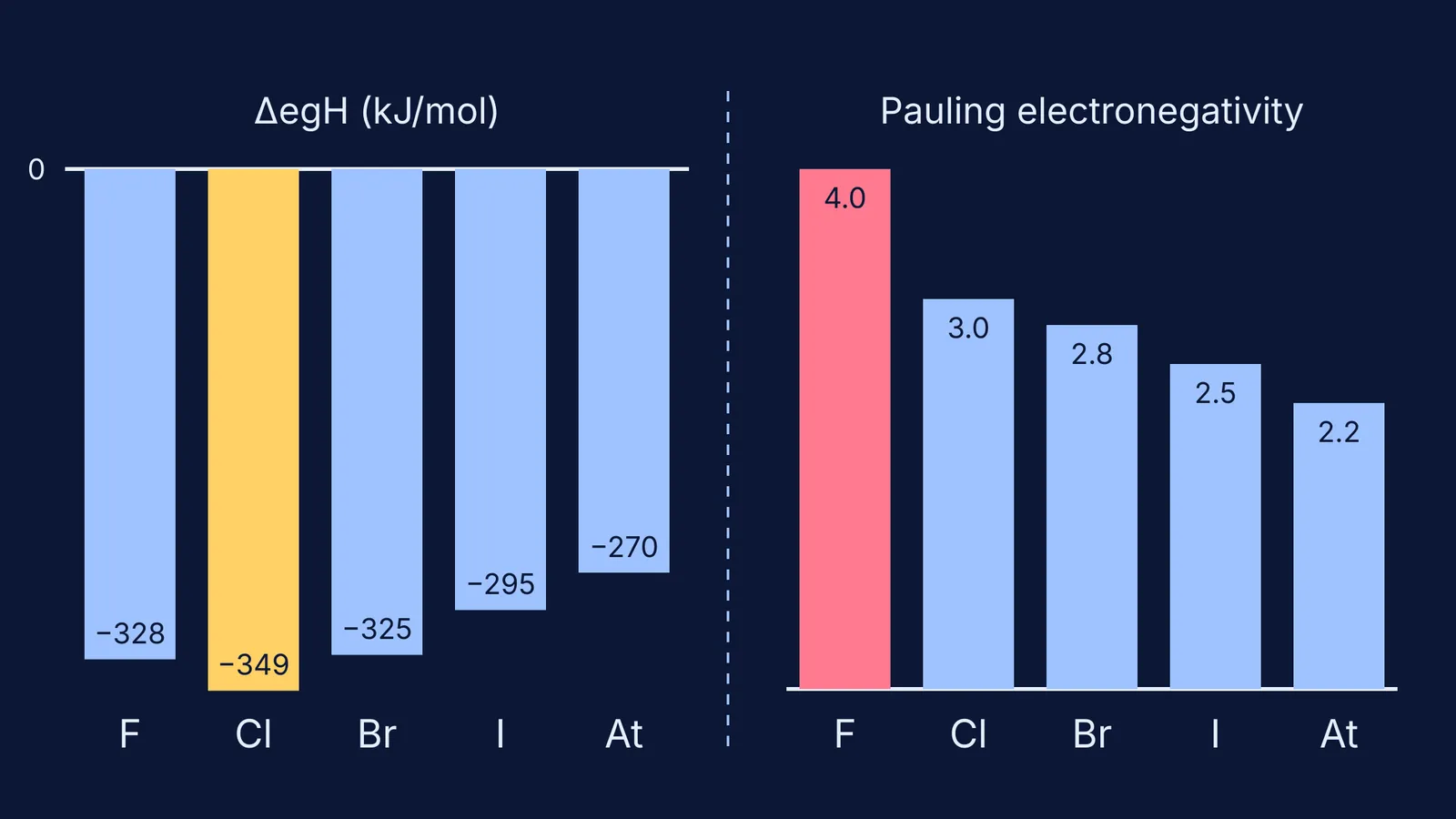
NCERT's Table 3.7 lists electron gain enthalpies in kJ mol⁻¹: for example −328 for fluorine, −349 for chlorine and +116 for neon (NCERT Class 11 Chemistry, Unit 3). Noble gases have positive values because the extra electron has to go into the next shell.
Many books instead use electron affinity, which is the negative of this enthalpy change, so it is positive when energy is released. A footnote to that table gives the link between them: ΔegH = −Ae − 5/2 RT. In an exam, check which quantity is being asked for before you write a sign.
Electronegativity has no unit at all. The most widely used scale, according to NCERT, is Pauling's, which he based on bond energies in a 1932 paper in the Journal of the American Chemical Society. In NCERT's Pauling values, fluorine is 4.0. If you want the story behind the scale, read our post on Linus Pauling, electronegativity and the chemical bond.
Why does chlorine have a more negative electron gain enthalpy than fluorine?
NCERT gives the general trend: electron gain enthalpy becomes more negative across a period and less negative down a group (NCERT Class 11 Chemistry). Fluorine and oxygen break this trend. Their values are less negative than those of chlorine and sulphur, the elements just below them.
The reason is size. In fluorine, the incoming electron enters the small n = 2 shell. The electrons already packed there repel it strongly. In chlorine, the electron goes into the larger n = 3 shell, where it has more room and suffers much less electron-electron repulsion. So chlorine releases more energy (−349 against −328 kJ mol⁻¹).
Inside a bond, though, fluorine still wins. What counts there is the pull on a shared pair, and NCERT ties that pull to atomic radius: smaller atoms pull harder. That is why fluorine is the most electronegative element even though chlorine has the more negative electron gain enthalpy. Exceptions like this one are covered in our guide to periodic trends and their exceptions.
How do you rank elements on both scales? A worked example
Take O, S, F and Cl. Using NCERT's Tables 3.7 and 3.8 (source):
Write the data. ΔegH (kJ mol⁻¹): O −141, S −200, F −328, Cl −349. Pauling electronegativity: O 3.5, S 2.5, F 4.0, Cl 3.0.
Rank by electron gain enthalpy, most negative first: Cl > F > S > O. Each third-period element beats the second-period element above it, because of repulsion in the small n = 2 shell.
Rank by electronegativity: F > O > Cl > S. Here the second-period elements win, because a small atom pulls a shared pair more strongly.
Notice that the two orders disagree. That disagreement is the whole point of the question.
That four-part frame also works for CBSE-style questions. Our post on answering give-reasons questions in CBSE chemistry shows how to set them out.
If you keep mixing up the two definitions, the Fermi Concept Library has a separate lesson for each concept in chemistry, along with its place in the concept map. To check a ranking question, try the Fermi Problem Library: its step-by-step solver explains the reasoning instead of just printing the order.
To test yourself, cover the tables and rank N, P, O and S on both scales. Then explain any place where the two orders differ.


