

On this page
This chapter follows the Gujjar Bakarwals and Dhangars in India and the Maasai in East Africa, then shows what colonial rule did to each. Everything below comes from NCERT's India and the Contemporary World I (NCERT chapter, archived copy).
CBSE's Class 9 Social Science curriculum for 2026-27 prescribes NCERT's Social Science Part 1 and 2, and none of its themes is this chapter. Ask your teacher whether your board will test it.
Who are pastoralists, and why do they move?
NCERT defines nomads as people who do not live in one place but move from one area to another to earn their living (NCERT). Pastoralists are nomads who herd animals. Moving lets a pasture recover before the herd returns, so no place is overgrazed.
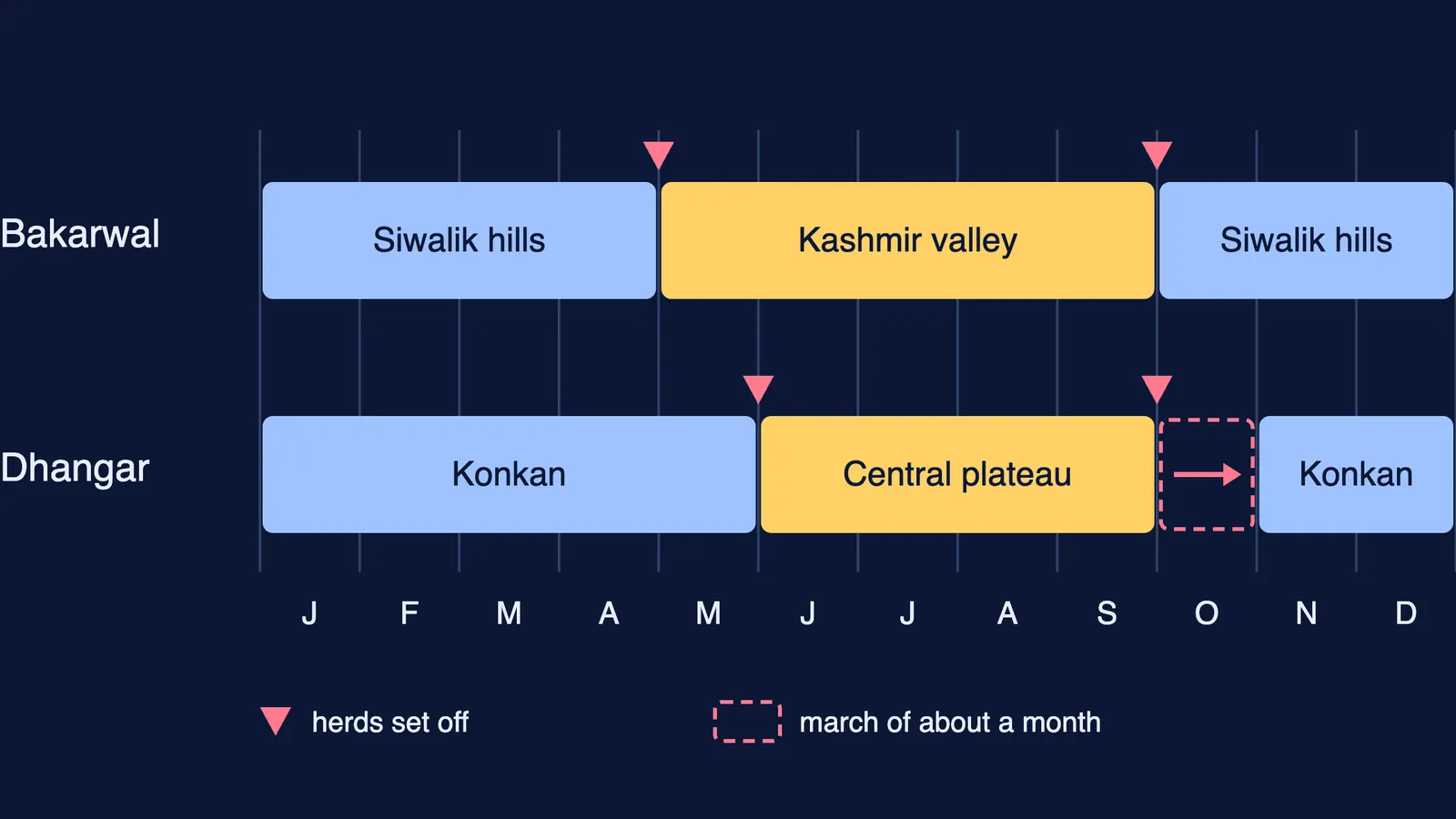
Gujjar Bakarwals (Jammu and Kashmir): goat and sheep herders who spent winter in the low Siwalik hills. By the end of April, households travelled together in a group called a kafila, crossed the Pir Panjal passes into the Kashmir valley for summer, and turned back by the end of September.
Dhangars (Maharashtra): their population in the early twentieth century was estimated at 467,000. They spent the monsoon on the dry central plateau, then marched about a month west to the Konkan after the October bajra harvest. There the flocks manured the fields for the rabi crop, and peasants gave rice in return.
Maasai (East Africa): cattle herders, about 300,000 in southern Kenya and 150,000 in Tanzania.
How did colonial rule change pastoralists' lives in India?
The chapter names four measures. For each one, learn why the state wanted it and what it did to herders (NCERT).
Waste Land Rules (from the mid-nineteenth century): uncultivated land paid no revenue, so it was handed to selected individuals to farm. In most areas, it was grazing land herders used regularly.
Forest Acts: forests with valuable timber such as deodar or sal were made 'Reserved', closed to pastoralists. In 'Protected' forests, permits fixed when herders could enter and how many days they could stay.
Criminal Tribes Act, 1871: it labelled many communities of craftsmen, traders and pastoralists criminal by birth. They had to live in notified villages and could not leave without a permit.
Grazing tax: herders paid tax on every animal. Between the 1850s and 1880s, the right to collect it was auctioned to contractors, who squeezed out as much as they could.
The result was too little pasture. Herds grazed the same land over and over, the grass got worse, and underfed cattle died in large numbers during famines. Herders adapted: some kept smaller herds, and others found new pastures. After 1947, the new border cut the Raikas off from Sindh, and in recent years they have been going to Haryana. Richer herders bought land and settled; poorer ones borrowed from moneylenders, and some became labourers.
What happened to the Maasai under colonial rule?
In 1885, Maasailand was cut in half by a border between British Kenya and German Tanganyika (NCERT). The best grazing land went to white settlers. The Maasai lost about 60 per cent of their pre-colonial lands and were pushed into a dry area with poor pastures. Large areas also became game reserves, such as the Maasai Mara and the Serengeti, which herders were not allowed to enter.
An enquiry in 1930 counted 720,000 cattle with the Maasai in Kenya. In two years of severe drought, 1933 and 1934, over half the cattle in the Maasai Reserve died, because the herders could not take them to where grass still grew.
Maasai society changed at two levels. The old split between elders and warriors was disturbed, because the British appointed chiefs and limited raiding. And a new gap opened between rich and poor: chiefs with a regular income could restock after drought, while poor herders lost nearly everything and looked for work in towns.
How do you answer the 'how did this law change their lives' questions?
Use the same three steps for every law. Here is the Criminal Tribes Act worked through:
Why the state wanted it: the British wanted a settled population that was easy to identify and control, and they saw mobile people as suspect.
What it did: in 1871, it classed many pastoral communities as 'criminal by birth'.
Effect on herders: they were confined to notified villages, needed a permit to move, and were watched by the village police.
For the India and Maasai comparison, sort every rule into one of three groups: it took land, limited movement, or took money. Then pair rules from the same group, such as Forest Act permits and Maasai reserve boundaries, which both limited movement.
To turn this into marks, practise writing full board answers after MCQ practice and draw the chapter as a mind map for revision. For a Class 9 economics link to rural livelihoods, read how the poverty line is measured.
If Class 9 science is also competing for your evening, Fermi's AI tutor can work out what you already know and build a plan for the session, so you know what to do first.


