On this page
You have separated the variables, integrated both sides, and you have an answer ending in "+ C". But the question gave you a point and wants a particular solution. This is where marks slip: C gets found from the wrong line, or never checked. Here is the method, two worked examples and a two-part check.
What is a particular solution of a differential equation?
A solution to a differential equation is a function y = f(x) that satisfies the equation when f and its derivatives are substituted into it, as defined in OpenStax Calculus Volume 2, section 4.1.
Solving usually gives you a whole family of curves, not one curve. The same OpenStax section shows that every function y = x² + C solves y′ = 2x, because the derivative of a constant is zero. That family, with its arbitrary constant, is the general solution.
A particular solution is the one member of the family that also fits extra information. OpenStax calls that information an initial value, and calls a differential equation together with its initial values an initial-value problem.
OpenStax also gives the rule that the number of initial values an initial-value problem needs is equal to the order of the differential equation. A first-order equation needs one point. A second-order equation needs two conditions, which is why finding the SHM equation takes both a starting position and a starting velocity.
How do you use an initial condition to find the constant?
Solve the equation fully, down to the general solution with one constant. If you integrated both sides and got two constants, combine them into one.
Substitute the given x and y into the general solution, not into the differential equation.
Solve that equation for C.
Rewrite the solution with the number in place of C, then check it (see the checks below).
OpenStax works this example: y′ = 3eˣ + x² − 4 with y(0) = 5 gives the general solution y = 3eˣ + x³/3 − 4x + C. Putting in x = 0 and y = 5 gives 5 = 3 + C, so C = 2.
Worked example 1: a separable equation
Solve dy/dx = 2xy, given y(0) = 3. (A refresher on the method: how to solve variable separable differential equations.)
Separate: dy/y = 2x dx.
Integrate: ln|y| = x² + c.
Exponentiate: y = A·e^(x²), where A stands for ±e^c.
Use the point: 3 = A·e⁰, so A = 3.
Particular solution: y = 3e^(x²).
Substituting at the ln stage (ln 3 = c) gives the same answer; any correct line of the general solution works.
Worked example 2: a linear equation
Solve x·dy/dx = y + x² for x > 0, given y(1) = 2. (The method is in linear differential equations and the integrating factor.)
Standard form: dy/dx − y/x = x.
Integrating factor: e^(∫−1/x dx) = 1/x.
Multiply through: d/dx(y/x) = 1, so y/x = x + C.
Multiply by x: y = x² + Cx.
Use the point: 2 = 1 + C, so C = 1.
Particular solution: y = x² + x.
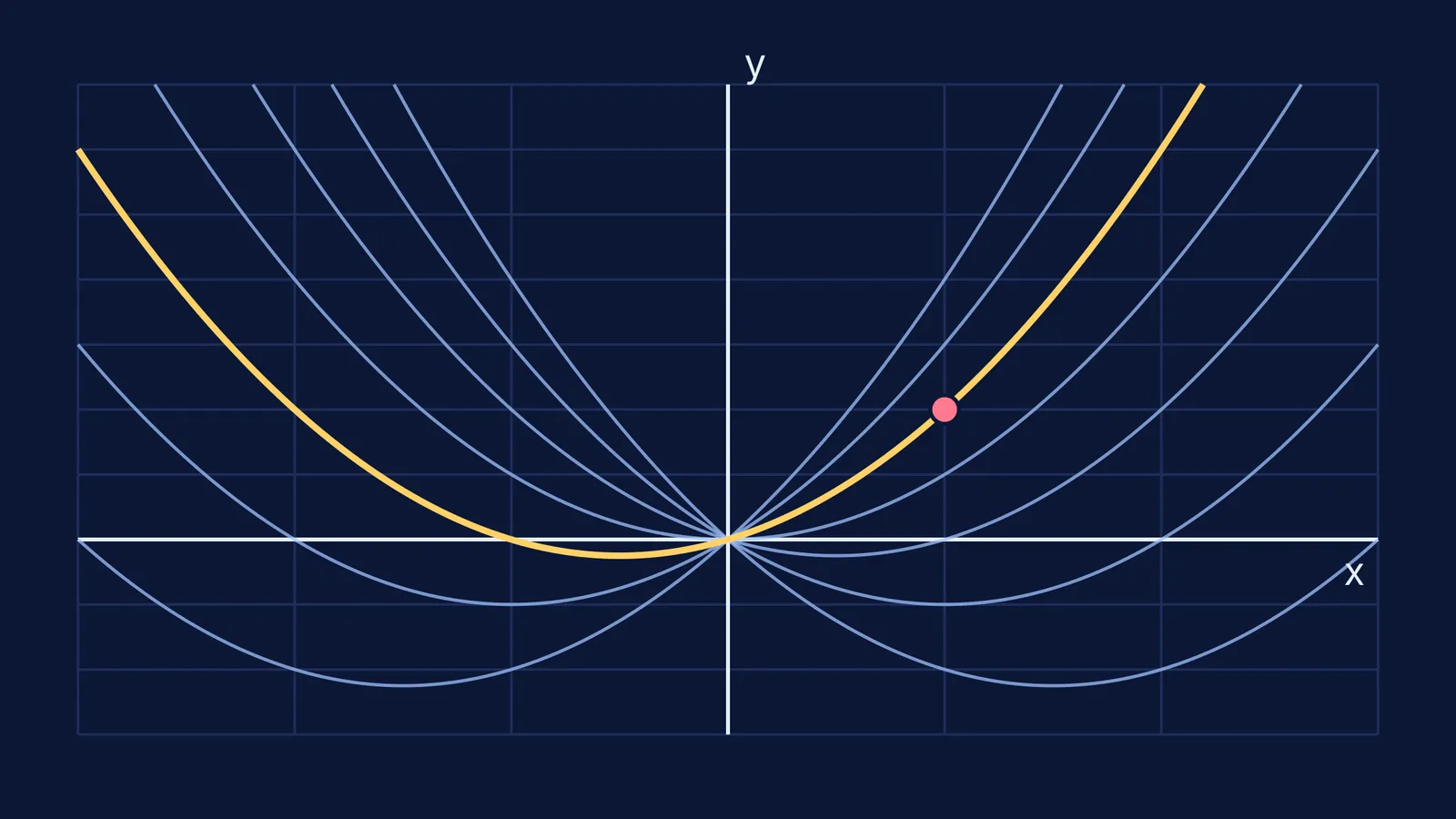
The diagram at the top shows this family: many curves solve the equation, and only C = 1 passes through (1, 2).
How do you check a particular solution?
There are two checks, and you need both.
Point check: put the given x into your answer. For example 2, y(1) = 1 + 1 = 2, which matches.
Equation check: differentiate your answer and substitute it into the original equation, as OpenStax describes. For example 2, y′ = 2x + 1, so x·y′ = 2x² + x, and y + x² = 2x² + x. Both sides agree.
For example 1: y′ = 6x·e^(x²) = 2x·(3e^(x²)) = 2xy, and y(0) = 3. Both checks pass.
If you keep losing the constant somewhere between integrating and the final line, the Fermi Problem Library has worked problems with a step-by-step solver that explains the reasoning rather than printing an answer.
Which mistakes cost marks with initial conditions?
Putting the point into the differential equation instead of the solution. The equation contains y′, which the point does not give you.
Keeping two constants, one from each side of the integral, and then solving for only one.
Dropping a sign. With ln|y| and a negative starting value such as y(0) = −3, the constant A is −3, not 3.
Ignoring the domain. In example 2, dividing by x only works because x > 0 was given.
If the general solution itself is the shaky part, the Fermi Concept Library gives every concept in mathematics its own lesson, so you can revise integrating factors first.
Next time you reach "+ C", write "point check, equation check" in the margin, and don't move on until both are ticked.