On this page
Matka kulfi is made the old way: sealed moulds of thickened milk sit in an earthen pot packed with ice and salt. Wikipedia's kulfi entry describes this method, and says it quickly freezes the mixture, giving a soft, smooth consistency free of ice crystals. The salt is what turns a pot of ice into a freezer.
Why is salt added to ice when making kulfi?
Ice on its own stays at 0 °C while it melts. The kulfi mix has sugar and milk solids dissolved in it, so it has to go below 0 °C to set. A bath stuck at 0 °C could never freeze the moulds solid.
Salt fixes this. Dissolved salt lowers the temperature at which water freezes, so the ice-salt bath settles far below 0 °C, and the moulds lose heat into it quickly.
How does salt make ice colder than 0 °C?
Freezing-point depression is a colligative property. According to OpenStax Chemistry 2e, colligative properties are solution properties that depend only on the total concentration of solute particles, not on what those particles are.
Here is what happens inside the matka:
Ice in a warm kitchen soon has a thin film of meltwater on it. Salt dissolves in that film and makes brine.
Brine freezes below 0 °C, so ice touching brine at 0 °C is too warm to stay solid. It melts.
Melting takes energy: 6.01 kJ for every mole of ice, according to LibreTexts' ChemPRIME chapter on enthalpy of fusion/10%3A_Solids_Liquids_and_Solutions/10.10%3A_Enthalpy_of_Fusion_and_Enthalpy_of_Vaporization).
Inside the insulated pot, that heat comes mostly from the ice, the brine and the kulfi moulds, so all of them get colder.
Melting slows and stops once the bath reaches the freezing point of the brine, just as plain ice holds at 0 °C.
So salt does not make cold. It moves the temperature at which ice and water can sit together, and melting ice pulls the bath down to that new temperature.
How cold can an ice-salt mixture get?
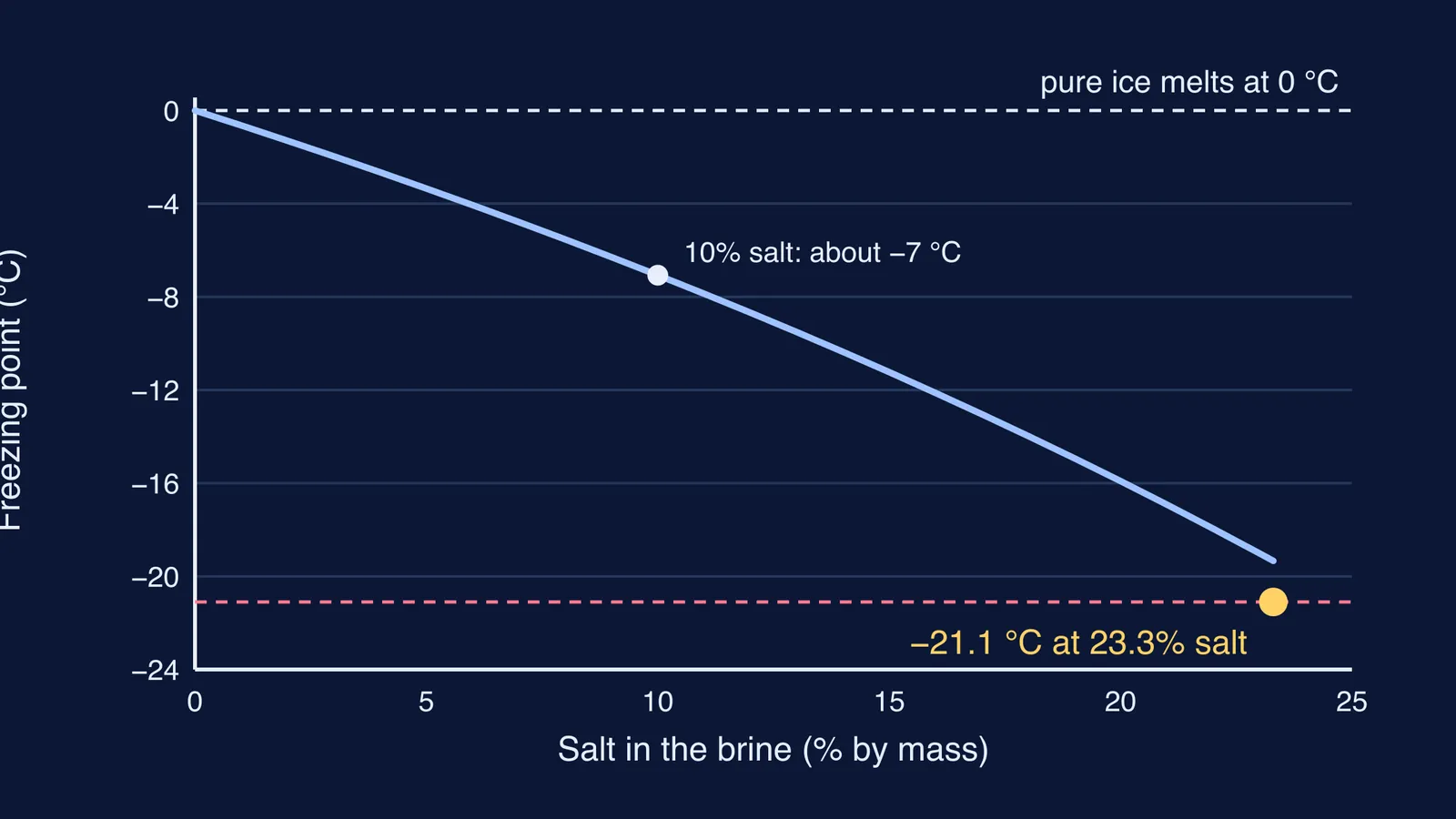
There is a floor. Chemguide's salt-solution phase diagram shows that up to 23.3% salt, the more salt you add, the lower the freezing point of the water.
The eutectic temperature of salt and water is −21.1 °C, the lowest temperature at which a salt-water mixture can contain any liquid, reached at 23.3% salt by mass (Chemguide; the same −21.1 °C appears in Purdue's road-salt research summary).
Piling on salt past that point does not help. A 23.3% brine is 23.3 g of salt in 76.7 g of water, about 30 g of salt per 100 g of water. So there is no point using more than roughly 1 part salt to 3 parts ice by mass; extra salt just sits undissolved.
Worked example: how much salt for −10 °C?
Class 12 and JEE Main chemistry use ΔTf = i × Kf × m, where m is molality. OpenStax lists Kf for water as 1.86 °C kg/mol. Sodium chloride splits into Na⁺ and Cl⁻, so its ideal van 't Hoff factor is 2; OpenStax notes the measured value is lower, 1.9 at 0.050 m, because the ions still attract each other.
Molality needed: m = 10 ÷ (2 × 1.86) = 2.69 mol/kg.
Mass of salt: 2.69 × 58.44 g/mol = 157 g of NaCl per kg of water.
Sanity check: at 23.3% salt (about 5.2 mol/kg) the same formula predicts −19.3 °C, close to but not the −21.1 °C eutectic temperature Chemguide gives. The formula is built for dilute solutions, so treat answers for strong brines as estimates.
For more practice, see our guides to colligative properties and the van 't Hoff factor and finding molar mass from depression in freezing point.
If your ΔTf numericals keep slipping at the i or molality step, the Fermi Problem Library has worked problems with a step-by-step solver that explains the reasoning rather than printing an answer.
Can you test this at home?
Yes, with two glasses and a thermometer. Here is a simple plan:
You need two steel glasses, crushed ice, table salt and a thermometer that reads below 0 °C.
Glass A: crushed ice and a splash of water. Glass B: the same, plus three spoons of salt, stirred well.
Read both thermometers every two minutes and note the numbers in your notebook.
Then add one more spoon of salt to Glass B and see whether the temperature drops further.
Use a spoon to stir, not your fingers: very cold brine can hurt skin on long contact.
Glass A should hover near 0 °C. If Glass B falls well below it, you have just measured a colligative property in your kitchen. Some ideas are easier to see than to read, and the Fermi Simulation Lab has interactive simulations built for exactly those.
Next, compare this with how instant ice packs get cold without a freezer.