

On this page
Have you ever snapped a plastic pouch on the sidelines of a football match and felt it turn freezing cold in seconds? That immediate chill is an everyday demonstration of chemical thermodynamics.
How does an instant ice pack get cold without a freezer?
Inside a commercial instant cold pack, there are two compartments: an outer pouch holding dry chemical crystals (usually ammonium nitrate or urea) and an inner pouch containing liquid water. When you squeeze the pack, the water pouch bursts.
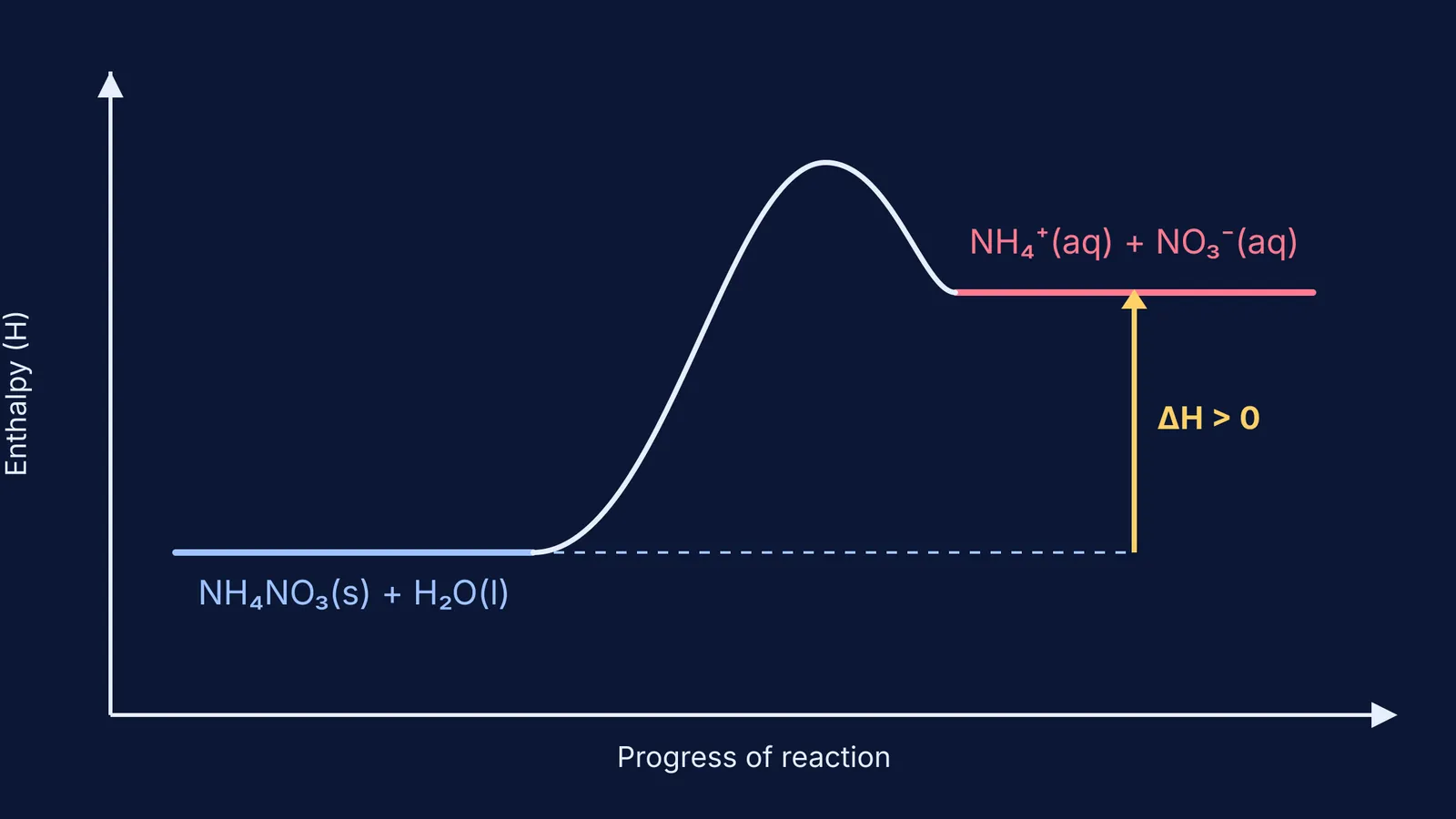
The mixing of ammonium nitrate (NH₄NO₃) and water triggers an endothermic dissolution process. This means the chemical reaction absorbs heat from its surroundings in order to proceed. In the case of a cold pack, the "surroundings" include the water in the pouch and, eventually, the skin of the person holding it. As the salt dissolves, it rapidly pulls thermal energy out of the water, causing the temperature of the resulting solution to plummet.
Why does dissolving a solid absorb heat?
When a solid ionic compound like ammonium nitrate dissolves, two things happen at the molecular level. First, the ionic bonds holding the solid crystal lattice together must break. This step always requires an input of energy. Second, the separated ions bond with the surrounding water molecules (a process called hydration), which releases energy.
For ammonium nitrate, the energy required to break the lattice is greater than the energy released during hydration. According to the OpenStax textbook *Chemistry 2e*, the dissolution of ammonium nitrate in water is endothermic, absorbing heat. This positive enthalpy of solution acts like a thermal deficit that must be paid by the ambient heat of the water, making the pack intensely cold.
How long does an instant ice pack last?
The temperature drop is almost immediate, but the therapeutic effect has a specific window. A 2002 study published in *Medicine & Science in Sports & Exercise* tracked soft tissue temperatures before, during, and after cold pack therapy. The researchers found that a 20-minute cold pack treatment produces significant temperature falls in the skin and the tissue 1 cm below the surface starting from 8 minutes of treatment.
A typical instant ice pack maintains its cold temperature for the duration of this treatment. Once all the ammonium nitrate has dissolved and the reaction concludes, the pack slowly absorbs heat from your body and the room until it returns to room temperature. Because deeper tissues (2 cm or more) do not cool significantly during standard application times, and because superficial tissues can be damaged by prolonged freezing, sports medicine guidelines generally recommend removing the pack after 20 minutes.
Studying the chemistry of cold
When preparing for board exams or competitive tests, thermodynamics and the enthalpies of phase changes are core concepts. The principles governing the heat flow in chemical processes are the same whether you are tracking a gas expansion or cracking a cold pack on a sprained ankle.
Visualising the energy profile of an endothermic reaction can sometimes be difficult from a textbook alone. The Fermi Simulation Lab has interactive simulations for the ideas that are easier to see than to read, such as how breaking and forming bonds shifts a system's enthalpy. If you are stuck on thermodynamics questions or calculating the enthalpy of solution from experimental data, the Fermi Problem Library has worked problems with a step-by-step solver that explains the reasoning rather than printing an answer.
A practical rule for calculations: If you are asked to calculate the final temperature of a dissolving salt in a calorimeter, remember that an endothermic reaction (positive ΔH) means the measured temperature of the water will go down, not up. Always use q = mcΔT, and assign the heat gained by the reaction as the heat lost by the water.


