

On this page
A small block or bead is let go from the rim of a smooth hemispherical bowl and slides down the inside. How hard does it press on the bowl at any angle? It takes two equations, used in the right order: energy for the speed, then Newton's second law along the radius for the force.
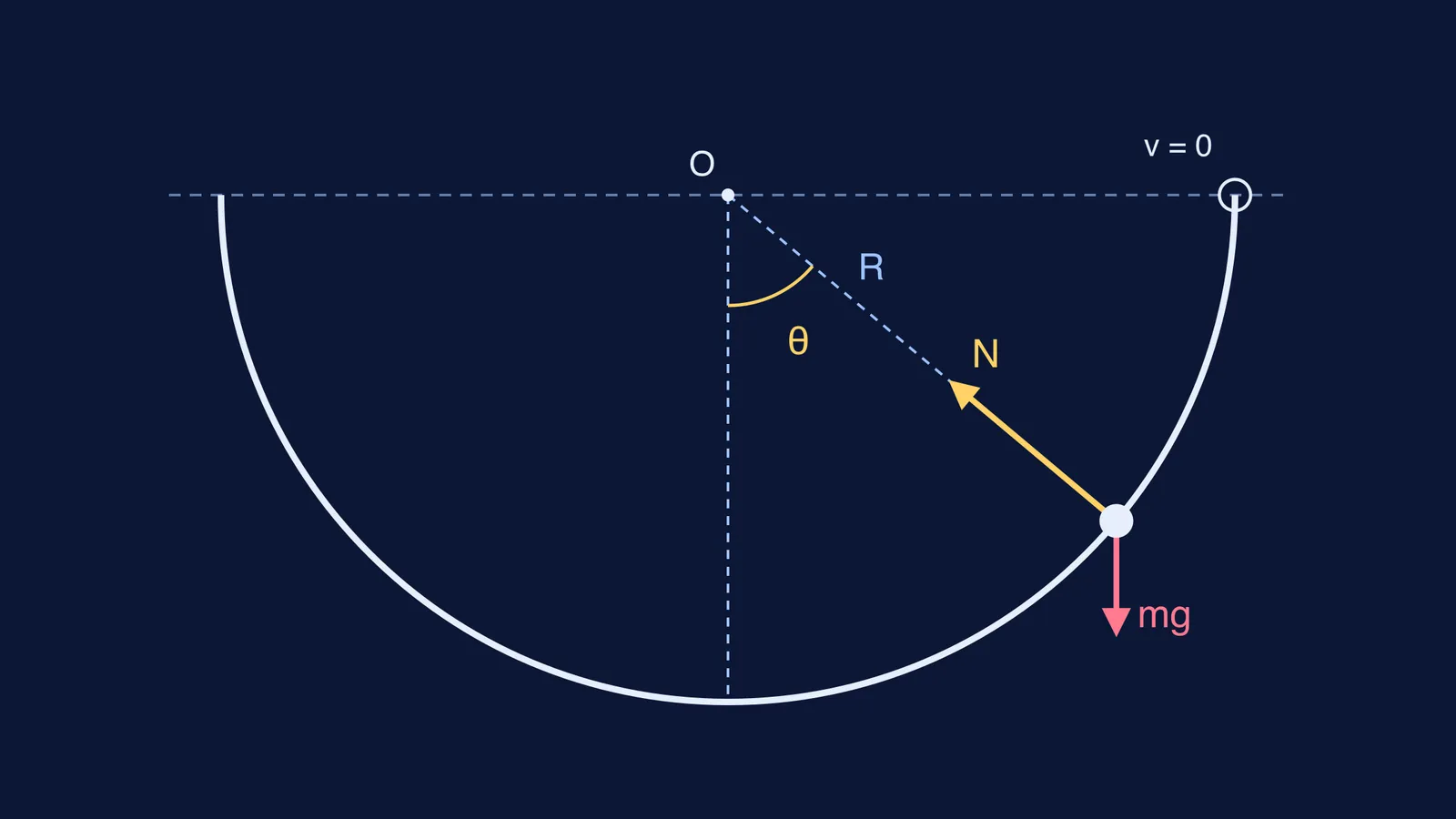
Throughout, θ is the angle between the radius to the particle and the vertical line through the centre O. So θ = 90° at the rim and θ = 0 at the bottom.
How do you find the speed at angle θ?
The bowl is smooth, so the only forces are gravity and the normal force. The normal force is always perpendicular to the surface, and so to the motion, which means it does no work. OpenStax University Physics notes that forces like the normal force do zero work when the motion is parallel to the surface, and that mechanical energy does not change if the non-conservative forces do no work.
The rim is level with O. At angle θ the particle is R cos θ below O, so it has fallen a height R cos θ. Starting from rest:
½mv² = mgR cos θ
v² = 2gR cos θ
The same energy step is used in how to find the speed of a pendulum bob at angle θ.
Why is N = 3mg cos θ and not mg cos θ?
The particle moves on a circle of radius R centred at O. Its speed is changing, so it has a tangential acceleration as well, but the component of acceleration toward the centre is still v²/R. OpenStax describes the total acceleration in such motion as the vector sum of the centripetal and tangential accelerations.
Now resolve the forces along the radius, taking "toward O" as positive:
The normal force N points from the particle straight toward O.
Gravity has a component mg cos θ along the radius, pointing away from O.
The net inward force must equal mv²/R.
So N − mg cos θ = mv²/R. Substitute v² = 2gR cos θ:
N = mg cos θ + 2mg cos θ
N = 3mg cos θ
Centripetal force is not an extra force to draw. OpenStax defines it as any net force causing uniform circular motion; with changing speed, the radial part of the net force, N − mg cos θ, does that job.
Worked example: a 0.20 kg block in a 0.50 m bowl
Take m = 0.20 kg, R = 0.50 m and g = 9.8 m/s². The block starts from rest at the rim. Both formulas follow from conservation of mechanical energy and the centripetal force relation Fc = mv²/r.
At the rim (θ = 90°): cos θ = 0, so v = 0 and N = 0.
At θ = 60°: v² = 2 × 9.8 × 0.50 × 0.5 = 4.9 m²/s², so v ≈ 2.2 m/s. N = 3 × 0.20 × 9.8 × 0.5 = 2.94 N.
At the bottom (θ = 0): v² = 9.8 m²/s², so v ≈ 3.1 m/s. N = 3 × 0.20 × 9.8 = 5.88 N, three times the weight.
The "three times the weight at the bottom" result is worth remembering as a sanity check, the same way the 6mg tension difference works for a full loop, derived in the vertical circle tension post.
What changes if the particle is not released from the rim?
Questions often change one detail:
Released from rest at angle θ₀ (measured from the vertical): the height fallen is R(cos θ − cos θ₀), so v² = 2gR(cos θ − cos θ₀) and N = mg(3 cos θ − 2 cos θ₀). Put θ₀ = 90° and you are back to 3mg cos θ.
Angle measured from the horizontal (call it φ, so φ = 90° − θ): the same result reads N = 3mg sin φ. Check which angle the question defines before you write cos.
Given a speed u at the rim: add ½mu² to the starting energy, so v² = u² + 2gR cos θ and N = 3mg cos θ + mu²/R.
A three-line checklist for any "inside a smooth surface" problem
Energy first: write the height fallen in terms of the angle the question uses, and get v².
Radial equation second: inward forces minus outward components equals mv²/R.
Test the limits: the start point, the lowest point, and whether N ever goes negative (if it does, the particle has left the surface).
If the energy step is where you slip, our list of three common work-energy mistakes walks through the usual traps. To practise variants, the Fermi Problem Library has worked problems with a step-by-step solver that explains the reasoning rather than printing an answer. If circular motion itself still feels shaky, the Fermi Concept Library gives each concept its own lesson and its place in the map.


