

On this page
Your job: find the weight of an unlabelled wooden block on Gravesand's apparatus, with no balance, using only the parallelogram law. The CBSE Senior Secondary Physics curriculum for 2025-26 lists it as Class XI Section A experiment 6: "To find the weight of a given body using parallelogram law of vectors." The same document gives the practical exam 30 marks, with 7 marks for each of the two experiments you perform (one from each section).
What does the parallelogram law say?
If two forces acting at a point are represented in size and direction by the two adjacent sides of a parallelogram drawn from that point, their resultant is represented by the diagonal through that point.
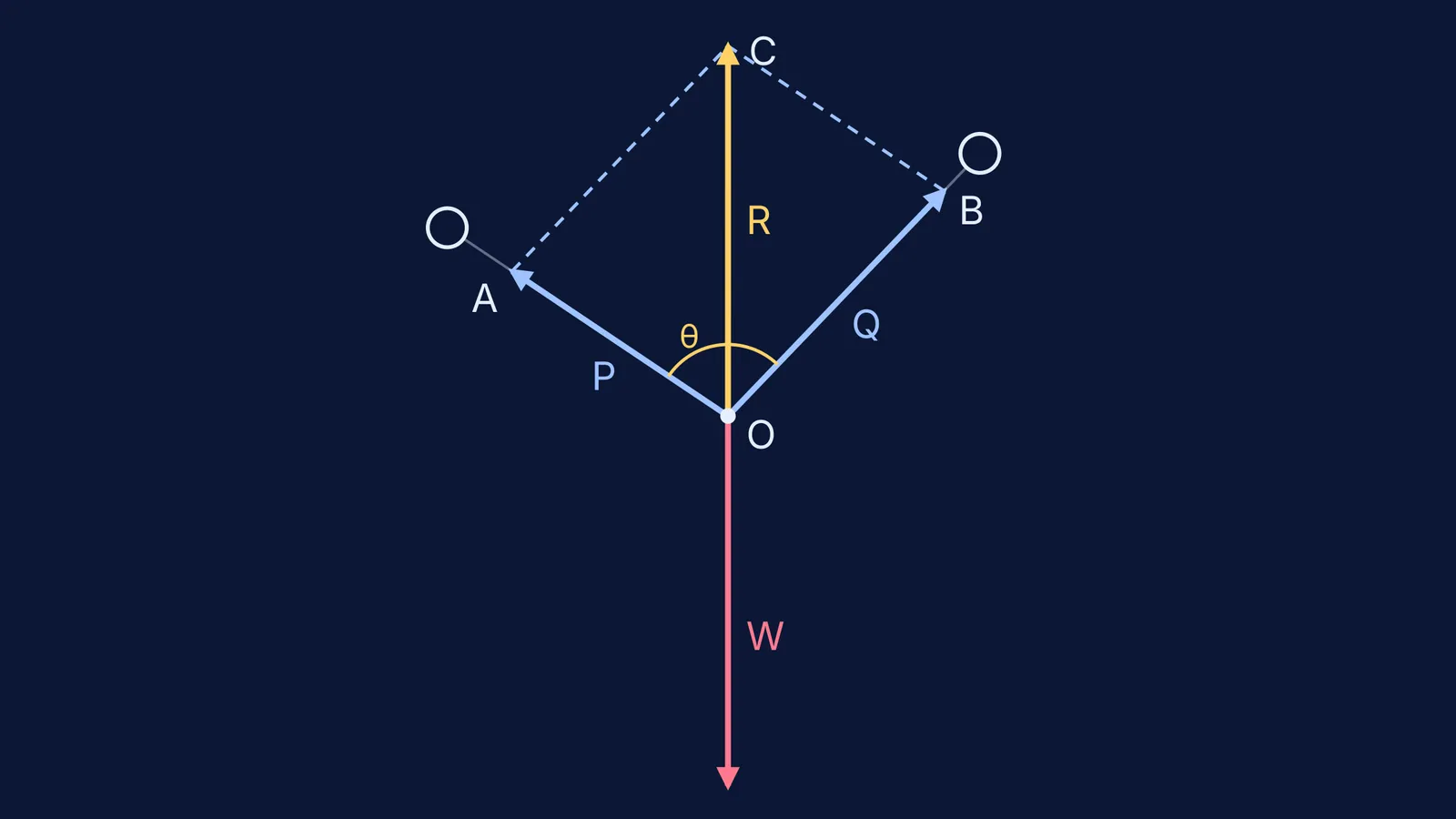
On Gravesand's apparatus, the knot O is held still by three forces: P and Q pulling up along the threads over the pulleys, and the unknown weight W pulling straight down. Because the knot is in equilibrium, the resultant R of P and Q must be equal and opposite to W. So the diagonal you draw should point straight up, and its length, converted with your scale, is W. In symbols, W = √(P² + Q² + 2PQ cos θ), where θ is the angle between the two threads.
For why three balanced forces must sum to zero, see our post on when three vectors of given magnitudes add to zero.
How do you set the weights on Gravesand's apparatus?
The steps follow the standard procedure in this Class 11 practical write-up.
Check that the board is vertical and both pulleys turn freely. Pulley friction is a common source of error.
Pin white paper on the board between the pulleys.
Run a thread over both pulleys with a hanger on each end, and tie the unknown body to the middle so the threads meet at a knot O.
Add slotted weights until the knot sits near the middle of the paper and no weight touches the board or the table. Count each hanger's own mass in P and Q.
Tap the board gently and mark only once everything is at rest.
Choose P and Q so the threads make a clear V. A very flat or very narrow V gives a thin parallelogram, where small pencil errors change the diagonal a lot.
How do you draw the force diagram to scale?
Hold the mirror strip under each thread, line the thread up with its own image to avoid parallax, and mark two points far apart on each of the three threads.
Take the paper down and join each pair of points. The three lines should meet at O.
Pick a scale that makes the drawing large, such as 1 cm = 25 gf (gram-force). Mark OA = P along the left thread and OB = Q along the right one.
Through A draw a line parallel to OB, and through B a line parallel to OA. They meet at C.
Measure OC. Then W = OC × scale.
Repeat with two more pairs of P and Q, take the mean and check the body on a spring balance.
How do you work out the weight from the diagram?
Suppose P = 250 gf, Q = 300 gf and your protractor shows 100° between the threads.
With 1 cm = 25 gf, OA = 10.0 cm and OB = 12.0 cm.
Completing the parallelogram, OC measures about 14.2 cm.
So W = 14.2 × 25 = 355 gf.
Check with the formula: √(250² + 300² + 2 × 250 × 300 × cos 100°) = √(152500 − 26047) ≈ 356 gf. Close agreement means the drawing is good.
If the spring balance then reads 360 gf, the percentage error is (360 − 355) ÷ 360 × 100 ≈ 1.4%.
The larger force, Q, makes the smaller angle with the vertical (about 44° against about 56° for P here). Equilibrium demands it: the sideways pulls P sin α and Q sin β must cancel. Splitting a force along slanted lines is the same skill as resolving a vector along two non-perpendicular axes.
When a vector problem goes wrong and you cannot see where, the Fermi Problem Library has worked problems with a step-by-step solver that explains the reasoning rather than printing an answer.
What might the viva ask?
Why must the diagonal be vertical? Because R balances W, and W acts straight down.
Why use a mirror strip? To avoid parallax when marking where the thread runs.
Is gf a unit of mass? No. Gram-force is a unit of force: the weight of a one-gram mass.
Why is the answer only approximate? Pulley friction, thread stiffness and the thickness of pencil lines.
Working out W from the formula before you read OC is the same predict-first habit as in our post on using a vector addition simulation to predict the resultant. If the theory itself feels shaky, the Fermi Concept Library gives every concept in physics its own lesson to revise before your practical.


