

On this page
Cut two parallel lines with a third line, called a transversal, and you get eight angles with four or five different names. It all comes down to one idea, plus a habit that works on any figure.
Which angles are equal when a transversal cuts parallel lines?
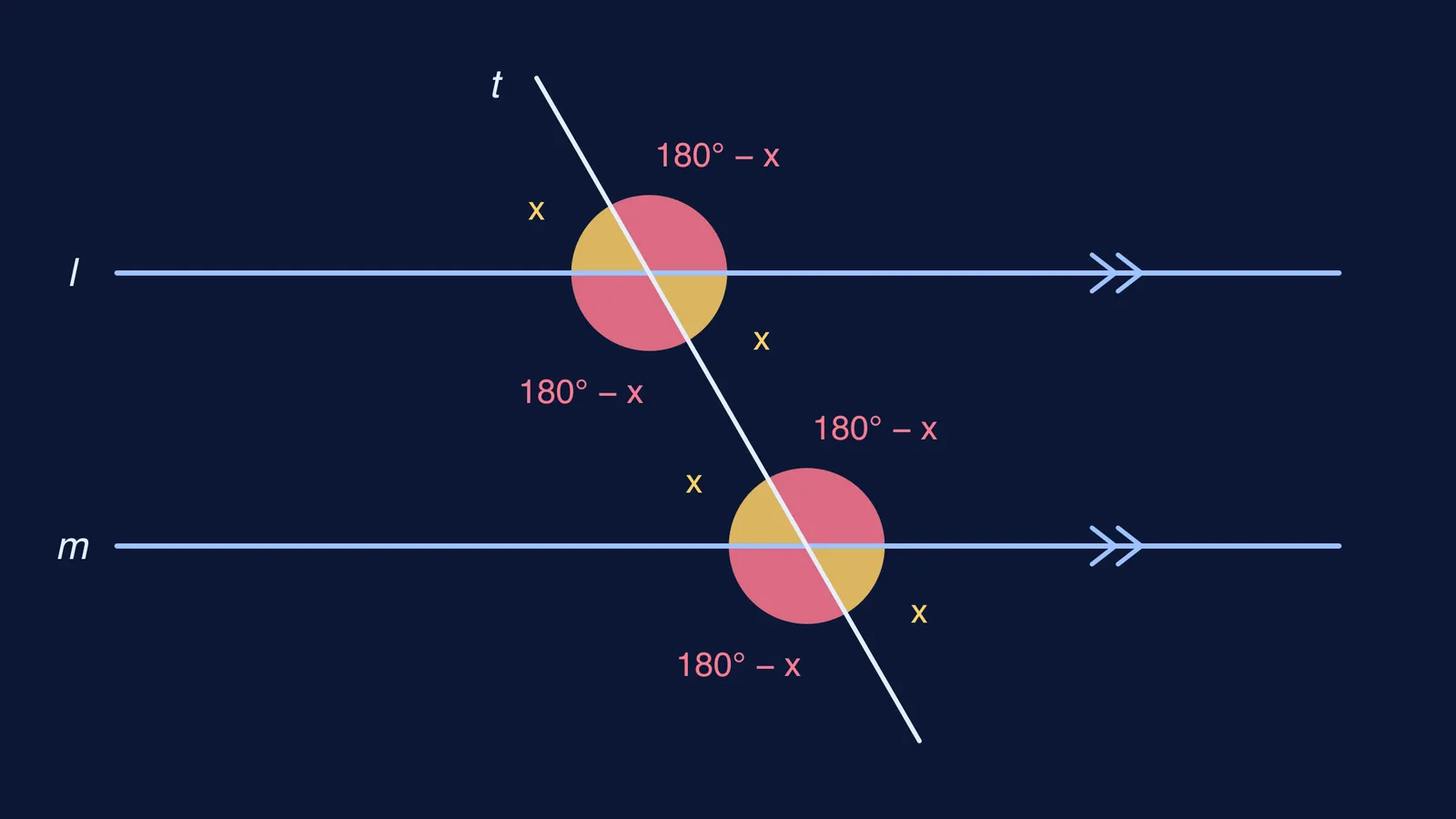
The rule goes back to Euclid. Proposition 29 of Book I of the Elements says that a straight line falling on parallel straight lines makes the alternate angles equal, the exterior angle equal to the interior and opposite angle, and the sum of the interior angles on the same side equal to two right angles (two right angles is 180°). Here it is in the words your textbook uses:
Corresponding angles sit in the same position at each crossing, for example both below their line and to the right of the transversal. They are equal. Look for an F shape.
Alternate interior angles lie between the two lines, on opposite sides of the transversal. They are equal. Look for a Z shape.
Alternate exterior angles lie outside the lines, on opposite sides. They are also equal.
Co-interior angles (also called same-side interior or consecutive interior angles) lie between the lines, on the same side of the transversal. They add to 180°. Look for a C or U shape.
One special case: a transversal perpendicular to both lines gives x = 90°, so all eight angles are 90°.
Which angle pairs add up to 180°?
Three kinds of pair add to 180°: co-interior angles, a linear pair (neighbouring angles on one straight line), and any acute angle with any obtuse angle in the figure. Vertically opposite angles are always equal, parallel or not. Our post on why vertically opposite angles are equal gives the two-line proof.
The rules hold only for parallel lines. Euclid's fifth postulate says that if the interior angles on one side add to less than two right angles, the two lines meet on that side. Proposition 29 is the first proposition in the Elements that depends on this postulate (Joyce's notes on I.29). No arrow marks and no "parallel" in the question means you cannot use these pairs.
The rule also works backwards: by Proposition 28, if corresponding angles are equal or co-interior angles add to two right angles, the lines are parallel. Use this to prove two lines parallel.
How do you chase angles across more than two lines?
Work through one crossing at a time, and write the reason as you go. Here is a worked example.
Lines l ∥ m, with l on top. From P on l, two lines run down to m, meeting it at Q (left) and R (right). PQ makes 70° with l on the left of P; PR makes 50° with l on the right. Find all three angles of triangle PQR.
At P, the three angles along l make a straight line: 70° + ∠QPR + 50° = 180°, so ∠QPR = 60°.
Angle PQR (at Q, inside the triangle) and the 70° angle at P are alternate angles across transversal PQ, because l ∥ m. So ∠PQR = 70°.
In the same way, ∠PRQ and the 50° angle are alternate angles across PR, so ∠PRQ = 50°.
Check: 70° + 60° + 50° = 180°, which is the angle sum of a triangle.
That check is a proof in disguise: this is how you prove a triangle's angles add to 180° using a parallel line.
With three or more parallel lines, use Proposition 30: straight lines parallel to the same straight line are also parallel to one another. So if l ∥ m and m ∥ n, then l ∥ n, and you can carry an angle straight from l to n along the transversal. If the path between two parallel lines has a bend in it, draw an extra line through the bend, parallel to both. The extra-line trick for a bend between parallel lines works that case through step by step.
A checklist before you write down any angle
Confirm the lines are parallel: arrow marks, or the question says so.
Name the transversal. Both angles in a pair must sit on it, one at each parallel line.
Decide the shape: F or Z means equal, C or U means they add to 180°.
Write each reason, such as "alternate angles, l ∥ m". In a proof, the reason is part of the answer.
Check with the two-number rule: acute matches acute, and acute plus obtuse is 180°.
Stuck? Draw a new line through the awkward vertex, parallel to the others.
If a chase stalls, the Fermi Problem Library has worked problems with a step-by-step solver that explains the reasoning rather than printing an answer, so you can see which pair was used at each step. To revise the idea first, the Fermi Concept Library gives each mathematics concept its own lesson.
Try it now: draw two parallel lines and a transversal, measure one angle, and predict the other seven.


