

On this page
When a kinetics problem gives you two rate constants, there are only two set-ups to learn. In parallel (competing) reactions, one reactant splits two ways. In consecutive reactions, a second step uses up the product of the first. Once you know which, each problem takes a few lines.
Everything below assumes every step is first order, the standard exam case. For a refresher on where ln 2 comes from, see our walk-through of deriving the first-order integrated rate equation.
How do you find the product ratio in parallel reactions?
Take A → B with rate constant k1, and A → C with rate constant k2. Both steps use up A, so A disappears at the rate (k1 + k2)[A], and [A] = [A]0 e^(−(k1 + k2)t), as the rate equation reference on Wikipedia sets out.
The key result: for two parallel first-order reactions that start with only A, [B]/[C] = k1/k2 at every moment of the reaction, as stated in Roberto Peverati's open physical chemistry textbook on LibreTexts/15%3A_Chemical_Kinetics/15.02%3A_Complex_Rate_Laws).
So the fraction of A that becomes B is k1/(k1 + k2), and the fraction that becomes C is k2/(k1 + k2). The ratio never drifts, so a "percentage of B" question needs no time.
What is the half-life of a parallel reaction?
Because A decays with the single constant k = k1 + k2, as the Pacific Union College LibreTexts notes show, the overall half-life is t½ = 0.693/(k1 + k2).
The same result can be written as 1/t½ = 1/t½(1) + 1/t½(2), where each term is the half-life A would have if only that path existed. It is the same algebra as a radioactive nucleus with two decay modes, covered in our post on effective half-life with two parallel decay modes.
Worked example: parallel. A → B with k1 = 0.02 min⁻¹, and A → C with k2 = 0.06 min⁻¹.
Overall constant: k = 0.02 + 0.06 = 0.08 min⁻¹.
Half-life: t½ = 0.693/0.08 = 8.66 min.
Product split: B is 0.02/0.08 = 25% of the product, C is 75%, so [B]/[C] = 1:3 at all times.
Check: the separate half-lives are 34.7 min and 11.6 min, and 1/34.7 + 1/11.6 gives back about 8.66 min.
After one half-life, half of A has reacted, so [B] = 0.25 × 0.5[A]0 = 0.125[A]0.
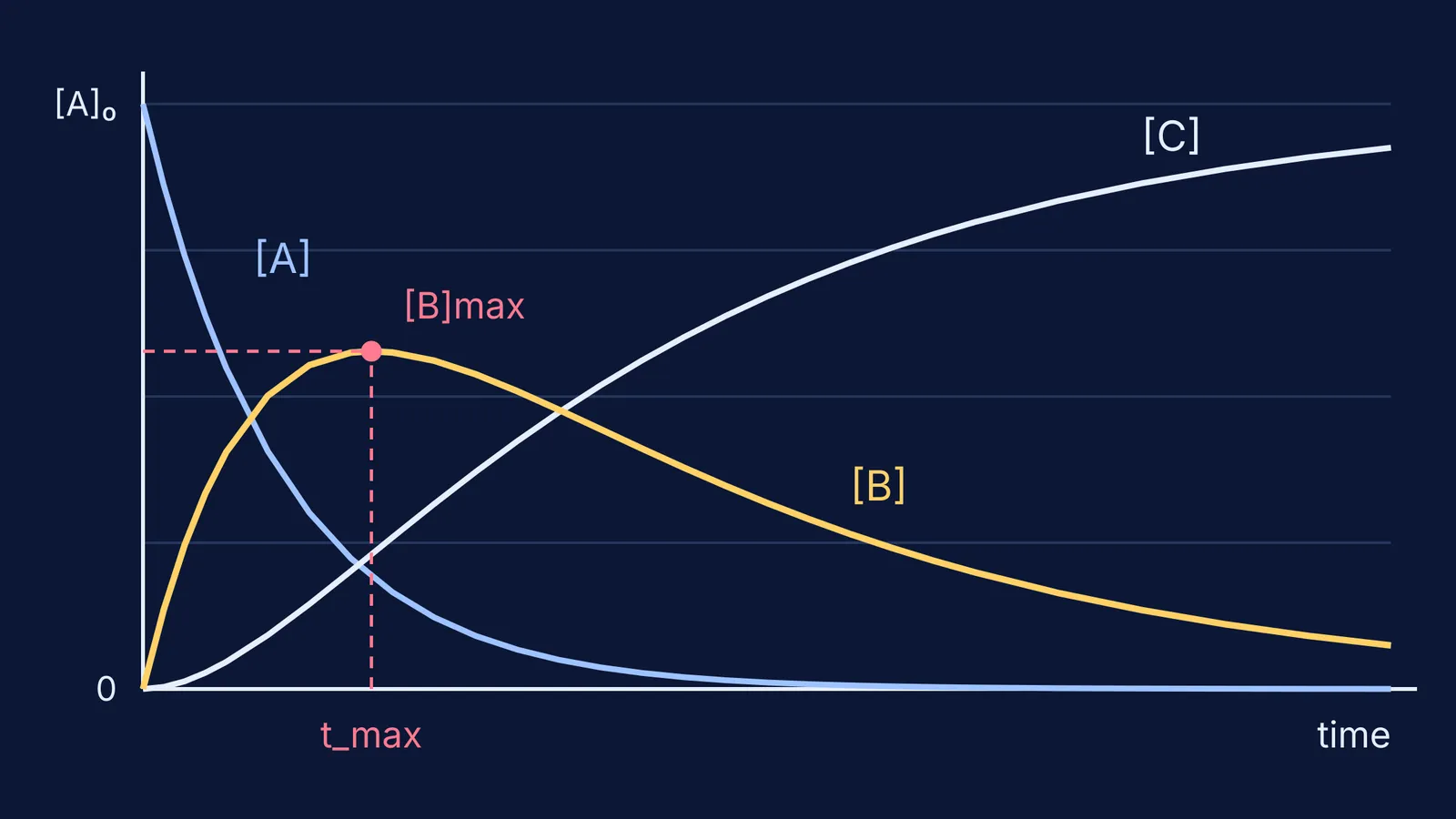
When does the intermediate reach its maximum in A → B → C?
Now let A → B have constant k1 and B → C have constant k2. The rate of change of B is d[B]/dt = k1[A] − k2[B]: B is made from A and used up to make C. Starting with pure A, the integrated result (from the same Wikipedia rate equation page and the LibreTexts chapter/15%3A_Chemical_Kinetics/15.02%3A_Complex_Rate_Laws)) is:
[B] = [A]0 · k1/(k2 − k1) · (e^(−k1t) − e^(−k2t)), for k1 ≠ k2.
B starts at zero, rises and then falls, so it has a peak. At the peak, its slope is zero. Differentiate the bracket and set it to zero: k1e^(−k1t) = k2e^(−k2t), so e^((k2 − k1)t) = k2/k1, which gives:
t_max = ln(k2/k1)/(k2 − k1)
at t_max, k1[A] = k2[B], because the rate at which B forms equals the rate at which it is used up
so [B]max = (k1/k2) × [A] at t_max, which is often the quickest route to the peak height
Worked example: consecutive. A → B with k1 = 0.3 min⁻¹, then B → C with k2 = 0.1 min⁻¹ (the curves in the diagram above).
t_max = ln(0.1/0.3)/(0.1 − 0.3) = ln 3/0.2 = 5.49 min.
[A] at that moment: e^(−0.3 × 5.49) = e^(−1.648) = 0.193[A]0.
[B]max = (0.3/0.1) × 0.193[A]0 = 0.577[A]0, so about 58% of the starting A is sitting as B.
Swap the constants (k1 = 0.1, k2 = 0.3) and t_max stays 5.49 min, because the formula is symmetric. But [B]max = (1/3) × e^(−0.549)[A]0 = 0.192[A]0. A slow second step lets B pile up; a fast one keeps it scarce.
How do you tell which type of problem you have?
Read the arrows before you reach for a formula:
One reactant, two arrows leaving it: parallel. Use k1 + k2 for anything about A, and k1/k2 for anything about the products. Never use k1 alone for the half-life.
A chain of arrows: consecutive. [A] decays with k1 alone; B needs the two-exponential formula.
"Maximum yield of the intermediate" or "when is B highest": find t_max first, then [B]max.
One step much slower than the rest: it controls the overall rate. See our guide on finding the rate law from a reaction mechanism.
If you keep picking the wrong set-up, work a few in a row. The Fermi Problem Library has worked problems with a step-by-step solver that explains the reasoning rather than printing an answer. If the gap is the idea of a rate constant itself, the Fermi Concept Library gives each chemistry concept its own lesson.
Try it now: change k2 to 0.2 min⁻¹ in the consecutive example and predict whether t_max moves earlier or later before you calculate it.


