On this page
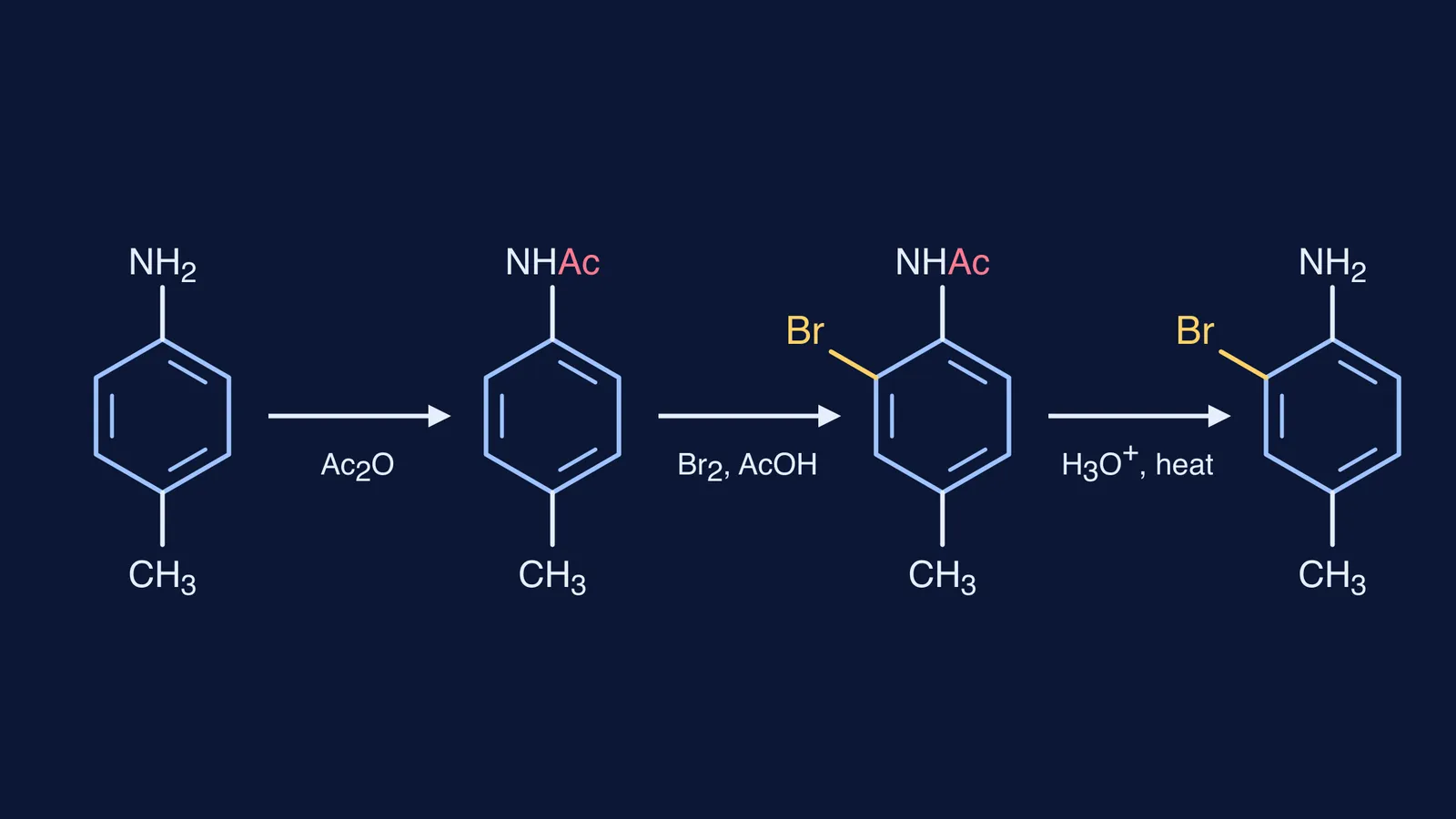
If a question asks you to convert p-toluidine (4-methylaniline) into 2-bromo-4-methylaniline, it is testing one idea: you cannot control an amino group on a benzene ring until you tame it. The route has three steps, and each has a reason you should be able to say in one line.
Why can't you brominate p-toluidine directly?
The –NH2 group is a powerful activating, ortho- and para-directing group. NCERT's Class 12 chapter on amines shows what that means in practice: aniline reacts with bromine water at room temperature to give a white precipitate of 2,4,6-tribromoaniline. The same chapter names the main problem as the very high reactivity of aromatic amines, with substitution tending to occur at the ortho and para positions.
In p-toluidine the para position is already taken by the methyl group, but both positions ortho to –NH2 are open. A free amino group gives you no reason to expect the reaction to stop after one bromine. You want exactly one, so you need a calmer ring.
How does acetylation tame the amino group?
NCERT's fix is to protect the –NH2 group by acetylation with acetic anhydride, carry out the substitution, then hydrolyse the substituted amide back to the amine. In the amide, the nitrogen lone pair interacts with the carbonyl oxygen by resonance, so it is less available to the ring and –NHCOCH3 activates less than –NH2.
The chapter also shows why control matters for other reactions. Direct nitration of aniline gives tarry oxidation products and a mixture of 51% para, 47% meta and 2% ortho nitroaniline; the large meta share appears because, in the strongly acidic medium, aniline is protonated to the meta-directing anilinium ion. Nitrating the acetylated compound instead makes the para product the major one. For more on this idea, read our explainer on why acetylation protects aniline.
Why does bromine go next to the nitrogen, not the methyl?
After acetylation you have N-(4-methylphenyl)acetamide, also called p-acetotoluidide. Both substituents direct ortho and para, but they sit para to each other, so each can only send bromine to its own ortho positions:
–NHCOCH3 still donates its lone pair into the ring, so it remains the stronger activator.
–CH3 is only a weak activator.
The stronger director wins, so bromine enters at carbon 2, beside the nitrogen. Because the amide has toned down the ring, adding about one equivalent of bromine slowly gives a single substitution.
How was this conversion done in a real lab?
This is not only a textbook exercise. An Organic Syntheses procedure for 3-bromo-4-aminotoluene, submitted by J. R. Johnson and L. T. Sandborn and first published in 1926, runs exactly these three steps:
Acetylation: p-toluidine is refluxed with glacial acetic acid for two hours to give p-acetotoluide.
Bromination: about one equivalent of bromine is added slowly while the mixture is held at 50–55 °C, and the bromo amide separates when the mixture is poured into cold water containing sodium bisulfite, which removes leftover bromine.
Hydrolysis: the bromo amide is refluxed with ethanol and concentrated hydrochloric acid for three hours, the amine hydrochloride crystallises out, and sodium hydroxide sets the free amine loose as an oil.
The procedure reports a crude yield of 60–67% based on the p-toluidine used, and says the amine, once distilled, melts at 16–18 °C. Notice one difference from NCERT, which acetylates with acetic anhydride and pyridine: both reagents give the same amide.
How should you write this conversion in an exam?
Here is a short answer you can copy the shape of. Write the reagent above the arrow and one reason under each step.
p-Toluidine + (CH3CO)2O, pyridine → N-(4-methylphenyl)acetamide. Reason: lowers the activating effect of –NH2 so only one bromine enters.
N-(4-methylphenyl)acetamide + Br2 in CH3COOH → N-(2-bromo-4-methylphenyl)acetamide. Reason: –NHCOCH3 directs ortho; its para position is blocked by –CH3.
N-(2-bromo-4-methylphenyl)acetamide + H3O+ (or OH–), heat → 2-bromo-4-methylaniline. Reason: hydrolysis removes the acetyl group and returns the amine.
Before you move on, check three things:
Bromine is drawn beside –NH2, not beside –CH3.
The answer does not stop at the amide: without step 3 your final product is the bromo amide, not the amine.
Every step has a one-line reason, not just a reagent.
The same protect, substitute, hydrolyse pattern turns up in the p-nitroacetanilide preparation practical. For contrast, look at a route where you want every free position brominated, as in converting aniline to tribromofluorobenzene.
If you get the steps right but cannot say why bromine lands where it does, the Fermi Problem Library has worked problems with a step-by-step solver that explains the reasoning rather than printing an answer. To revise directing groups themselves, the Fermi Concept Library gives each chemistry concept its own lesson.