

On this page
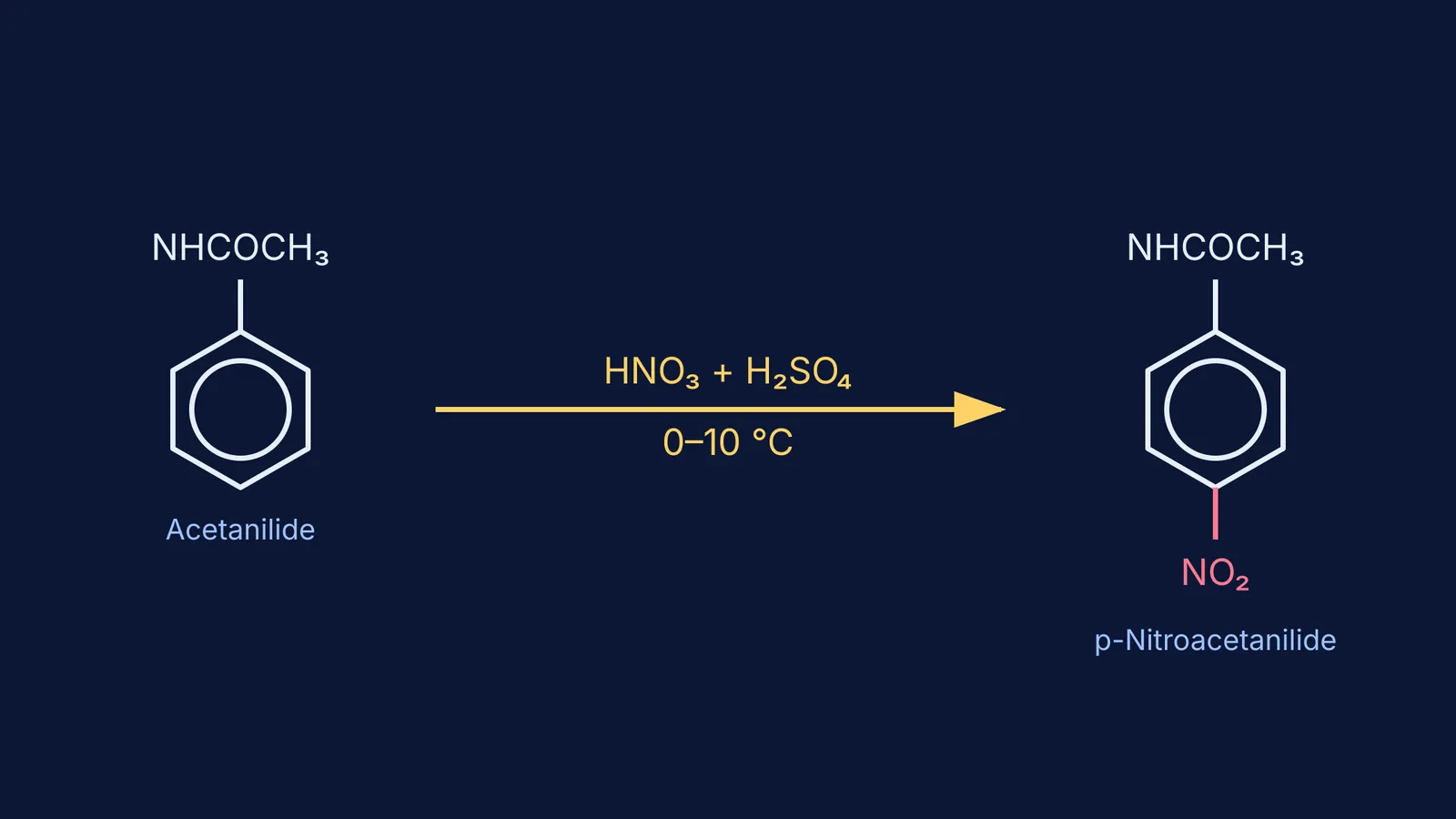
Directly adding nitric acid to aniline does not yield a good amount of the expected nitroanilines. Instead, the highly reactive amino group is oxidised, forming a dark, tarry mixture. Furthermore, in the strongly acidic nitrating mixture, aniline is protonated to form the anilinium ion. The -NH₃⁺ ion is a meta-directing group, leading to an unexpected mixture of roughly 51% para, 47% meta, and 2% ortho products (NCERT). To solve this, the amino group is first protected by acetylation to form acetanilide.
Why do we control the temperature?
The nitration is carried out strictly between 0 °C and 10 °C (NCERT Lab Manual). If the temperature rises, the reaction becomes violent and can lead to the formation of dinitro by-products. The bulky acetamido group (-NHCOCH₃) is ortho- and para-directing. Due to steric hindrance, the incoming nitronium ion (NO₂⁺) predominantly attacks the para position, making p-nitroacetanilide the major product. The Fermi Concept Library covers every concept in physics, chemistry, biology, mathematics and computing, each with its own lesson and its place in the map.
What happens during the electrophilic substitution?
The nitration of acetanilide is a classic example of an electrophilic aromatic substitution reaction. In the first step, the nitrating mixture generates the active electrophile, the nitronium ion (NO₂⁺). Concentrated sulphuric acid acts as a stronger acid and donates a proton to nitric acid. The protonated nitric acid then loses a water molecule to form the highly reactive nitronium ion. This step is why concentrated sulphuric acid is essential; nitric acid alone cannot produce enough electrophiles for a fast reaction.
Once the nitronium ion is formed, it attacks the electron-rich benzene ring of acetanilide. The intermediate formed is a resonance-stabilised carbocation known as an arenium ion or sigma complex. Finally, a base in the reaction mixture, such as the hydrogen sulphate ion (HSO₄⁻), removes a proton from the carbon atom bearing the nitro group. This restores the aromaticity of the ring and yields the substituted product. The acetamido group's lone pair of electrons on nitrogen delocalises into the ring, increasing electron density primarily at the ortho and para positions, directing the attack.
What is the procedure for nitrating acetanilide?
This method follows the standard organic chemistry laboratory instructions for synthesising p-nitroacetanilide.
Dissolve the reactant: Place 5 g of powdered acetanilide into a conical flask and add 5 mL of glacial acetic acid. Stir well.
Add sulphuric acid: Slowly add 10 mL of concentrated H₂SO₄ with constant stirring. The mixture will warm up; cool it under tap water until it becomes clear.
Cool the flask: Place the flask in an ice bath (crushed ice and salt) until the temperature drops below 5 °C.
Prepare the nitrating mixture: In a separate test tube, slowly add 2 mL of fuming HNO₃ to 2 mL of concentrated H₂SO₄ while keeping it chilled in ice.
Nitration: Add this cold nitrating mixture drop-by-drop to the acetanilide solution. Stir continuously and ensure the temperature never exceeds 10 °C.
Precipitation: Let the flask stand at room temperature for 30 minutes, then pour the contents over 100 g of crushed ice. The crude p-nitroacetanilide will precipitate as a pale yellow solid.
Filtration and purification: Filter the solid using a funnel, washing thoroughly with cold water to remove the acid. Finally, dissolve the crude solid in about 20 mL of hot ethanol and allow it to cool. Pure, colourless crystals of p-nitroacetanilide will separate out.
Like the selective bromination of phenol or reducing nitrobenzene to aniline, success relies on carefully controlling the reagents and conditions.
Why is crystallisation necessary for purification?
After the reaction, the crude product is a pale yellow solid that contains impurities. These impurities include the minor ortho-nitroacetanilide isomer, unreacted acetanilide, and potentially traces of dinitro compounds or acidic residues. Crystallisation from ethanol is a highly effective purification technique because it relies on differences in solubility at varying temperatures.
Both the ortho and para isomers are soluble in hot ethanol, but the para isomer is much less soluble in cold ethanol. This difference arises because the highly symmetrical structure of p-nitroacetanilide allows it to pack tightly into a crystal lattice, reducing its solubility. As the hot solution cools, the p-nitroacetanilide crystallises out, while the ortho isomer and other impurities remain dissolved in the cold mother liquor. Washing the filtered crystals with cold water or a small amount of cold solvent removes any adhering mother liquor without dissolving the desired product. This straightforward purification step ensures that the final dried crystals have a sharp melting point, characteristic of a high-purity chemical compound.
How do you calculate the percentage yield?
When you report your practical results, you must calculate the percentage yield. Pure p-nitroacetanilide forms white or colourless crystals with a melting point of 215–217 °C (PubChem).
For a starting mass of 5.0 g of acetanilide (molar mass = 135.17 g/mol), you begin with 0.037 moles. Since the reaction is 1:1, the theoretical yield of p-nitroacetanilide (molar mass = 180.16 g/mol) is:
0.037 mol × 180.16 g/mol = 6.66 g
If your dried, recrystallised product weighs 4.0 g, your percentage yield is:
(4.0 g / 6.66 g) × 100 = 60%
The ortho-nitroacetanilide formed as a minor product is more soluble in ethanol and remains dissolved in the mother liquor during the crystallisation step, ensuring your final solid is the pure para isomer.


