On this page
Most students would bet on fluorine to hold a metal in a high oxidation state. Manganese says otherwise. It reaches +7 with oxygen, in Mn2O7, but only +4 with fluorine: manganese tetrafluoride, MnF4, is the highest fluoride of manganese_fluoride). This post explains why, using the measured structure of Mn2O7, and ends with an answer you can write in an exam.
Why does oxygen stabilise higher oxidation states than fluorine?
There are two reasons, and the second one does most of the work.
Charge per ligand. Oxide is O2− and fluoride is F−. Each oxygen balances two units of positive charge on the metal, each fluorine only one. To reach +7, manganese needs 3.5 oxygens per atom (Mn2O7), but it would need seven fluorines packed around one atom.
Multiple bonds. Manganese is [Ar]3d5 4s2, so at +7 it has no d electrons left and its d orbitals are empty. Filled 2p orbitals on oxygen can push electron density into those empty orbitals, so each terminal link becomes a Mn=O double bond (one σ bond plus one π bond). That extra bonding feeds electron density back to the very positive metal. Fluorine bonds to the metal through a single bond, so each fluorine gives less.
This fits a wider pattern in inorganic chemistry: metals bound to multiply bonded oxo ligands are generally assigned high oxidation states with low d-electron counts.
What does the structure of Mn2O7 show?
The crystal structure of Mn2O7 was solved in 1987 by Arndt Simon, Richard Dronskowski, Bernt Krebs and Bernhard Hettich. Their abstract reports that the Mn atoms are surrounded tetrahedrally by O atoms, and that the bridging and terminal Mn–O bonds have different lengths.
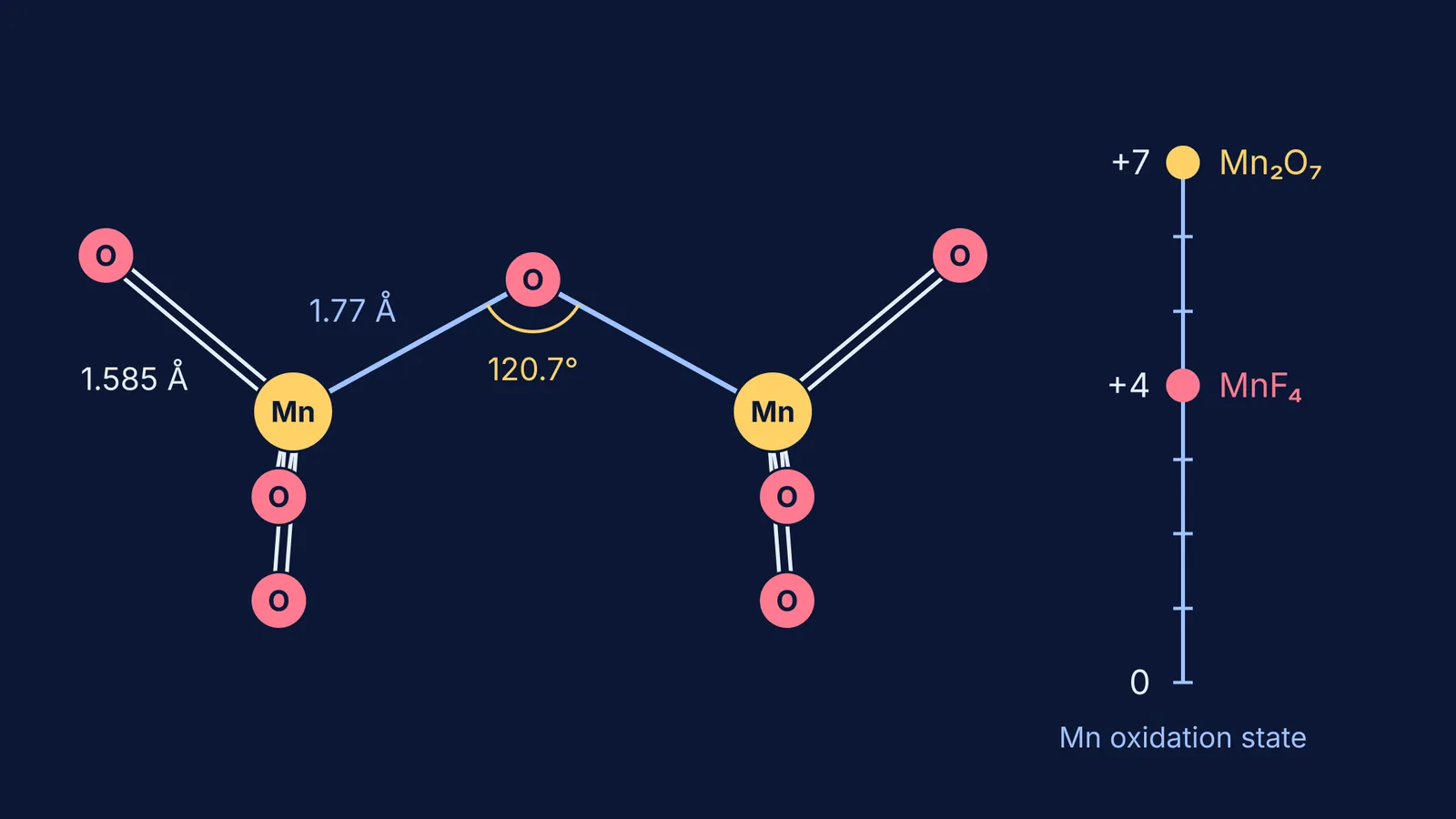
The manganese heptoxide reference entry, citing that paper, gives the numbers. Each terminal Mn–O bond is 1.585 Å long. Each bridging Mn–O bond is 1.77 Å long. The Mn–O–Mn angle is 120.7°.
So the molecule is two MnO4 tetrahedra sharing one corner: O3Mn–O–MnO3. The six terminal bonds are shorter than the two bridging ones. Between the same two atoms, a shorter bond usually means a higher bond order. That is what you expect if the terminal bonds are Mn=O doubles and the shared bridge oxygen, bonded to two metals, forms single bonds. Each half looks like permanganate, the tetrahedral ion that also holds manganese at +7. See also the structure of dichromate and permanganate ions.
Mn2O7 is a volatile, oily liquid that decomposes near room temperature, explosively above 55 °C. Here, "stabilise" means the oxidation state can be reached in a real compound, not that the compound is safe to handle.
Why does manganese stop at MnF4?
Even +4 is only just held: MnF4 sits in equilibrium with MnF3 and fluorine gas_fluoride). Molecular fluorides tell a similar story. In a 2016 matrix-isolation study in Dalton Transactions, Felix Brosi, Sebastian Riedel and colleagues co-deposited manganese or MnF3 with fluorine in solid neon, argon, nitrogen or neat fluorine at 5–12 K. The new infrared bands they detected were assigned to MnF, MnF2 and MnF3.
One compound tests the multiple-bond idea neatly. Permanganyl fluoride, MnO3F, does exist with manganese at +7: three oxygens supply the multiple bonding and one fluorine sits on a single bond. Even so, it is a liquid that decomposes above its melting point of −45 °C. Replace all the oxygens with fluorines and the +7 state is gone.
If the link between oxidation state, d-electron count and bonding still feels shaky, the Fermi Concept Library gives each concept its own lesson, so you can revisit d-orbital filling first.
How do you write this answer in an exam?
Work through it in four lines first:
Mn in Mn2O7: 2x + 7(−2) = 0, so x = +7.
Mn in MnF4: x + 4(−1) = 0, so x = +4.
Mn is [Ar]3d5 4s2, so Mn(VII) is d0 and has empty d orbitals to accept π electrons.
In the Lewis picture, Mn2O7 has six Mn=O double bonds and two Mn–O single bonds to the bridge: 8 σ bonds and 6 π bonds.
A two-mark answer: "Oxygen can form pπ–dπ multiple bonds with the metal, while fluorine forms only single bonds. So oxygen stabilises higher oxidation states. The highest oxide of manganese is Mn2O7 (+7), while the highest fluoride is MnF4 (+4)."
Check these before you write:
Name both compounds and both oxidation states.
Use the words "multiple bonds". That is the standard textbook reason.
Do not argue from electronegativity alone. It points the wrong way here.
If asked for the structure, say "two tetrahedra sharing a corner, with a Mn–O–Mn bridge".
The +7 state also explains a related question: why Mn2O7 is acidic while MnO is basic. For the bigger picture across the series, read which transition metal oxidation states are stable and why.
To practise, try oxidation-state and bonding questions in the Fermi Problem Library, where a step-by-step solver explains the reasoning rather than printing an answer.