

On this page
Transition metal compounds like potassium dichromate and potassium permanganate are famous for their intense colours and oxidising power. But when you look closely at their structures, a common question arises: why are all the bonds in permanganate identical, while dichromate has two distinct bond lengths?
The answer lies in how their tetrahedra are arranged and how resonance is shared across the oxygen atoms.
What is the structure of the permanganate ion?
The permanganate ion (MnO₄⁻) is built around a central manganese atom in its highest oxidation state (+7).
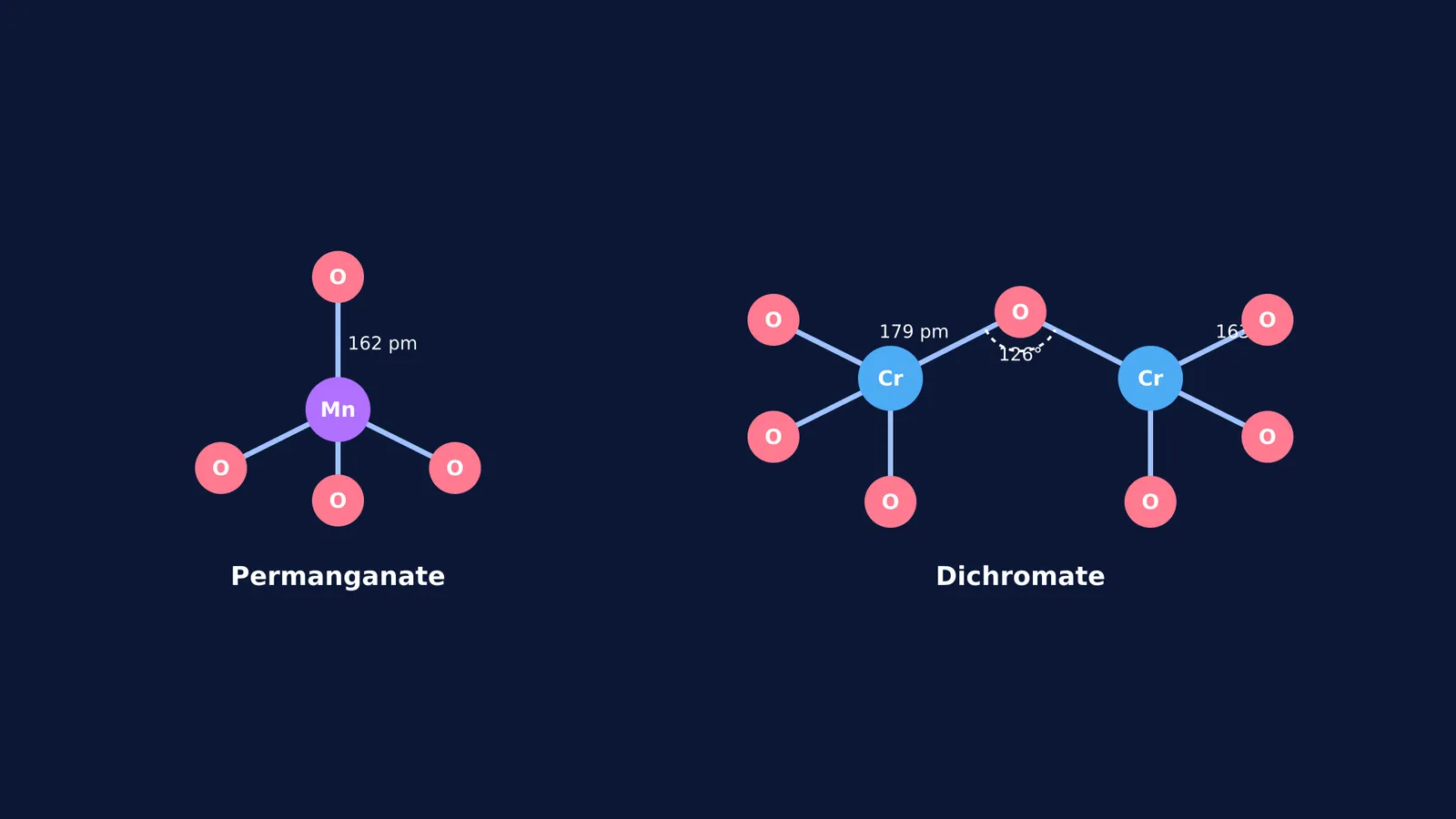
Its geometry is a single, symmetrical tetrahedron. Although we often draw a Lewis structure with three double bonds and one single bond, resonance ensures that the pi electrons are delocalised over the entire molecule. Because of this, all four Mn–O bonds are strictly equivalent. They each have a bond length of approximately 162 pm, which is shorter than a pure single bond. If you want to know more about how delocalisation affects bond length, see how to find the average bond order from resonance.
What is the structure of the dichromate ion?
The dichromate ion (Cr₂O₇²⁻) features chromium in the +6 oxidation state. Unlike permanganate, it does not form a single tetrahedron.
Instead, its structure consists of two tetrahedral CrO₄ units that share a common vertex. This shared vertex is a single bridging oxygen atom, which links the two chromium atoms together (Cr–O–Cr). The geometry is not perfectly straight; the Cr–O–Cr bond angle is approximately 126°.
Why are all Cr–O bonds not equal in length?
Because the dichromate ion has two types of oxygen atoms—one bridging and six terminal—it has two different bond lengths:
Bridging bonds: The two Cr–O bonds connecting to the central bridging oxygen are pure single bonds. They are longer, measuring about 179 pm.
Terminal bonds: The remaining three oxygen atoms on each chromium atom are terminal. Resonance spreads the double-bond character equally among these three on each side. As a result, all six terminal Cr–O bonds are equivalent and shorter, measuring about 163 pm.
This structural difference is a favourite for exam setters testing whether you can deduce oxidation numbers from structure and identify non-equivalent bonds.
Why are these ions so intensely coloured?
A striking feature of both the permanganate and dichromate ions is their bright appearance. Permanganate solutions are famous for their deep, intense purple colour, while dichromate solutions show a distinct orange hue. In aqueous solution, dichromate exists in equilibrium with the chromate ion (CrO₄²⁻), which is bright yellow.
At first glance, this is a puzzle for transition metal chemistry. Normally, transition metal complexes get their colours from electrons jumping between different d-orbitals. However, in both of these ions, the central metal is in its highest oxidation state. This leaves them with a d⁰ configuration, meaning they have no d-electrons at all to make these jumps.
The intense colours instead come from a process called ligand-to-metal charge transfer (LMCT). When light hits the molecule, an electron from a filled p-orbital on the oxygen atom (the ligand) is excited and jumps into an empty d-orbital on the central manganese or chromium atom. This charge transfer absorbs specific wavelengths of light very strongly, leaving the transmitted light coloured. When dichromate reacts and reduces to Cr³⁺, the colour changes from orange to blue-green, providing a clear visual cue of the chemical change.
How to spot the difference in exams
When revising for exams, remembering the physical shapes is much easier than memorising abstract numbers. If you need help visualising these overlapping orbitals or practising similar structural geometry questions, the Fermi Concept Library has a lesson for every concept in chemistry and its place in the map.
Here is a quick checklist for distinguishing these ions:
Geometry: Permanganate is a single tetrahedron; dichromate is two corner-sharing tetrahedra.
Bond equivalence: Permanganate has 4 equivalent bonds; dichromate has 6 equivalent terminal bonds and 2 distinct bridging bonds.
Bond angles: Permanganate features the standard tetrahedral angle (~109.5°), while dichromate features a characteristic 126° bend at its bridging oxygen.


