

On this page
In transition metal chemistry, a single element can form multiple distinct oxides simply by changing its oxidation state. Manganese is a classic example: it forms everything from basic manganese(II) oxide (MnO) to the highly acidic manganese(VII) oxide (Mn₂O₇).
The underlying rule for this behaviour is straightforward: as the oxidation state of the transition metal increases, the chemical character of its oxide becomes progressively more acidic and less basic. Here is exactly how that rule works and the fundamental chemistry principles behind it.
Why is MnO basic?
In its +2 oxidation state, the manganese atom has a relatively low positive charge (Wikipedia, 2024_oxide)). This low charge density means the metal cation does not strongly polarise the surrounding oxygen atom's electron cloud. Because the electrons remain largely with the oxygen atom, the bond in manganese(II) oxide (MnO) is predominantly ionic in character.
Ionic metal oxides behave generally as basic oxides. While MnO is insoluble in pure water, it acts as a base by reacting readily with acids to form manganese(II) salts and water. For example, if you place manganese(II) oxide in a beaker of dilute sulphuric acid, it neutralises the acid to produce manganese(II) sulphate, a classic acid-base neutralisation reaction.
Why is Mn₂O₇ acidic?
On the other end of the spectrum is manganese(VII) oxide (Mn₂O₇), where the metal sits in its highest possible oxidation state of +7 (Wikipedia, 2024). Stripped of seven electrons, the manganese atom carries an extremely high positive charge density. It strongly attracts and distorts the oxygen atom's electron cloud, forcing the atoms to share the electrons more equally. This makes the chemical bond highly covalent.
Covalent oxides of high-state transition metals behave much like the oxides of non-metals: they act as acids. Mn₂O₇ is technically the acid anhydride of permanganic acid. When this dark green, oily liquid reacts with water, it forms the strong acid HMnO₄ (permanganic acid).
How do Fajans' rules explain the trend?
The shift from basic to acidic behaviour is neatly explained by Fajans' rules (Wikipedia, 2024). These rules predict whether a chemical bond will be ionic or covalent based on the charge and size of the ions involved.
According to Fajans' rules, as a cation's positive charge increases, its polarising power grows significantly. The highly charged metal cation distorts the negatively charged anion's electron cloud more effectively. This distortion draws the electron density into the space between the two nuclei, shifting the nature of the bond from strictly ionic to increasingly covalent. Because covalent metal oxides pull electron density away from oxygen, they make it easier for water molecules to release H⁺ ions, thus creating an acidic solution.
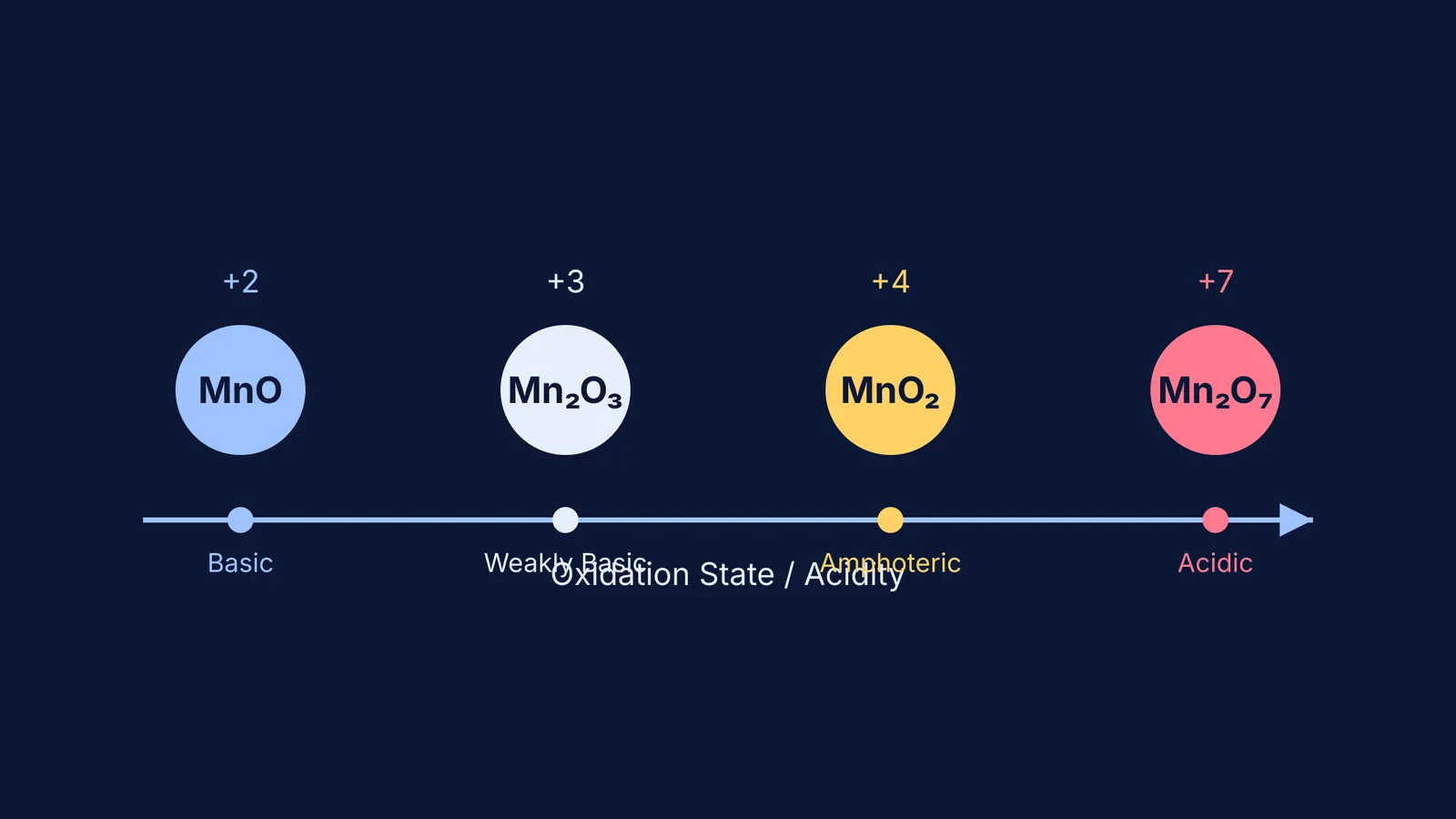
You can observe this progressive pattern across the various oxides of manganese:
MnO (+2) has ionic bonds and is completely basic.
Mn₂O₃ (+3) is weakly basic, showing the first hints of changing character.
MnO₂ (+4) is amphoteric, meaning it sits in the middle and can react with both acids and bases.
Mn₂O₇ (+7) has highly covalent bonds and is strongly acidic.
Do other metals follow the same pattern?
This rule is not unique to manganese; it applies consistently across the d-block elements. Chromium, another important transition metal in the syllabus, shows the exact same transition as its oxidation state rises:
Chromium(II) oxide (CrO), where the metal is in a +2 state, is ionic and basic.
Chromium(III) oxide (Cr₂O₃), in the +3 state, is amphoteric.
Chromium trioxide (CrO₃), where chromium is in the highly charged +6 state, is a powerful Lewis acid and highly covalent (Wikipedia, 2024). It reacts with water to form a highly acidic solution containing chromic acid (H₂CrO₄) and dichromic acid (H₂Cr₂O₇).
This shifting character is a classic, recurring pattern in JEE and NEET inorganic chemistry. If you are struggling to remember the specific properties and exceptions for the d-block elements, the Fermi Concept Library organises every concept in chemistry into a clear map. Instead of asking you to memorise a long list of oxides, Fermi's AI tutor holds a line of reasoning across a study session, working out what you already know about Fajans' rules and teaching you how to apply them to any transition metal you encounter.
For more practical guidance on the chemistry of the d-block, read our guides on why zinc is not a transition element and how to accurately find oxidation numbers from a molecule's structure.


