On this page
If you buy something, fix it and bring it home, the price on the receipt is not what it cost you. That is the whole idea behind overhead expenses, and it is an easy step to miss in Class 8 profit-and-loss questions. Below is one used-scooter problem worked three ways: as a profit, as a loss, and backwards to a target selling price.
What are overhead expenses in cost price?
NCERT's Class 8 Exemplar Problems defines them in one line: "Additional expenses made after buying an article are included in the cost price and are known as overhead expenses" (NCERT Exemplar, Comparing Quantities). The same page gives the formula: cost price = buying price + overhead expenses.
In word problems, overheads usually appear as repairs, transport or cartage, and labour charges. The Exemplar even tests the point as a true-or-false question: "Overhead charges, if any, are sometimes included in the cost price." Its answer: False.
Once you have the full cost price, the rest is the usual formula from profit percentage: cost price versus selling price: profit % = profit ÷ CP × 100, and loss % = loss ÷ CP × 100.
How do you find profit or loss percent with repairs and transport?
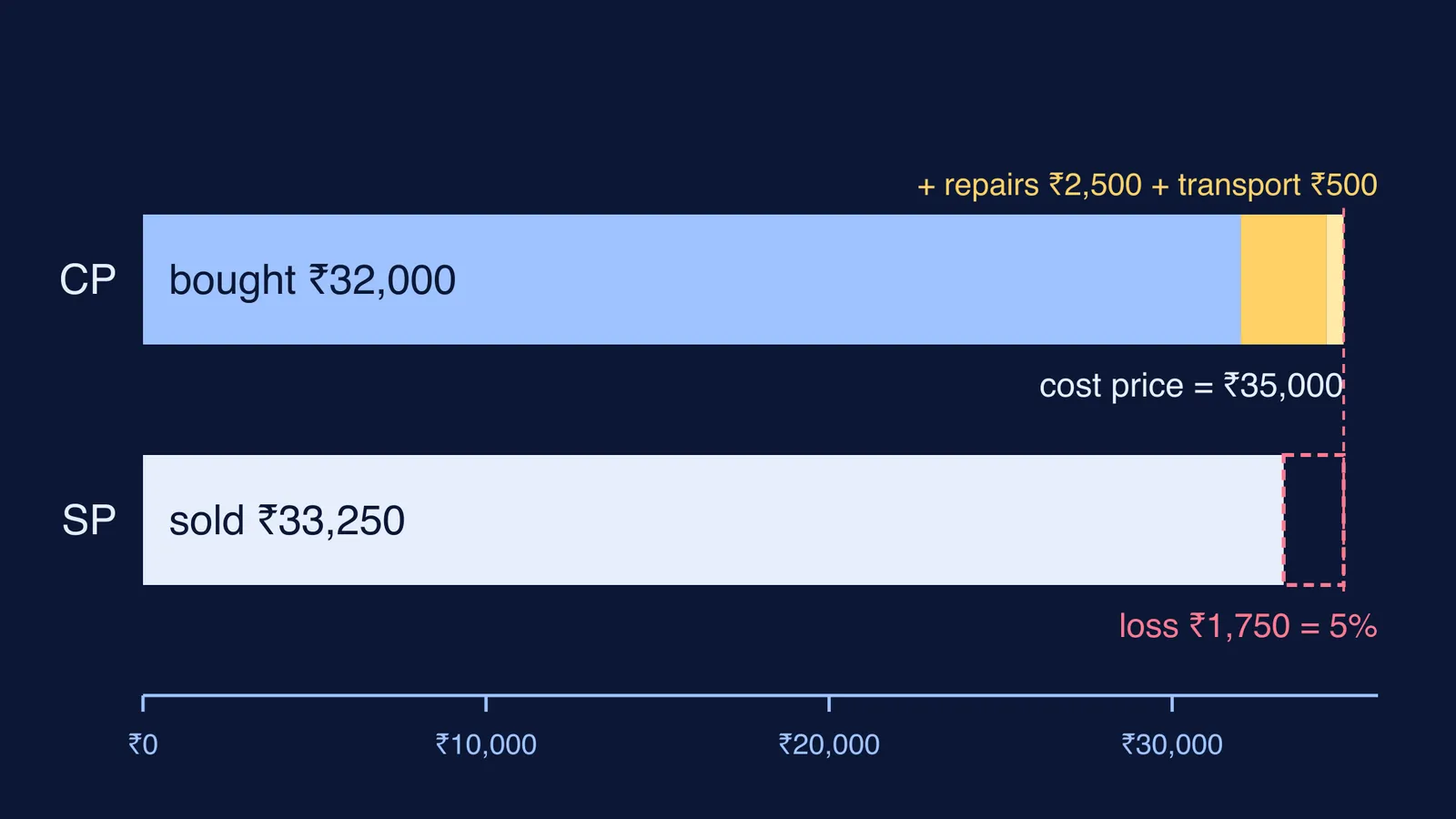
Here is the problem, solved with the NCERT Exemplar formula. Meera buys a used scooter for ₹32,000. She spends ₹2,500 on repairs (new tyres and a service) and ₹500 to have it brought home on a tempo. She later sells it for ₹36,400. Find her profit or loss percent.
List every rupee spent before the sale: ₹32,000 + ₹2,500 + ₹500.
Cost price = ₹35,000.
The selling price of ₹36,400 is more than the cost price, so it is a profit: ₹36,400 − ₹35,000 = ₹1,400.
Profit % = 1,400 ÷ 35,000 × 100 = 4%.
Now change one number. Suppose the market is slow and she sells for ₹33,250 instead.
Cost price is still ₹35,000.
The selling price is less than the cost price, so it is a loss: ₹35,000 − ₹33,250 = ₹1,750.
Loss % = 1,750 ÷ 35,000 × 100 = 5%.
Why does leaving out repairs flip the answer?
The common slip is to compare the selling price with the ₹32,000 on the receipt, ignoring the rule that overheads are part of the cost price. Watch what happens.
At ₹36,400: the profit looks like ₹4,400, and 4,400 ÷ 32,000 × 100 = 13.75%. The true answer is 4%.
At ₹33,250: it looks like a profit of ₹1,250, about 3.9%. The true answer is a 5% loss.
The second case is the dangerous one. The wrong method does not just give a slightly different number; it gets the direction wrong. Meera would think she had made money when she actually lost ₹1,750. It is the same kind of trap as why the same selling price with equal profit and loss is always a loss: the base you divide by decides the answer.
How do you find the selling price for a target profit?
Questions also run the problem backwards, and the same cost price rule applies. Suppose Meera wants a 10% profit on the scooter.
Full cost price = ₹35,000.
10% of ₹35,000 = ₹3,500.
Selling price = ₹35,000 + ₹3,500 = ₹38,500.
If you used ₹32,000 as the base, you would get ₹35,200. That is only ₹200 above what she really spent, a profit of well under 1%. The same base-first habit matters once discounts enter the picture, as in marked price, discount and profit word problems.
What counts as an overhead in a word problem?
Use this checklist, based on the NCERT definition of overhead expenses, as you read the question:
Money spent on the article after buying it and before selling it (repairs, servicing, painting): add it.
Money spent to move it (transport, cartage, delivery): add it.
Money paid to someone to work on it (labour charges): add it.
A number given only as background, such as the price a previous owner paid: do not add it.
One transport bill for several items bought together: add it to the total cost of all the items, then work with that total.
Then write "CP = buying price + overheads" as your first line, every time, so the examiner can see your method even if a later step slips.
If you keep going wrong at the same step, the Fermi Problem Library has worked problems with a step-by-step solver that explains the reasoning rather than printing an answer, so you can see exactly where the base went wrong. To revise percentages from the start, the Fermi Concept Library gives each maths concept its own lesson.
Try one yourself: a cycle bought for ₹2,400, with ₹350 spent on repairs and ₹50 on transport, is sold for ₹3,080. Find the profit or loss percent. (Answer: a 10% profit on a cost price of ₹2,800.)