

On this page
To test whether a square matrix is orthogonal, multiply it by its transpose and see whether you get the identity. Every other property (inverse equals transpose, determinant ±1, rows of length one) follows from that single line.
What is an orthogonal matrix?
Wolfram MathWorld defines an orthogonal matrix as an n×n real matrix A satisfying AAᵀ = I, where Aᵀ is the transpose and I is the identity matrix. The same page notes that such a matrix is always invertible, with A⁻¹ = Aᵀ.
The entry in row i, column j of AAᵀ is the dot product of row i of A with row j of A. So AAᵀ = I says two things at once: every row dotted with itself gives 1, and every row dotted with a different row gives 0. In MathWorld's words, each row has length one and the rows are mutually perpendicular; the columns are too.
What are the properties of an orthogonal matrix?
The Wikipedia article on orthogonal matrices lists the core facts, each a short step from the definition:
AᵀA = AAᵀ = I, so the transpose is the inverse: A⁻¹ = Aᵀ.
The rows form a set of perpendicular unit vectors, and so do the columns.
The determinant of any orthogonal matrix is either +1 or −1.
Multiplying by an orthogonal matrix keeps the length of every vector and the angle between any two vectors unchanged.
The product of two orthogonal matrices is orthogonal: (AB)(AB)ᵀ = ABBᵀAᵀ = AIAᵀ = I.
That last line uses the rule (AB)ᵀ = BᵀAᵀ; if the reversed order feels arbitrary, our explainer on why the order reverses for matrix transposes and inverses walks through it.
The determinant proof is two lines. Take determinants of AAᵀ = I: det(A) × det(Aᵀ) = 1. Since det(Aᵀ) = det(A), you get (det A)² = 1, so det A = ±1, exactly as the Wikipedia article derives it.
The converse is a common trap. A determinant of 1 does not make a matrix orthogonal. The matrix with rows (1, 1) and (0, 1) has determinant 1, but multiplying it by its transpose gives rows (2, 1) and (1, 1), not the identity.
Why is a rotation matrix orthogonal?
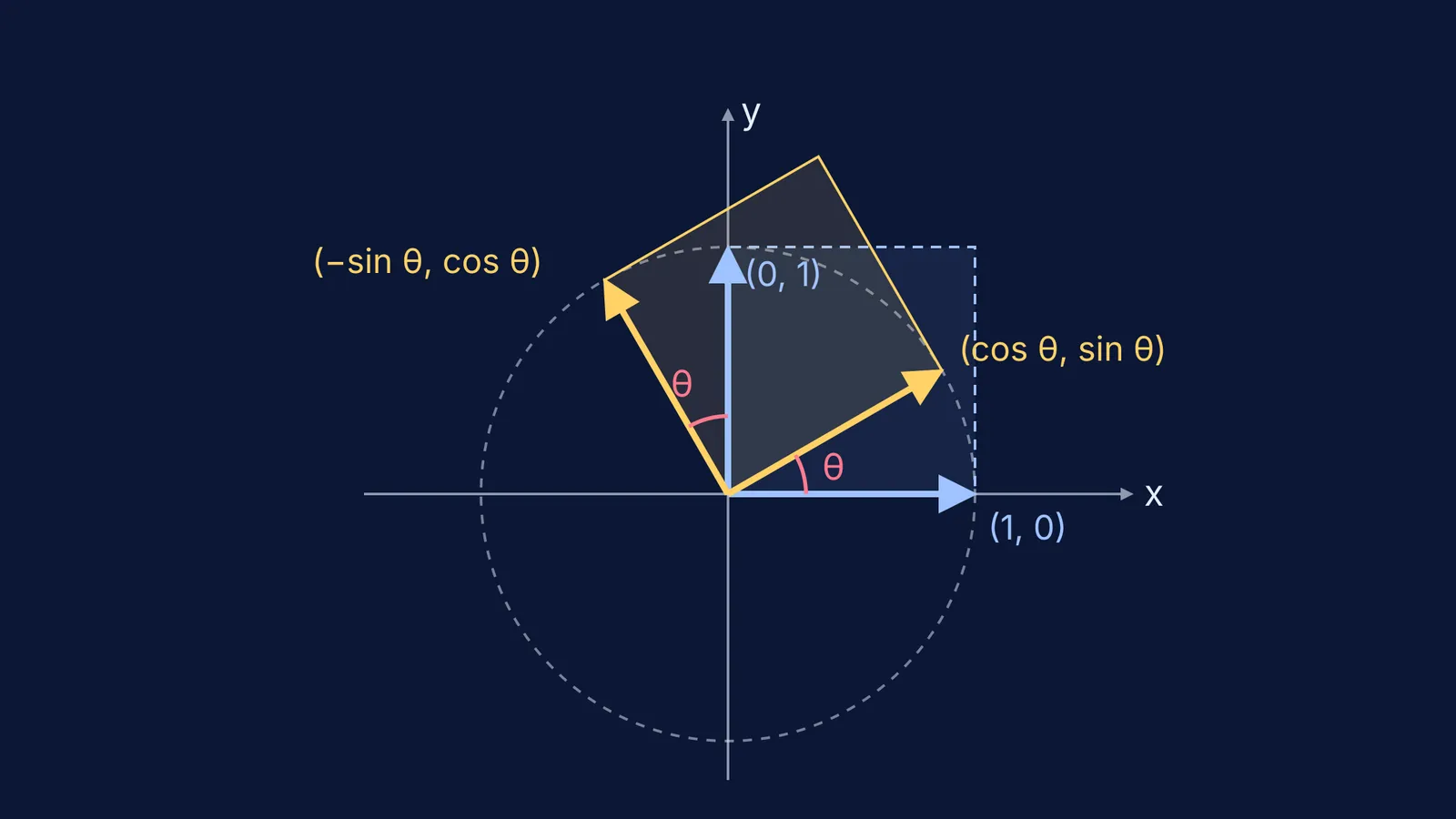
The 2×2 rotation matrix R(θ) has rows (cos θ, −sin θ) and (sin θ, cos θ), and it turns every vector about the origin through angle θ, as the Wikipedia article shows. Check the definition directly:
Row 1 dotted with itself: cos²θ + sin²θ = 1.
Row 2 dotted with itself: sin²θ + cos²θ = 1.
Row 1 dotted with row 2: cos θ sin θ − sin θ cos θ = 0.
Determinant: cos²θ + sin²θ = 1.
So RRᵀ = I for every angle, and det R = +1. MathWorld states that orthogonal matrices with determinant 1 are rotations, called special orthogonal matrices. The reflection form, with rows (cos θ, sin θ) and (sin θ, −cos θ), is also orthogonal but has determinant −1. For more practice with sines and cosines inside determinants, see how to evaluate a determinant with trig entries.
How do you find unknown entries in an orthogonal matrix?
Use the rows as vectors and turn AAᵀ = I into small equations:
Pull out any common factor, such as 1/3, and write each row as a vector.
Set the dot product of the unknown row with each known row equal to 0.
Solve those linear equations for the unknowns.
Check that the unknown row has length 1 after the factor is put back.
If the question asks whether it is a rotation or a reflection, compute the determinant and check its sign.
Worked example. A = (1/3) × the matrix with rows (1, 2, 2), (2, 1, −2) and (a, 2, b). Find a and b if A is orthogonal.
Row 1 · row 3 = 0 gives a + 4 + 2b = 0.
Row 2 · row 3 = 0 gives 2a + 2 − 2b = 0, so a = b − 1.
Substitute: (b − 1) + 4 + 2b = 0, so 3b = −3, giving b = −1 and a = −2.
Length check: row 3 is (−2, 2, −1), and (4 + 4 + 1)/9 = 1. It works.
Determinant: the integer matrix has determinant 27, and dividing each of three rows by 3 divides it by 27, so det A = +1. This A is a rotation in three dimensions.
Most mistakes come from forgetting the 1/3 when checking lengths, or from testing only the determinant. Our post on proving AA′ is always symmetric builds the same row-times-row habit. If you can set up the equations but get stuck solving them, the Fermi Problem Library has worked problems with a step-by-step solver that explains the reasoning rather than printing an answer.
Try one now: show that the matrix with rows (cos θ, sin θ) and (−sin θ, cos θ) is orthogonal, then write its inverse without calculating.


