

On this page
How do you evaluate a 2×2 determinant with sine and cosine?
Every determinant problem with trigonometric entries relies on the same core operation: forming cross-multiplied products and simplifying them with standard identities. For a general 2×2 matrix, the determinant equals the main diagonal product minus the off-diagonal product:
| a b | | c d | = ad − bc
When the entries are trigonometric ratios, the subtraction built into the determinant formula interacts directly with negative signs in trigonometric formulas. Consider the standard rotation array:
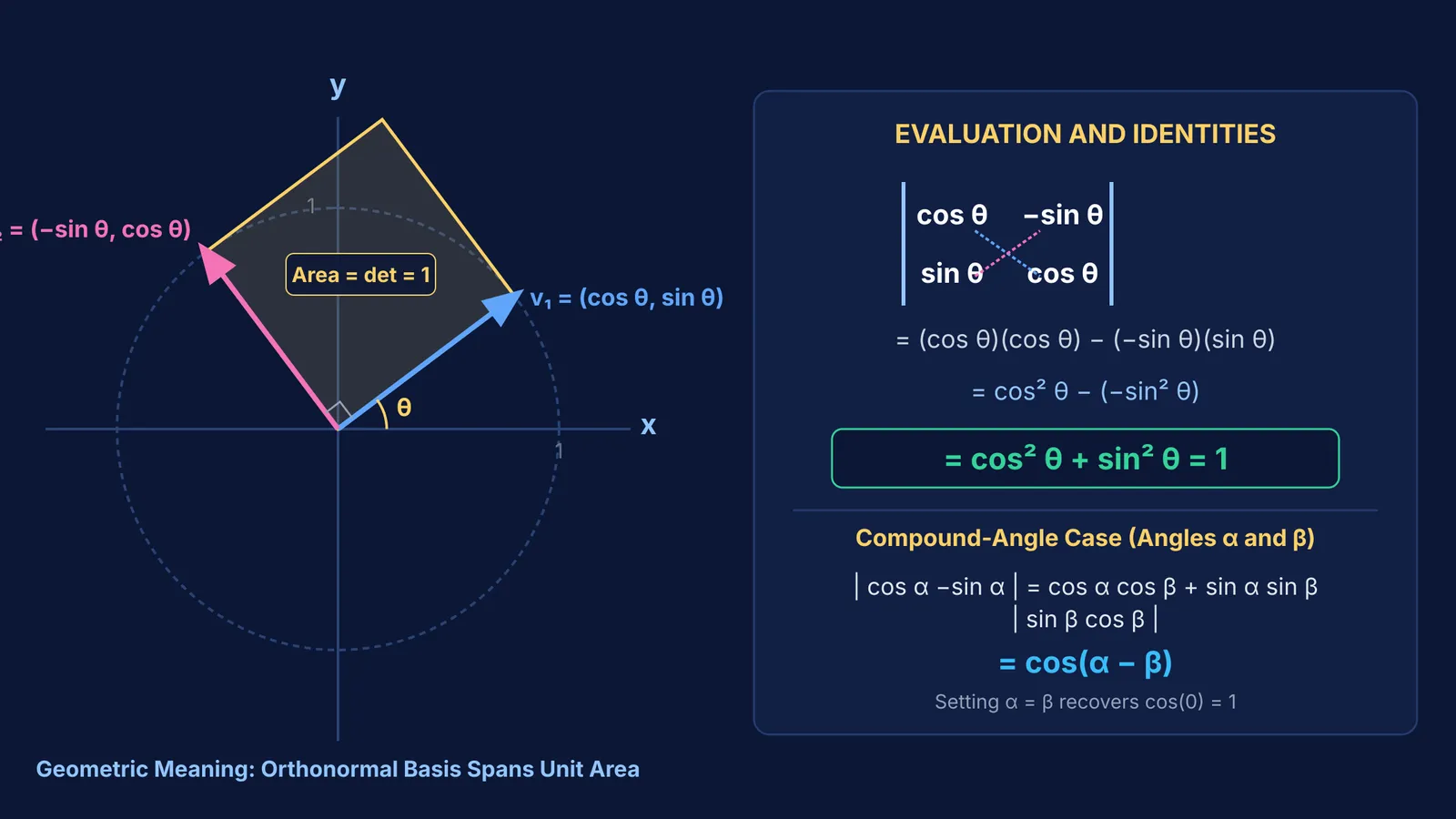
Δ = | cos θ −sin θ | | sin θ cos θ |
Multiplying the primary diagonal gives (cos θ)(cos θ) = cos² θ. Multiplying the secondary diagonal gives (−sin θ)(sin θ) = −sin² θ. Subtracting the second product from the first yields:
Δ = cos² θ − (−sin² θ) = cos² θ + sin² θ = 1
This result equals 1 for every real angle θ. Geometrically, the column vectors (cos θ, sin θ) and (−sin θ, cos θ) are orthogonal unit vectors on the Cartesian plane. The determinant measures the signed area of the unit square they enclose.
When the angles in the rows or columns differ, the expansion produces compound-angle formulas instead of pure constants:
Δ = | cos α −sin α | | sin β cos β |
Expanding across rows yields:
Δ = (cos α)(cos β) − (−sin α)(sin β) = cos α cos β + sin α sin β
Recognising the cosine difference formula condenses the expression into a single term: cos(α − β). If α = β, the difference becomes cos(0) = 1, restoring the Pythagorean identity.
How do compound-angle identities simplify a 3×3 trigonometric determinant?
Higher-order determinants look intimidating because a 3×3 array generates six distinct products across three 2×2 minors. Yet exam questions in CBSE Class 12 and JEE Main are intentionally designed so that cross terms cancel when expanded systematically.
Consider this classic problem from NCERT Class 12 Mathematics: evaluate the determinant and determine whether it depends on θ:
Δ = | x sin θ cos θ | | −sin θ −x 1 | | cos θ 1 x |
Expanding along the first row produces three terms weighted by their respective minors:
Δ = x · | −x 1 | − sin θ · | −sin θ 1 | + cos θ · | −sin θ −x | | 1 x | | cos θ x | | cos θ 1 |
Now evaluate each 2×2 minor separately:
The first minor yields (−x)(x) − (1)(1) = −x² − 1.
The second minor yields (−sin θ)(x) − (1)(cos θ) = −x sin θ − cos θ.
The third minor yields (−sin θ)(1) − (−x)(cos θ) = −sin θ + x cos θ.
Multiplying each minor by its row coefficient produces:
Δ = x(−x² − 1) − sin θ(−x sin θ − cos θ) + cos θ(−sin θ + x cos θ)
Distribute carefully across each group:
Δ = −x³ − x + x sin² θ + sin θ cos θ − sin θ cos θ + x cos² θ
Notice the immediate symmetry: the mixed terms +sin θ cos θ and −sin θ cos θ cancel out completely. Factoring the remaining trigonometric terms gives:
x sin² θ + x cos² θ = x(sin² θ + cos² θ) = x(1) = x
Adding this back to the polynomial component gives Δ = −x³ − x + x = −x³. The variable θ vanishes entirely, proving that the value of the determinant is independent of θ.
Why do students get trapped in trigonometric determinant algebra?
The difficulty in solving these problems rarely comes from forgetting the definition of a determinant. Instead, errors emerge when juggling multiple intermediate algebraic expressions under timed exam pressure.
In his foundational research on cognitive load during problem solving, John Sweller (1988) demonstrated that working memory has severe processing limits when handling unorganised elements. Students who expand every bracket without a clear target schema experience heavy cognitive load, making them prone to simple arithmetic slips. Later research on instructional design by Sweller, van Merriënboer, and Paas (1998) emphasised that coordinating two separate rule sets simultaneously—such as matrix sign conventions and angle identities—creates split-attention and processing bottlenecks.
A systematic review by Hamzah, Maat, and Ikhsan in the *Pegem Journal of Education and Instruction* (2021) confirmed that procedural and algebraic execution errors predominate when students manipulate trigonometric expressions, particularly with sign distribution and bracket placement. When evaluating determinants, distributing a negative sign across a minor that already contains negative trigonometric terms (such as −sin θ) is the single most frequent point of failure.
What step-by-step routine prevents sign errors in trig expansions?
To evaluate trigonometric determinants reliably, follow a fixed four-step routine:
Write out the cofactor signs first: Before expanding, mark the signs (+, −, +) above the chosen row or column to isolate determinant signs from the negative signs attached to trigonometric functions.
Group products in brackets before distributing: Keep expressions like −(sin θ)(−x sin θ − cos θ) inside parentheses so you do not drop double negatives.
Factor common variables before replacing identities: When terms like x sin² θ + x cos² θ appear, factor out x first so the identity sin² θ + cos² θ = 1 is obvious.
Check for compound-angle forms: If an expansion contains sin α cos β ± cos α sin β, collapse it to sin(α ± β) immediately rather than expanding each angle into individual ratios.
Reviewing our guide on matrices and determinants for JEE helps reinforce which row and column operations keep determinants manageable. Combining that with a consistent practice plan for trigonometric identities ensures compound-angle conversions become automatic. For geometric applications where coordinates involve trigonometric parameters, see our article on finding the area of a triangle using determinants.
If you find yourself stuck on multi-step expansions or losing track of algebraic signs, the Fermi Problem Library provides worked problems with a step-by-step solver that explains the reasoning rather than printing an answer. To see how these determinant properties integrate into broader linear algebra and coordinate geometry, the Fermi Concept Library maps every concept in physics, chemistry, biology, mathematics and computing, each with its own lesson and its place in the map.


