

On this page
When you first learn matrix algebra, you might naturally guess that the transpose of a product (AB)′ is simply A′B′. However, matrices do not behave like ordinary numbers. When you transpose or invert a product of matrices, the order flips to become B′A′. This necessary flip is known as the reversal law.
What is the reversal law?
The reversal law tells us how to unpack the transpose or inverse of a product of matrices. It states that while the operation applies to each matrix individually, their order must be strictly reversed.
According to the foundational rules of linear algebra, the transpose of a product is the product of their transposes in reverse order (LibreTexts/02%3A_Matrices/2.01%3A_Matrix_Arithmetic)). This means that (AB)′ = B′A′. The exact same logic applies to matrix inverses: (AB)⁻¹ = B⁻¹A⁻¹. If you try to keep the original order, the dimensions of the matrices will often make multiplication impossible.
If you are studying for exams and get stuck on these properties, the Fermi Concept Library maps out every concept in physics, chemistry, biology, mathematics and computing, each with its own lesson and its place in the map.
Why does the order flip for transposes?
A matrix's dimensions are written as rows × columns. For multiplication to work, the inner dimensions of the two matrices must match. If A is a 2 × 4 matrix and B is a 4 × 3 matrix, you can multiply them because the inner dimensions (4 and 4) are equal. The result, AB, takes the outer dimensions: 2 × 3.
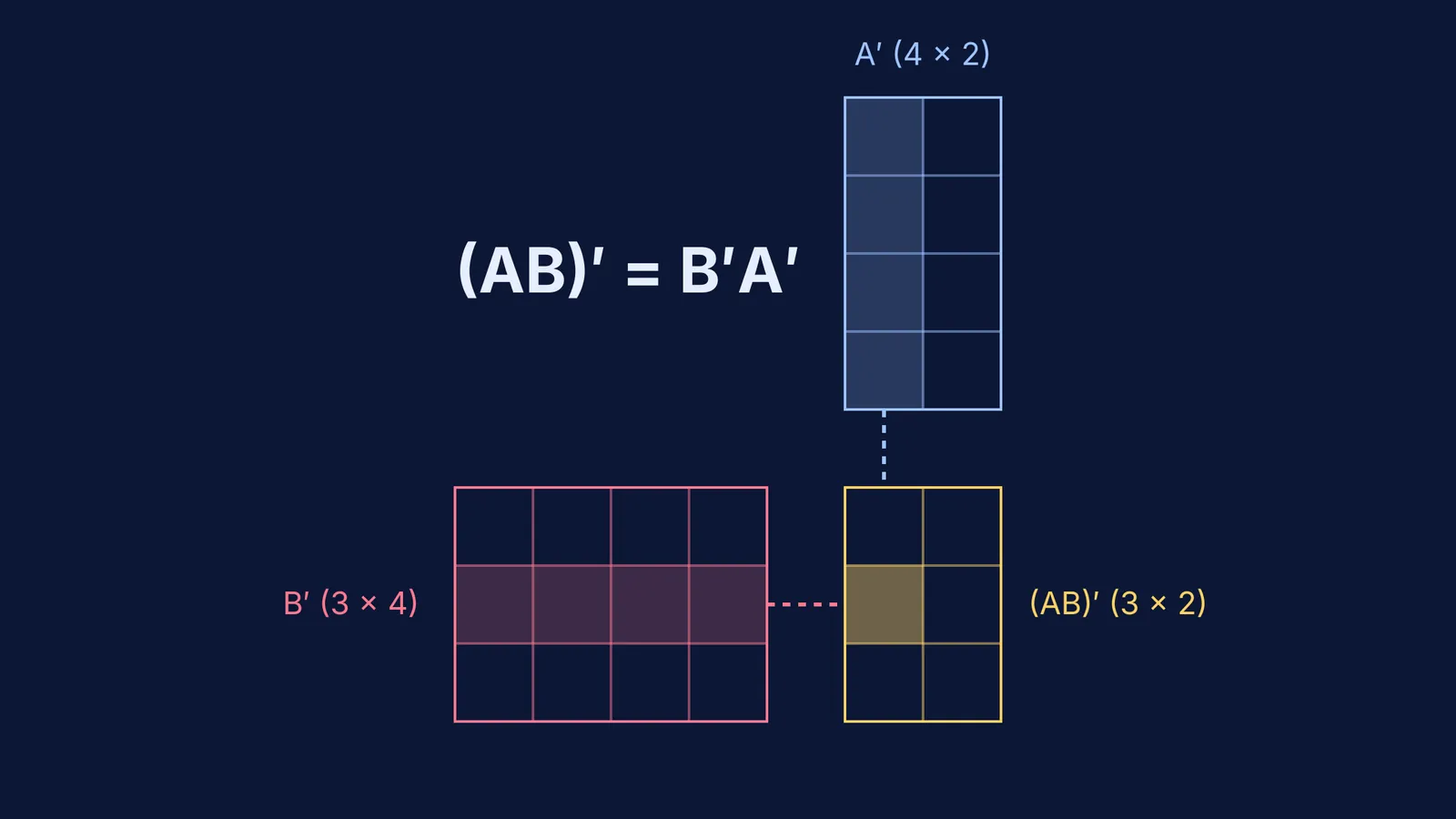
Transposing a matrix swaps its rows and its columns. Therefore, A′ becomes a 4 × 2 matrix, and B′ becomes a 3 × 4 matrix.
If you attempt to multiply A′B′, you are trying to multiply a 4 × 2 matrix by a 3 × 4 matrix. The inner dimensions (2 and 3) do not match, meaning the multiplication is undefined.
To make the inner dimensions match, you must reverse the order. When you multiply B′ (3 × 4) by A′ (4 × 2), the inner 4s match perfectly. The result is a 3 × 2 matrix. This matches the dimension of the transposed product (AB)′ perfectly.
How do you check it with 2×2 matrices?
Let us verify the reversal law with a concrete example using 2×2 matrices.
Suppose we have:
A = [1 2] [3 4]
B = [0 1] [2 3]
First, find the product AB:
AB = [1×0 + 2×2 1×1 + 2×3] [3×0 + 4×2 3×1 + 4×3]
Which simplifies to:
AB = [4 7] [8 15]
Then, transpose this result to find (AB)′:
(AB)′ = [4 8] [7 15]
Now, find the product of the transposes in reverse order, B′A′. First, write down the individual transposes:
A′ = [1 3] [2 4]
B′ = [0 2] [1 3]
Multiply B′A′:
B′A′ = [0×1 + 2×2 0×3 + 2×4] [1×1 + 3×2 1×3 + 3×4]
Which simplifies to:
B′A′ = [4 8] [7 15]
Both paths give the exact same matrix, confirming that (AB)′ = B′A′. If you make a calculation mistake halfway through a long matrix multiplication problem like this, the Fermi Problem Library has worked problems with a step-by-step solver that explains the reasoning rather than printing an answer.
What happens with the three-matrix version?
The reversal law applies consistently no matter how many matrices you multiply together. For a chain of three matrices A, B, and C, the transpose of their product is:
(ABC)′ = C′B′A′
You can prove this for yourself by treating AB as a single matrix and applying the rule twice in succession:
Group the first two matrices: (ABC)′ = ((AB)C)′
Apply the rule to the two parts, (AB) and C: C′(AB)′
Apply the rule again to the inner part (AB)′: C′(B′A′)
Remove the brackets: C′B′A′
This cascading effect works for any number of matrices. The last matrix in the original product will always become the first matrix in the transposed product.
Why does the order flip for inverses?
The reversal law for matrix inverses states that (AB)⁻¹ = B⁻¹A⁻¹. Instead of looking at grid dimensions, it is easier to think about this in terms of undoing a sequence of operations.
Imagine that matrix B represents putting on your socks, and matrix A represents putting on your shoes. The product AB means you put on your socks, and then you put on your shoes.
To completely undo this process (which is what finding an inverse means), you cannot take off your socks first. You must take off your shoes first (A⁻¹), and only then can you take off your socks (B⁻¹).
Mathematically, an inverse must satisfy the condition that multiplying a matrix by its inverse yields the identity matrix I. If we multiply the original product (AB) by the reversed inverses (B⁻¹A⁻¹), we get:
A B B⁻¹ A⁻¹
Because B B⁻¹ forms the identity matrix I, the expression simplifies to A I A⁻¹, which is equivalent to A A⁻¹. This final product equals I, proving that reversing the order successfully undoes the original matrix operations.
If you are dealing with repeated multiplication rather than transposes, read our guide on Finding Aⁿ for a matrix by spotting the pattern. For other algebraic techniques, you might find our walkthrough on solving equations in complex numbers by putting z = x + iy helpful.


