On this page
The WHO and UNICEF oral rehydration salts (ORS) formula dissolves 2.6 g of sodium chloride, 13.5 g of anhydrous glucose, 1.5 g of potassium chloride and 2.9 g of trisodium citrate dihydrate in one litre of water (WHO/UNICEF, Oral rehydration salts: production of the new ORS, 2006). One recipe tests molarity, the van 't Hoff factor and osmolarity together, which makes it a good practice problem. Here is the full working, with WHO's own figures so you can check each step.
What is the molarity of glucose and salt in ORS?
Molarity is moles of solute per litre of solution. So you need one step: moles = mass ÷ molar mass, using the molar masses in Table 2 of the WHO production guide.
Sodium chloride: 2.6 g ÷ 58.44 g/mol = 0.0445 mol, so the solution is 0.0445 M, or 44.5 mmol/L.
Anhydrous glucose: 13.5 g ÷ 180.2 g/mol = 0.0749 mol, so the solution is 0.0749 M, or 74.9 mmol/L.
Both match the mmol/L values WHO lists in the same table. Many textbooks use 180.16 g/mol for glucose; the answer is still 0.0749 M to three significant figures.
The numbers are not random. In the same table, total sodium (from NaCl and citrate together) comes to 74.1 mmol/L, almost exactly the glucose figure. The WHO guide explains that glucose helps the small intestine absorb sodium, and with it water, on a 1:1 molar basis (WHO/UNICEF, 2006). The near-equal sodium and glucose figures fit that ratio.
How do you get osmolarity from molarity?
Osmolarity counts every dissolved particle per litre: for each solute, multiply its molarity by the number of particles it breaks into (the van 't Hoff factor, i), then add the results. Here we use the WHO Table 2 molarities.
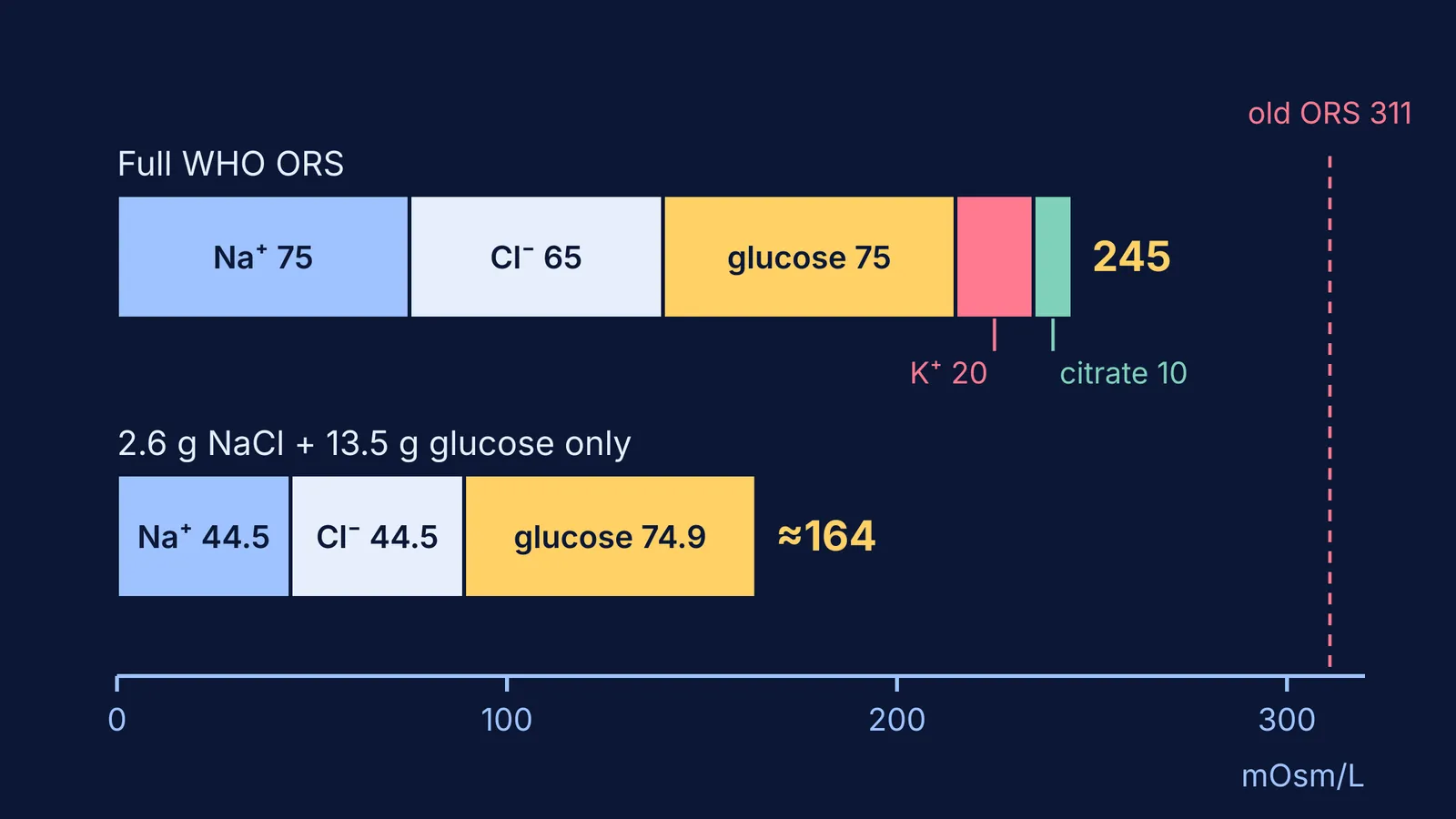
Glucose does not dissociate, so i = 1: 1 × 74.9 = 74.9 mOsm/L.
NaCl splits into Na⁺ and Cl⁻, so i = 2: 2 × 44.5 = 89.0 mOsm/L.
Salt and glucose together: 74.9 + 89.0 = 163.9, about 164 mOsm/L.
So the 2.6 g of salt and 13.5 g of glucose give about two-thirds of the solution's total osmolarity.
If you get the moles right but keep slipping on the particle count, the Fermi Problem Library has worked problems with a step-by-step solver that explains the reasoning rather than printing an answer.
Where does WHO's 245 mOsm/L figure come from?
The other two salts make up the rest. Using the molar masses in WHO's Table 2:
Potassium chloride: 1.5 g ÷ 74.55 g/mol = 20.1 mmol/L. It gives two ions, so it adds 40.2 mOsm/L.
Trisodium citrate dihydrate: 2.9 g ÷ 294.10 g/mol = 9.9 mmol/L. Each unit releases three Na⁺ and one citrate ion, so it adds 29.6 mmol/L of sodium plus 9.9 mmol/L of citrate, about 39.5 mOsm/L.
Total: 163.9 + 40.2 + 39.5 = 243.6 mOsm/L.
WHO's Table 1 rounds each ion first (sodium 75, chloride 65, glucose 75, potassium 20, citrate 10 mmol/L) and adds them to get a total osmolarity of 245 mOsm/L (WHO/UNICEF, 2006). The gap between 243.6 and 245 is rounding, not a mistake.
This 245 figure is the reduced-osmolarity ORS. According to the same WHO guide, the older formula had 90 mEq/L of sodium and a total osmolarity of 311 mOsm/L. Studies of lower-osmolarity solutions were reviewed at a consultative technical meeting in July 2001, and WHO and UNICEF have recommended the new formula since 2003. In children with acute non-cholera diarrhoea given it, the need for unscheduled supplemental intravenous therapy fell by 33% (WHO/UNICEF, 2006). Why a lower concentration helps is the same idea you meet in isotonic, hypotonic and hypertonic solutions and what they do to cells. For the history of salt water against cholera, read about Leonard Rogers and the stronger saline that cut cholera deaths.
Which mistakes cost marks on ORS questions?
Check your working against WHO's figures and this list before answering:
Forgetting i = 2 for NaCl. Molarity is 0.0445 M, but the salt contributes 89 mOsm/L, not 44.5.
Using the wrong glucose. WHO specifies anhydrous glucose. Glucose monohydrate carries a water molecule, so the same mass holds fewer moles.
Dropping the 2H₂O from citrate. The water of crystallisation is part of the 294.10 g/mol. Leave it out and you overcount moles.
Mixing mmol/L and mOsm/L. They are equal only for solutes that do not dissociate, like glucose.
Confusing molarity with molality. Molarity is per litre of solution; molality is per kilogram of solvent. Our guide to converting between molarity, molality and mole fraction walks through the difference.
Try one more yourself: a packet meant for 1 litre is dissolved in only 500 mL. Every concentration doubles, so the full solution comes to about 490 mOsm/L, twice the WHO figure of 245 mOsm/L. That is why the volume of water matters.
If the van 't Hoff factor itself is the shaky part, the Fermi Concept Library gives each concept its own lesson and its place in the map.