On this page
On an optical bench you never read the distance you actually want. The scale runs under the uprights, so it tells you where each upright's index mark is, not where the pin's tip or the lens's optical centre is. Index correction closes that gap, and the NCERT Class 12 physics lab manual, Experiment 10 builds it into the convex lens u-v experiment.
What is index correction in an optical bench experiment?
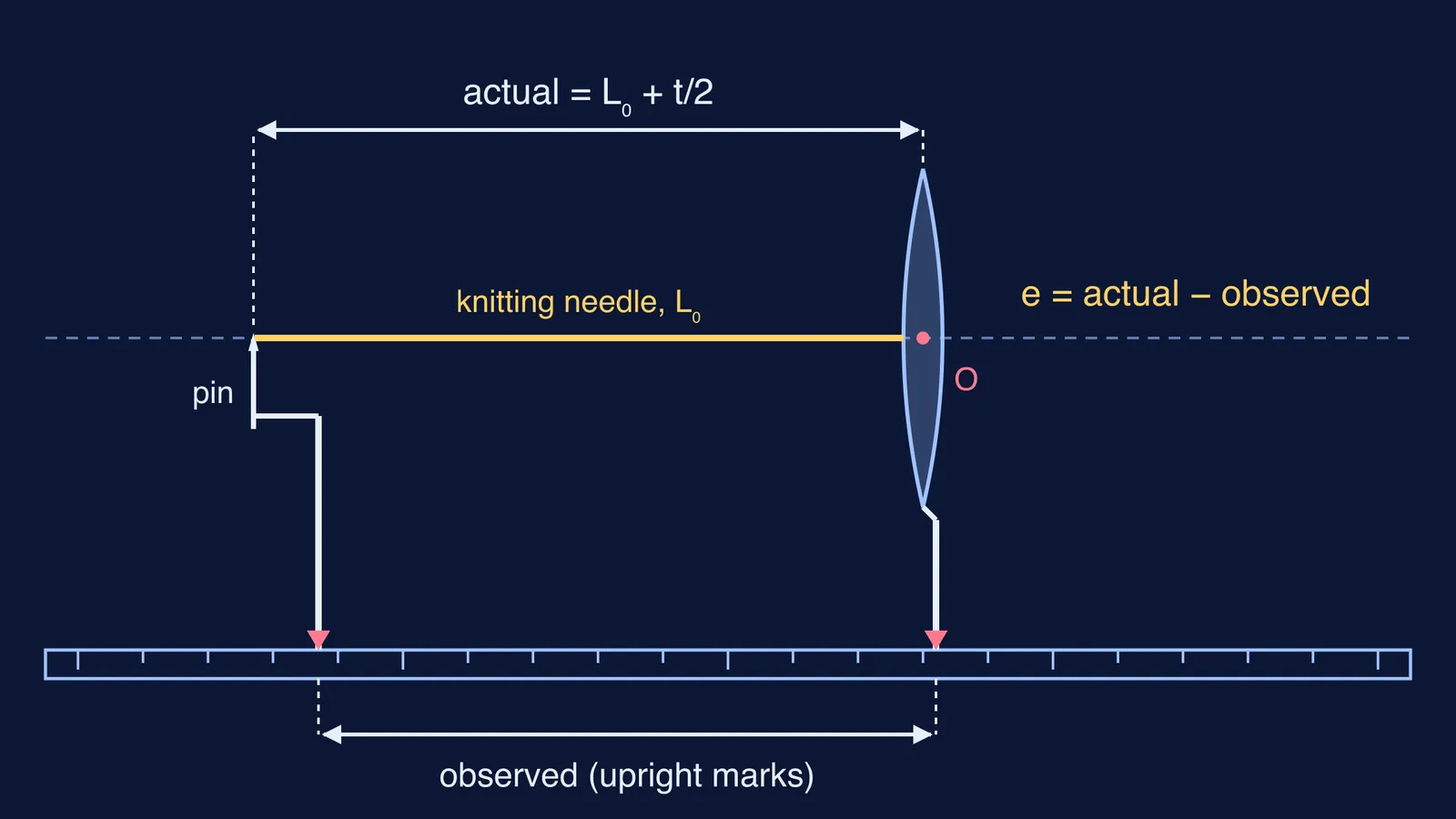
Index correction is the actual distance between a pin's tip and the lens's optical centre minus the distance shown by the uprights on the bench scale (NCERT lab manual, Experiment 10). The manual asks you to find it for both pins: one value for the object pin (e₀) and one for the image pin (eᵢ), since each pin sits in its own upright.
It is a systematic error: it shifts every reading by the same amount in the same direction, so taking more readings will not average it away. Our explainer on random and systematic errors covers the difference.
How do you find index correction with a knitting needle?
NCERT calls the tool an index needle and says a sharp-edged knitting needle would also serve the purpose (NCERT lab manual, Experiment 10). For each pin:
Bring the mounted pin close to the lens.
Hold the knitting needle horizontal, one end touching a curved surface of the lens and the other touching the tip of the pin.
Note the positions of the two uprights on the bench scale. Their difference is the observed length, l′.
Measure the knitting needle with a metre scale. Call it L₀.
Add half the lens thickness t, because the optical centre of an equi-convex lens is at its geometric centre: actual length l = L₀ + t/2.
Index correction e = l − l′. Repeat for the image pin.
How do you apply index correction to u and v?
The manual's observation table sets it out: corrected u = observed u + e₀, and corrected v = observed v + eᵢ (NCERT lab manual, Experiment 10). Work in magnitudes and add each correction with its sign. Here is one reading worked through with illustrative numbers.
Step 1: find the two corrections.
Knitting needle L₀ = 10.0 cm and lens thickness t = 0.6 cm, so the actual length l = 10.0 + 0.3 = 10.3 cm.
Object side: the lens upright reads 50.0 cm and the object pin upright 40.5 cm, so l′ = 9.5 cm and e₀ = 10.3 − 9.5 = +0.8 cm.
Image side: the uprights read 50.0 cm and 60.6 cm, so l′ = 10.6 cm and eᵢ = 10.3 − 10.6 = −0.3 cm.
Step 2: correct one u-v reading.
Uprights: lens 50.0 cm, object pin 22.0 cm, image pin 81.6 cm.
Observed u = 28.0 cm, so corrected u = 28.0 + 0.8 = 28.8 cm.
Observed v = 31.6 cm, so corrected v = 31.6 − 0.3 = 31.3 cm.
With magnitudes, f = uv/(u + v).
Uncorrected: f = (28.0 × 31.6)/59.6 = 14.85 cm.
Corrected: f = (28.8 × 31.3)/60.1 = 15.00 cm.
Notice the signs: the object-side uprights under-read, so e₀ is positive; the image-side uprights over-read, so eᵢ is negative. The sign falls out of l − l′; never force it.
Does a correction under 1 cm really matter?
The NCERT lab manual gives the error in f for this experiment as Δf = f²(Δu/u² + Δv/v²). Here, the correction moved f by 0.15 cm. If your bench reads to 0.1 cm, the formula gives Δf = 225 × (0.1/829.4 + 0.1/979.7), about 0.05 cm. Skipping the correction would have shifted the answer by three times the reading uncertainty, and it would push every reading's f the same way.
One more rule from the manual, and a habit that follows from it:
Put the corrected u and v into the formula for each reading, then take the mean of the values of f. Do not calculate f from the mean u and mean v.
Use the same corrected values on your u-v and 1/u-1/v graphs, because the observed ones carry the same offset.
The full experiment, with graphs, is in our walkthrough of the convex lens u-v method with readings.
What do you say if the examiner asks about it?
A three-line viva answer you can adapt:
The bench scale reads the uprights, not the pin tip or the optical centre, so I measured the gap with a knitting needle.
The actual length is the needle's length plus half the lens thickness, and index correction is actual minus observed.
I added it, with its sign, to every u and v before calculating f.
More practical-exam preparation is in our guide to Class 12 physics practicals and viva. If the sign convention or the uv/(u + v) algebra is where you slip, the Fermi Problem Library has worked problems with a step-by-step solver that explains the reasoning rather than printing an answer.