

On this page
A bottle of oleum marked 109% looks like a misprint, since nothing is more than 100% pure. But the number is not a purity. It tells you how much sulphuric acid the sample becomes once you add water, and from it you can work out exactly how much free SO₃ is inside. Here is how to read the label, and the calculation types that come up in JEE and board exams.
What does 109% oleum mean?
Oleum, or fuming sulphuric acid, is a solution of sulphur trioxide (SO₃) in sulphuric acid. It is made in the contact process, where SO₃ is dissolved in concentrated sulphuric acid. Added straight to water, SO₃ tends to form a fine acid mist that is hard to handle, while it dissolves readily in concentrated sulphuric acid (Wikipedia: Oleum).
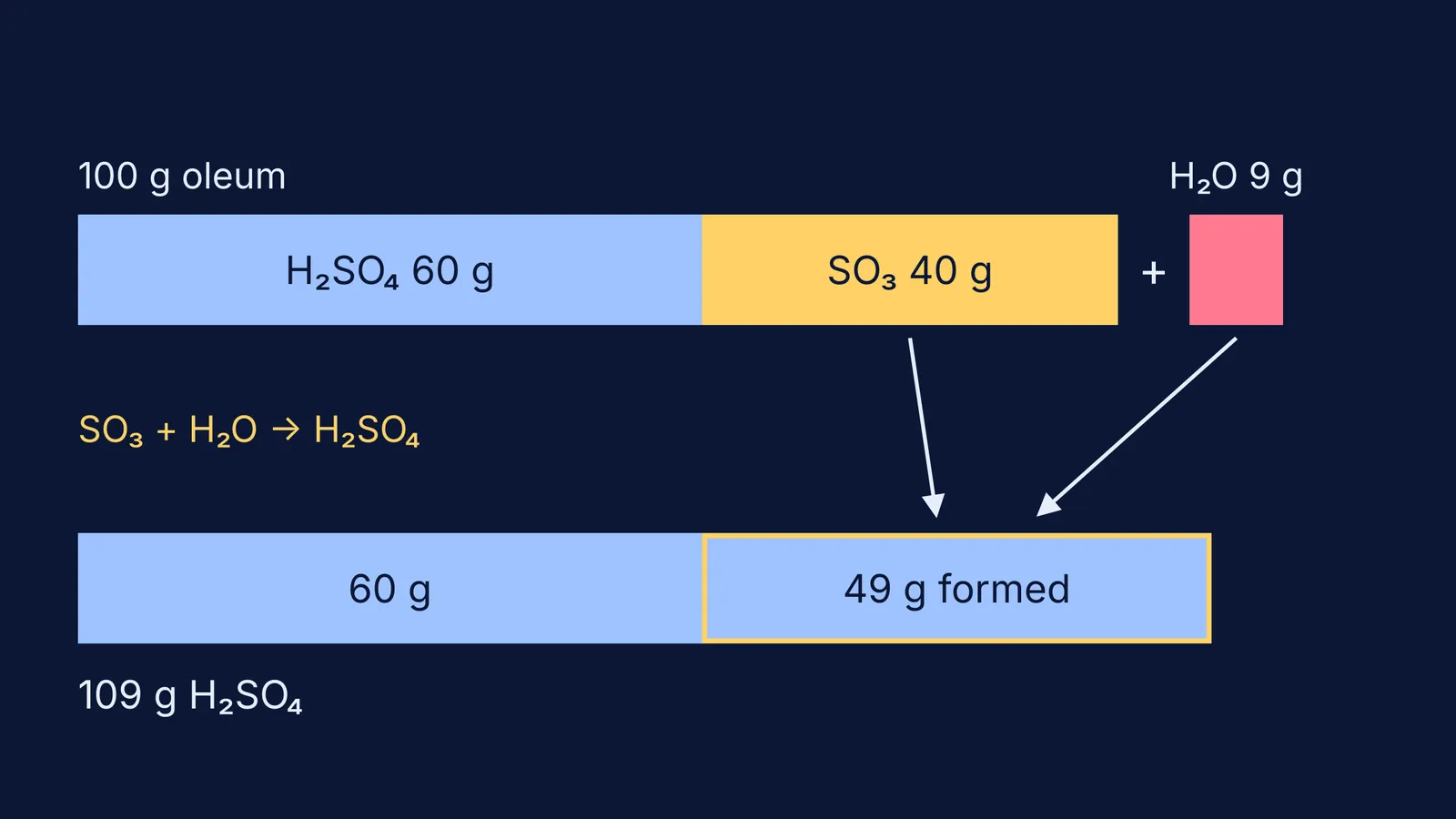
The percentage label of oleum is the mass of pure H₂SO₄ you get when 100 g of the sample is diluted with just enough water (Careers360: Oleum and its % labelling). So 109% oleum means that 100 g of the sample takes up 9 g of water and becomes 109 g of pure H₂SO₄.
The label can go above 100 because the free SO₃ still reacts with water: SO₃ + H₂O → H₂SO₄. The grams above 100 are the water it absorbed.
How do you find the free SO₃ from the label?
You need three molar masses, rounded from PubChem's values: SO₃ = 80 g/mol (PubChem: sulphur trioxide, 80.07), H₂O = 18 g/mol (PubChem: water, 18.015) and H₂SO₄ = 98 g/mol (PubChem: sulphuric acid, 98.08).
Worked example for 109% oleum:
Water absorbed = 109 − 100 = 9 g.
Moles of water = 9 ÷ 18 = 0.5 mol.
One mole of SO₃ takes one mole of water, so free SO₃ = 0.5 × 80 = 40 g.
The rest is acid: 100 − 40 = 60 g of H₂SO₄.
Free SO₃ = 40% by mass.
The same steps give a general rule: free SO₃ % = (80/18) × (label − 100). Going the other way, label = 100 + (18/80) × free SO₃ %, which is the formula Wikipedia gives, with the example that 10% oleum is 102.25% sulphuric acid.
What are the standard oleum calculation types?
Almost every oleum question is one of these six. Each uses the definition from Careers360 and the molar masses above.
Label to free SO₃. 109% oleum: (80/18) × 9 = 40% free SO₃.
Free SO₃ to label. 20% free SO₃: 100 + 0.225 × 20 = 104.5%.
Water for any mass. 25 g of 109% oleum needs 25 × 0.09 = 2.25 g of water and gives 27.25 g of H₂SO₄.
Dilute, then titrate. 1.00 g of 109% oleum made up to 100 mL holds 1.09 g of H₂SO₄, or 1.09 ÷ 98 = 0.0111 mol, so the solution is 0.111 M. Each H₂SO₄ needs two NaOH, so it takes 0.0222 mol, or 22.2 mL of 1 M NaOH.
The upper limit. Pure SO₃ is the extreme case: 100 g is 1.25 mol, which gives 1.25 × 98 = 122.5 g of acid. Every oleum label lies between 100% and 122.5%.
Too much water. 100 g of 109% oleum plus 20 g of water gives 109 g of acid in 120 g of solution, which is 90.8% H₂SO₄ by mass.
Type 4 is the easiest to get wrong. In a titration you never need the free SO₃: the label already gives the total acid after dilution. Counting sulphur atoms gives the same answer, the idea behind the principle of atom conservation. If a question adds impurities, the logic matches percentage purity problems in stoichiometry.
How can you check your oleum answer in the exam?
Run this quick checklist before you move on:
Free SO₃ is between 0% and 100%, and the label is between 100% and 122.5%.
Free SO₃ plus the original H₂SO₄ adds up to exactly 100 g.
Free SO₃ % is about 4.44 times the excess over 100 (80 ÷ 18, the inverse of the factor in Wikipedia's conversion formula). If yours equals the excess, you fell into the 104% trap.
For titrations, you used the label mass (1.09 g of acid per gram of 109% oleum), not 1 g.
If you keep landing on the wrong number, a step was usually skipped. The Fermi Problem Library has worked problems with a step-by-step solver that explains the reasoning rather than printing an answer, so you can see which step went wrong. If the mole concept itself feels shaky, the Fermi Concept Library has its own lesson for each concept in chemistry.
For the chemistry behind the bottle, read how concentrated sulphuric acid acts as a dehydrating and oxidising agent. Then try type 4 again with 104.5% oleum and check that you get 21.3 mL.


