

On this page
Concentrated sulphuric acid (H₂SO₄) is a versatile chemical reagent known for two defining properties. It is a powerful dehydrating agent that removes the elements of water from other compounds, and, when hot, it is a strong oxidising agent that provides nascent oxygen to oxidise metals and non-metals according to standard chemical properties.
If you are preparing for exams, these two properties explain many of the classic reactions of p-block elements and organic chemistry.
Why is it a good dehydrating agent?
Concentrated sulphuric acid has a very strong affinity for water. When you mix it with water, the hydration process is highly exothermic, which is why you must always add the acid to water slowly while stirring, and never the other way around. This affinity is so strong that it can remove chemically bound water—hydrogen and oxygen atoms in a 2:1 ratio—from various molecules.
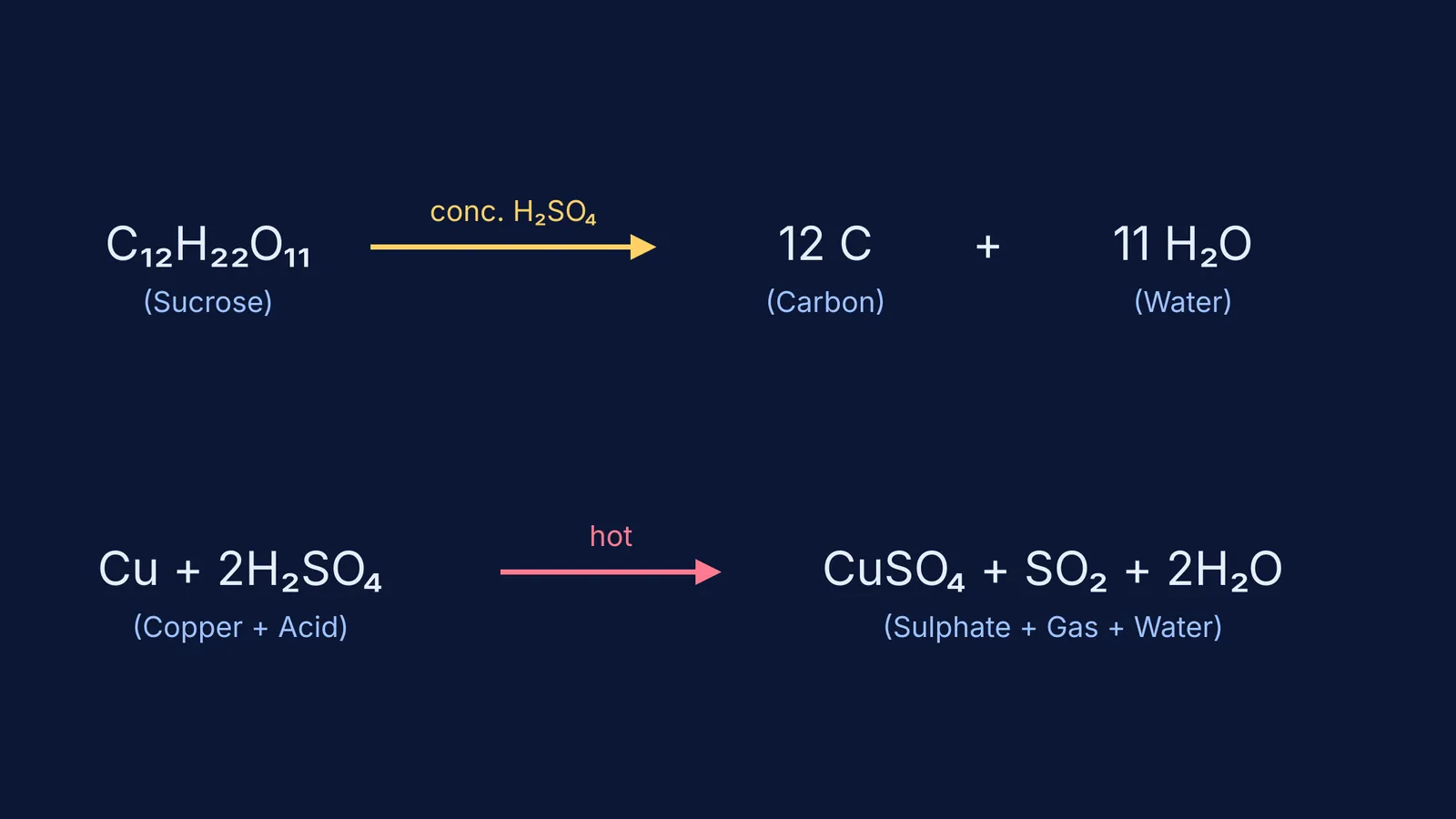
The most famous example is the charring of carbohydrates. When concentrated sulphuric acid is poured onto cane sugar (sucrose) in a beaker, it quickly strips away the water molecules. This leaves behind a growing, black, porous column of carbon, often called a carbon snake or sugar charcoal, while releasing large amounts of steam and heat. C₁₂H₂₂O₁₁ → 12C + 11H₂O
This same dehydrating power is widely used in organic chemistry preparations. For example, it is used to remove water from formic acid (HCOOH) to produce pure carbon monoxide (CO) gas. HCOOH → CO + H₂O
When acting on oxalic acid (H₂C₂O₄), concentrated sulphuric acid removes water to yield a mixture of carbon monoxide and carbon dioxide. H₂C₂O₄ → CO + CO₂ + H₂O
Another common use is the dehydration of alcohols to form alkenes. When ethanol is strongly heated with concentrated sulphuric acid, it undergoes dehydration to produce ethene gas and water. C₂H₅OH → C₂H₄ + H₂O
When does it act as a drying agent?
Concentrated sulphuric acid is not only a dehydrating agent but also an excellent drying agent (or desiccant). Because it readily absorbs water vapour, it is frequently used in the laboratory to dry gases.
For instance, gases like chlorine, sulphur dioxide, and hydrogen chloride are passed through concentrated sulphuric acid to remove any traces of moisture. However, it cannot be used to dry alkaline gases like ammonia. Because ammonia is basic, it reacts vigorously with the acid to form ammonium sulphate. 2NH₃ + H₂SO₄ → (NH₄)₂SO₄
Similarly, it is not suitable for drying hydrogen sulphide gas. Because hydrogen sulphide is a reducing agent, it would be oxidised by the acid to yield solid sulphur, sulphur dioxide, and water.
How does it act as an oxidising agent?
In its hot, concentrated form, sulphuric acid acts as a moderately strong oxidising agent. This is because it decomposes thermally to yield sulphur dioxide, water, and nascent oxygen. H₂SO₄ → H₂O + SO₂ + [O]
This nascent oxygen is responsible for its ability to oxidise both metals and non-metals, with the acid itself being reduced to sulphur dioxide gas (SO₂).
Action on non-metals
Concentrated sulphuric acid oxidises carbon to carbon dioxide. C + 2H₂SO₄ → CO₂ + 2SO₂ + 2H₂O
Similarly, it oxidises sulphur to sulphur dioxide. In this reaction, both the non-metal and the acid end up as SO₂. S + 2H₂SO₄ → 3SO₂ + 2H₂O
Action on metals
It also reacts with metals like copper, which sits below hydrogen in the reactivity series and does not displace hydrogen gas from dilute acids. Hot, concentrated sulphuric acid oxidises the copper to copper(II) sulphate, producing sulphur dioxide and water. Cu + 2H₂SO₄ → CuSO₄ + SO₂ + 2H₂O
A checklist for writing these equations
When you are asked to write a reaction for hot concentrated sulphuric acid in an exam, check these three things:
Did you write SO₂ and H₂O on the product side? The acid almost always reduces to SO₂.
For non-metals, did you oxidise them to their highest common oxide, such as CO₂ for carbon?
Are the atoms balanced? Remember that each H₂SO₄ molecule provides nascent oxygen for the oxidation step.
These reactions are a staple in the Fermi Concept Library, where every concept has its own lesson and its place in the map. If you are stuck on redox balancing, the Fermi Problem Library has worked problems with a step-by-step solver that explains the reasoning rather than printing an answer. You can also explore how Oxidation number from structure helps predict the products of such redox reactions, or review the industrial preparation of the acid in the Contact process for sulphuric acid.


